
Translated material
Maxim Russo: Two books
Maxim Russo 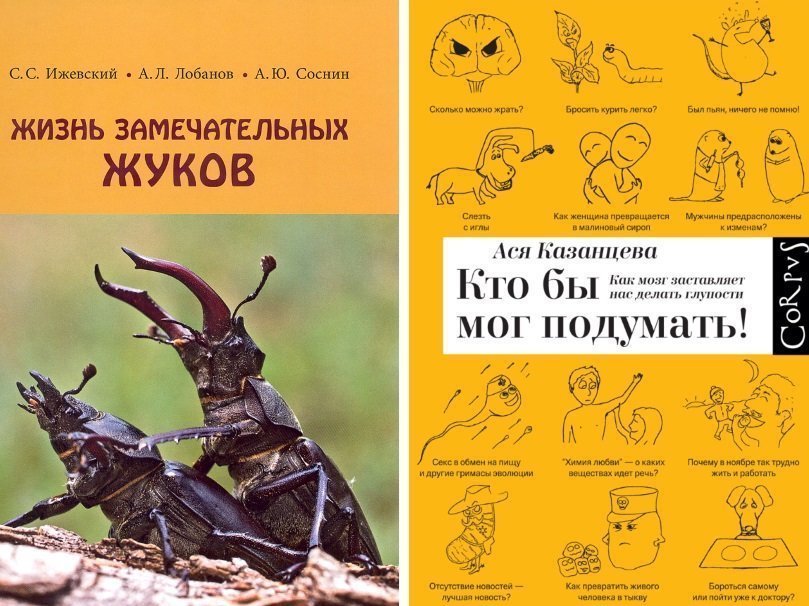
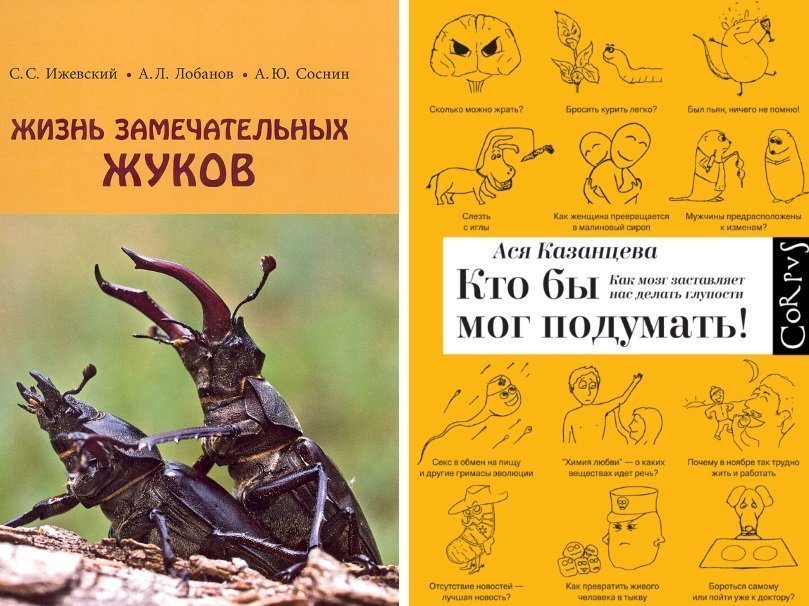
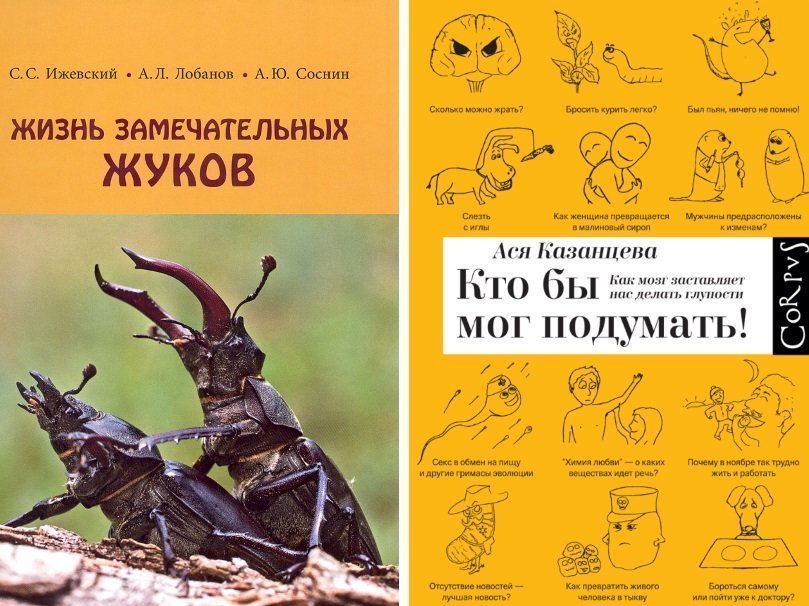
On October 30, in the framework of the Public Lectures of Polit.ru ", the authors of two popular science books, which became finalists of the 2014 Award, took place in the Turgenev library. The book “Life of wonderful Zhukov” was presented by one of its authors - Doctor of Biological Sciences Sergey Izhevsky, and the scientific journalist and deputy chief editor of the journal “Health” Asya Kazantseva told about her book “Who would have thought! How the brain makes us do nonsense. ”
Recall that earlier in the project “Public Lectures“ Polit.ru ”” were held meetings with two more authors of books that became the finalists of the Enlightener Prize. In the summer, a lecture was held by the physicist of Boris Stern, the author of the book “Breakthrough beyond the world”, and most recently Olga Weinstein, who wrote the book “Dandy: Fashion, Literature, Life”.
“The life of wonderful beetles” is the result of the work of three authors. Sergey Izhevsky, professor of the Department of Ecology and Forest Protection of Moscow State University of Forest, for a long time worked on the All-Russian Research Institute of Plant Quarantine. To ensure the protection of forests from insects, he studied a lot of the biology of the development of various types, the physiology of their nutrition, environmental relations, including their natural enemies. Dangerous invasion species were a special object of his research. Andrei Lobanov, a leading researcher at the Zoological Institute of the Russian Academy of Sciences in St. Petersburg, is known not only as the author of scientific research on beetles (the subject of his special interest is the family of barbeling), but also as the creator of the Zhuki (Coleoptera) site and the cruciferous resources in Runet. The third author is Alexander Sosnin, in the main specialty, a cardiologist, lives in Yaroslavl. For many years, he has been engaged in macro photographs of insects, in particular the preparation of the photo collection of beetles of central Russia. He owns many pictures that illustrated the book.
The publication of this book was not easy. Already ready to release the book, the publishing house at some point reported that it could not do this. As a result, the "life of wonderful beetles" was published at the expense of the authors, and the troubles of its distribution also fell on their shoulders. In this regard, the funds that publishes publishers of the book book to promote the book will be completely unnecessary for the “life of wonderful beetles” and will help to convey it to more readers.
The book "Life of wonderful beetles" continues the glorious tradition of popular entomological literature, which was still begun by the Fabr, and in our country, for example, the remarkable books of Nikolai Pudvilshchikov . A wonderful literary language is not inferior to the best examples of this genre.
At the beginning of the book, authors introduce readers to general information about beetles. They tell how the beetles are arranged, how they eat, move, breed, take care of the offspring, who are enemies of beetles and how beetles are protected from these enemies. The main part of the books is the actual description of the wonderful beetles. It represented beetles large, like a heck-Herkules, and small, like flour Khrushchak; Predators like beetles and vegetarians, like a apple -henchy, familiar to people for centuries, like a seven -point ladybug, and those that have become famous only in recent years, as an alternate emerald narrow -colored gold. You could read about the “exploits” of the last species listed in the special material , prepared in a lot with the help of the book “Life of wonderful beetles”.
The bugs described in the book are grouped by families, and for each of the 28 families presented, the authors describe the general characterization of the family, and then move on to the details of the biography of its wonderful representatives. Both the main characters of the book and their relatives, who did not receive personal essays, are richly represented in photo illustrations, of which the book is more than six hundred.
The advantage of the book about beetles is that it not only repeats the bright and entertaining, but already becoming a classic of popular literature, but also adds to them a new, no less interesting information from little -known sources, fresh studies and from the personal experience of the authors. The reader learns that the original homeland of the Colorado beetle, not at all the state of Colorado, but a completely different state, not even the USA, but Mexico (which one - you can find out from the book!). If you continue the conversation about the Colorado beetle, then the studies of its life cycle are also interesting, which showed that it is characterized not only by standard winter sleep, but also by five other forms of peace, including many years of likazua, when the beetles burrow into the ground and fall into a daze for several years. This explains their unexpected appearance in those places where the gardeners for three years have not seen and sighed with relief.
If that the burr beetle burns the corpses of small forest animals to lay their eggs there and provide the power of larvae in many books, then there are amazing details in the “life of wonderful beetles”. For example, that only the male beetle can find a dead body, and it already gives a special smell signal for the female (the female does not feel the cadaverous smell). That the beetles not only bury the body, but also build a brood chamber underground, cut their hair with their jaws in areas where the most massive muscles are located, prepare “meat lumps” to feed the larvae and female. That beetles stop the process of decay using bactericidal saliva. That the male leaves the masonry, and the female remains with the eggs, turning them over to prevent mold, and when the larvae hatch, at first feeds them, burping food. Only after the first molting of larvae, when they can eat on their own, the parental worries of the female burial beetle end.
Also, from the book, the reader can find out what kind of beetle Russian peasants went into the field with a flag, what this flag was and what the “gutting -carte cart” needed. The authors describe a lot of dramatic stories of intrusive species to new habitats and subsequent attempts to curb the unbridledly multiplying guest. At the end of the book, the diverse relationships of beetles and humans are described. For lovers of macro photography, a special section is intended in which Alexander Sosnin gives tips on choosing a camera, a mode of shooting and the disconnection of beetles.
The author of the book "Who would have thought!" Asya Kazantseva decided that it was more interesting to talk about something more new, so she devoted her performance to the relationship between the human body and bacteria living in it. Recall that in each of us lives up to quadrillion (1015) bacteria, this is more than the number of our own cells. And the total weight of these bacteria reaches one and a half kilograms. And these bacteria have a much more influence on our lives than before. We have repeatedly wrote about the studies of bacteria that live in the human digestive system and about the recently emerging method of therapy - fecal transplantation (Fecal Microbiota Transplantation, FMT) which consists in transplanting intestinal bacteria of a healthy person to the patient. Asya Kazantseva also spoke about the studies of bacteria living, for example, on the surface of the skin. As it turned out, in people suffering from atopic dermatitis, the species variety of skin bacteria is lower, while on the affected areas of the skin more than 60% of bacteria are staphylococci. When the species composition of bacteria expands, the symptoms of the disease become less pronounced. Now studies in this area are conducting several large cosmetic companies at once.
But it would be unfair not to tell about the book of A. Kazantseva. The book “Who would have thought! How the brain makes us do nonsense ”is devoted to the influence of biological mechanisms, especially the endocrine system, on human behavior. The mechanisms of this influence have long been formed during evolution, but now they work safely, making us happy or unhappy, irritable or calm.
The book has three main sections. The first is devoted to the biological foundations of bad habits. At the same time, it is not only about smoking and drinking alcohol and drugs (although, of course, more on this), but there is also a lot of habit, which so often leads to the appearance of excess weight. The system of positive reinforcement of the process of mining and eating food arose in animals in distant antiquity. The “remuneration system” existing in the brain gives a person a feeling of pleasure in the process of food. Studies on a tomograph show that the activity of the corresponding zones of the brain manifests itself even when a person only considers the pictures depicting food. Moreover, the well -fed participants in the experiment enjoyed the sight of pictures of vegetables, but the hungry - when they showed pizza or hamburger. The feeling of satiety in the body, as studies show, is provided to a greater extent not nervous, but hormonal signals that spread much slower. This is explained that we feel saturation with some delay (that is, when we have already begun to overeat).
The devices with which the body stimulates the extraction of food was very useful for survival, but a person living in the world of easily accessible food began to lead to abuse of food and obesity.
To keep this process under control, it is necessary to take into account the nature of our desire for sausage. For example, one of the substances responsible for the feeling of satiety is the peptide yy produced by the intestinal cells. In the experiment, he was introduced to volunteers, and they began to eat less. The history of the Indian people of Pima is entertaining and sad, among the representatives of which two mutations are common, which violate the normal synthesis of Peptide YY. These people constantly experience hunger, overeat, and their body mass index can exceed 45 (with a norm up to 25), which entails a variety of health problems.
The biological explanation also received why people who throw smoking have an exacerbation of desire to eat. Smoking increases the level of adrenaline and cortisol, and this causes a small rise in the concentration of glucose in the blood, which dulls a feeling of hunger. Therefore, people who have abandoned smoking want to eat more.
Among the latest works mentioned in the first section of the book, there is a Nicotine-Qune vaccine, directed in Switzerland, directed against smoking. It provides the body with antibodies that connect nicotine and prevent it from entering the brain. As a result, a person ceases to feel pleasant consequences of a smoked cigarette. During the first clinical test of this vaccine, 47 % of participants refrained from smoking within two months.
The second section of the book is dedicated to biochemical and nervous processes that accompany attraction, affection, love and sex. The third section talks about the causes of depression, including seasonal and methods of counteracting it. The content of the book is understandable for the reader-specialist, whose knowledge in the field of biology does not go beyond the school curriculum. If the reader has forgotten something or wants to clarify his knowledge, he will help him a “short course” located at the end of the book.
The finalists of the Enlightener Prize of this year were different publications, both on topics and by the author’s approach. Most books, as in previous years, are written by specialists in their field. The book "Who would have thought!" It is an infrequent exception, its author is a scientific journalist who conscientiously studied research and presented them in a popular form. “The life of wonderful beetles” and “who would have thought” are intended for any reader who is interested in their content, while Boris Stern’s book “Breakthrough beyond the End of the World” will require readers a few deeper knowledge of physics. A special case is the book of Olga Weinstein, which is the degree of scientific novelty and the apparatus of the publication by the author’s scientific monograph on the historical and cultural phenomenon of dendism, but thanks to the style of presentation, it also acts as a popular science book, interesting to a simple reader.
Jury members have something to choose from. We will consider our task to be fulfilled if our story is convinced of those who are interested in the biochemistry of behavior and the relationship of the brain with the endocrine system, that they learn a lot of entertaining from the book “Who could have thought!”, And those who are attracted to the world of insects, that they simply need to read the “life of wonderful beetles”.
See also: about beetles and bacteria Natalia Demina Enlightenment Enlightenment Prize "Educator" announced a long list of books in 2014. The start of the Enlightener Prize "Enlightener" of 2014 New Tatyana Pigarev Spain from and before, Sergey Sergeyev Russian autocracy. Power and its borders: 1462–1917.Katerina Mikhaleva-Eger 350 years of modern fashion Leonid is sensitive to Katya Kolpinets Formula Grez Sergey Padnovable Bastards of the Eastern Front David Chinese, Tom Chinese is lying. As not to give statistics to deceive himself, Pol Steinhardt, the impossibility of the second kind of Stephen Hoffman five forces, changing all Walter Aisekson hacking the code Rustam Alexander closed. The life of homosexuals in the USSR 3D karcasses for restoration of bone tissue platinum sandwich for spintronics