
Translated material
The effect of the rebelder
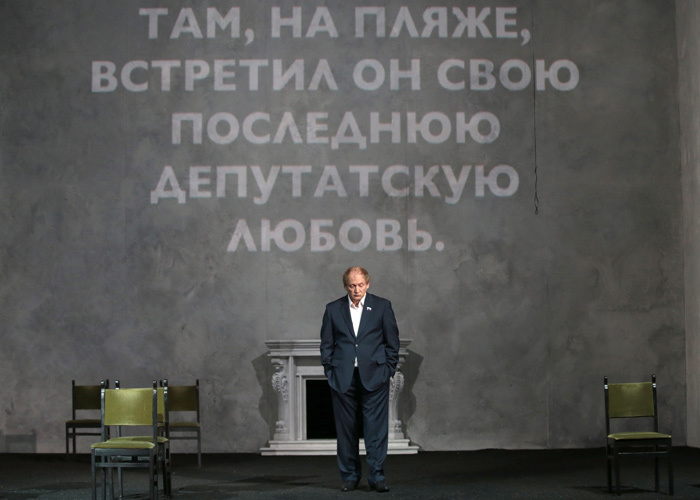
The new performance of Konstantin Bogomolov, released last weekend in the metropolitan “Lenkome”, managed to blow up the theater community and become the most discussed premiere of this season in a matter of days. Colta.ru represents the attention of the readers of two projections of the “prince” - Alena Solntseva and Andrei Pronin .
I have continuous questions to the performance of Bogomolov, there are almost no answers. Well, unless there are no questions to the name: “prince” is not an “idiot”, definitely.
Question one. Who is the hero of the performance?
Prince of Tmyshkin, who was played by the director himself, Konstantin Bogomolov (or, better to say, did not play, but presented it), with ironic detachment - not a blessed beggar in spirit, then traverse evil with a reducing suffix. However, Ymmyshkin can be interpreted as you like, the performance allows. A smart, educated person is able to wind up kilometers of meanings. At the beginning of the performance, in the first two scenes (a conversation with Ferdyshchenko and a meeting with General Epanchin), the artist Bogomolov is very charming, his hero, Prince Lev Myshkin, who came from Switzerland, is naive and smart, calm and open. But the titer reports: "Prince Tymishkin came from Transylvania." "And what?"
And you do not believe the texts, they lie. Everyone is lying. Prince Myshkin will eventually turn out to be Prince Stavrogin, because here, in a certain unknown place where Myshkin-Tyshkin came from the beautiful far from the beautiful, a person inevitably fragments, smaller, turns into a demon, a demon, a small demon ... There are many quotes from Dostoevsky, but there is no important source-about self-presentation of the local social essence. "Bobok" is called.
The second question. What is the text?
Everything that is pronounced from the stage has a source. A person sitting in the hall may not know who wrote this or that excerpt, but he was informed in the poster that he was watching “Experience of reading the novel by Dostoevsky“ Idiot ”.” There are no other explanations - not the list of authors whose works uses the mantis, and the works themselves (Thomas Mann, Nabokov, quotes from the “demons”, from the “Karamazovs”), or the names of episodes. And if the viewer himself is not an idiot (in a clinical sense), then he will assume that the texts that actors pronounce are related to the novel. In fact, they are related to the topic that the director Bogomolov read from the novel. About the topic - then, and about erudition - now. I don’t know how you, but I painfully treat my own ignorance. I remember about Ilyushechka Snegirev from the Karamazovs, so I easily recognized this passage in the story about the boy Ganya. But I remember Thomas Mann, so I did not recognize a quote from the Magic Mountain (and, they say, it is there), and the plot based on “death in Venice” was completely marked with the name of Visconti.
I am interested in something else: how much is this rebus, which is the author of the play, in principle, is important? Do I need to suffer at all, remember and reproach yourself for non -education? It may be more correct to assume that the texts of Bogomolov, improving on topics raised by the classic, are reported from the stage?
The third question. What is the performance about?
In principle, you can not answer it. Because the modern theater is against the clearly formulated meaning. Correct answer: for everyone their own meaning, which I understood, is yours. In this regard, those who scribble the angry Philippics at Bogomolov, accusing him of cynicism, blasphemy, insulting the classics, or that he revels in all indecent muck, rather mirrors their perception of the world, respond to their own ideas about the beautiful. They have nothing to do with the performance of Bogomolov. Its topic is a study of classical culture for borders, in this particular case - the boundaries of sex and age. Bogomolov makes the audience a swimming idea of them: a portrait of an innocent girl, a story about a passion for a Thai boy, infantile adults who are lying in the manner of cute crumbs, not by age of aging girls and young men, a mother, lusting to her son to a to a toy ... Children's is of different meaning: it may mean innocence, but may also mean underdevelopment, infantility, infantility, infantility, infantility, infantility, infantility, infantility, infantility, infantility, infantility. immaturity. Maybe - purity, or maybe - proximity to death, a short distance between the animal and social.
Bogomolov is not only a philologist, he has the advantage that he devoted to these thoughts for several months, or even years, and I came to the theater, looked at the performance and thought a couple of days. I did not re -read books, I did not look into the depths of Russian culture. What I’ll drag out, then mine, for that, thank you.
Question fourth. Why watch it?
Well, you will be ashamed of me now: how is it why, what a question. Meanwhile, the question is important, we can say - cornerstone. The modern theater does not promise pleasure. Old, classic, theater - promised. I tried to please. To make it elegantly, beautiful, fun or scary, instructive or original. The theater entertained, excited feelings and did not hide his goal. Then the era of meaning came. The theater became stricter, the drama advanced in the first place (because there are words, texts). The great Stanislavsky abolished gilding, outfits, forced the audience to sit into strict student seats, and the actors turned his back to the hall, erected the fourth wall, and now the viewer, before - the king and center of the theater world, was forced to listen and peer. For this, the viewer relied on a reward in the form of a message. The theater explained his life, denoted goals, taught and agitated.
The new, modern, theater went even further. In principle, he does not care about the viewer. He does not take care of him, does not teach him, does not tell him.
In that type of theater, which, it seems, is interested in Bogomolov, the actors still do not play. They do not intonate, do not emphasize the meaning, do not infect with a feeling. They sit with stone faces and pronounce the text indifferently. Which is also not an anecdote, not funny, with jokes and sears, elegant prose, but a continuous disorder: firstly, about unpleasant, and secondly, with indecent words. But which is worst - this theater does not campaign for nothing, does not teach anything. Only upset.
The modern theater does not promise pleasure. Old, classic, theater - promised.
Bogomolov is still a rather friendly director, he has funny jokes, a booth, music plays popular, acquaintances played-all this, of course, is parodidized, but the audience can translate at least a spirit. And there are much more stringent options - I will not point my finger.
So the question of why go to such a theater remains open. Because the answer that contemporary art gives is to feel a change in the state, go beyond the limits of stereotypes, be in a foreign space and survive the experience of its development - a few today seems attractive today.
The question is the fifth and the main one. How to evaluate such a theater?
This is not at all a idle matter. The viewer comes to the theater, spends three hours there (this performance of Bogomolov lasts so much, but in general he strives to put the canvases for four and five hours), and the viewer wants it not in vain. To leave the hall - and could say: well done, played well. Or there - a terrible performance, bad play, the actors are bad (this is also part of the pleasure from art: to evaluate it). So the mantis of this happiness deprives the audience.
The viewer sits, feels that it is boring, that it is not clear that it does not fascinate the action, not fun, not funny, not scary. And he is to blame. You know little, you look bad, inattentive, not interested. And the director does not owe you anything, he works with the artists, he needs him, the artist, to motivate him so that he was present on the stage all, without a trace, and not imagine at this time, as his car is taken to a penalty park.
Then the viewer leaves the theater, climbs on the Internet about the performance, and there are experts there: "Disorder of time is a diagnosis that is made by a whole society that looks back with hope, not forward." Or that this is “not a performance, but a sentence. About the fact that the notorious spirituality was paid not just by the tear of the child, but by the streams of these tears. About pedophilia in every sense of the word - as the basis of civilization. Myshkin-Tmyshkin is not an alternative to Svidrigailov-Stavrogin-Versilov, but by the direct successor of their vile business. ”
And the viewer didn’t feel anything like that, he didn’t even occur to him, he generally overslept a couple of scenes, and when he woke up, he began to think about the age of the actress, how old she was, was she too much, she was very thin or Tolsta, in general, distracted her, remembered something of her, drank cognac in the buffet, I wanted to eat, I decided ... he decided ...
The only thing the performance can attract the forever scattered attention of the viewer is social and ethical provocations. Rogozhin went out in the costume of the police general, and Ferdyshchenko is sitting in the children's room of the police, and someone circles under the ball with the head of the fly, who flew away, and the girl Nastasya Filippovna no longer cries, but has grown up and writes a letter with blood (in the credits added: menstrual - yes, puberty). The little jokes provoke the indignation of the audience, and this for Bogomolov is sweeter than honey: the more in the anger of the door slapping, the better. It is good when there are attacks, offended journalists, abusive articles: this is invigorating. And then, in defense of Bogomolov, everyone who is dear to creative freedom is dear. And he becomes a banner of the new world.
Now, if the provocation is not noticed, then worse. Here, for example, go to indignation. I haven’t seen anything, you won’t take me a fly, hello to you from Balabanov.
So the chapter six and the last is my personal answer to all questions I had previously asked.
Why do I go to the performances of Bogomolov? For the sake of a subtle game with texts, textures and stamps. I am interested in what he mixes with, in which he sees the connection with the relevant. What threads from a variegated pattern will be pulled out for a new meaning, which had not come to the head.
But it is at this level that I have my claims to the “prince”. All the mischievous Bogomolov’s little things, leprosy and figures are quite satisfied with me, there is no bazaar. I even have little of them, I would like more hell or, rather, more excitement; In this performance, I see some exhaustion of admission. Or current life is such a concentrated parody that its theatrical reflection simply cannot withstand competition.
On the other hand, so to speak, next to an insufficiently bright booth is too concentrated and the conceptual part seems to be dried, something does not grow together for me. I give my tribute to the sophisticated and formal game of the mind and I can admire the privacy, but still something graphomaniac is protruded for me due to the abundance of texts in which I, exclusively by the lack of brains, agree-I get tired of looking for logic.
Yes, this is my problem, not the problem of Bogomolov. The question is purely economic: what efforts do I agree to get pure gold of understanding from verbal and theatrical ore? In different performances of Bogomolov, I found a different ratio of costs and profits. In the “Karamazovs” , for example, I almost did not need efforts, and in the “prince” - rather, on the contrary. But, however, there is Alexander Zbruev there ...
The contract between the viewer and the theater is consisted each time. I don’t go out to bow, like the authors of the “prince”.