
Translated material
Without hysteria
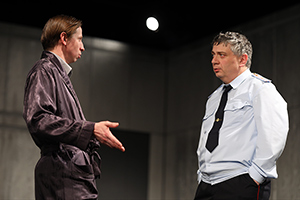
No matter what excited spectators to the Bogomolov Premiere in the “Comedian shelter” (whether they were counting on the continuation of the experiments with the “Karamazovs” or “Idiot”, that is, the “prince” , was nostalgic for the “shelter” “Lyra” or mentally trying on the style of the sensational television “containers”) Other. The director staged an invulnerable performance-those who want to accuse him of “mocking the classic”, of “free handling of text” will die from overstrain: everything is observed. Text F.M. Dostoevsky, classic, genuine, in the monologues and dialogues used for staging and at all, it seems, is given almost without bills. Bukovka to the Bukovka. That's the point that the "beaks". What censor is now trained on punctuation marks?!
Meanwhile, in them, in these commas, in dots, in exclamation signs (especially in them), the whole thing is. “Our time” is a case of syntax and punctuation, and not about vocabulary. Not about blood, but about intonation. But in this Bogomolov today there are few equal, if at all, they meet. The only intonation-sincere, sincere, reliable, that is, just one that the domestic theater school is dragged on by the artists of the stamp-so this perfect intonation, he positively drove the audience of his recent “glory” in the BDT. Well, how: about the party and Stalin - and so touching! And if with an academic roar, screening and stuttering about the same thing - then it would have come out more understandable, implacable, anti -tetlitant, more exposure? A h from the sensitivity was formed in terms of sound recovery, whispers and screams, as well as micromimics! A sure sign that the words themselves do not mean anything or anything and every physiognomy can be under suspicion - is the found is so raised, is it not with the intention of insulting? The basic meanings are lost, the remaining are unreliable - how can you not tremble for every sob? Konstantin Bogomolov learned to work in this territory of uncertainty, he does not cow entropy, as he knows how to cook it. The more unreliable, the more dangerous, the more entertaining. Maybe - more significant.
In “Crime and Punishment”, the mantis deprives the novel of the usual soil. Everything, it turns out, can happen to the old proponent, although there could be no heroes at all, we saw the angel-like martyr Rodya, and the evil Napoleonishka, the romantic cynic, Porfiry Petrovich and the healed in the world Ivan Karamazov, the Steak of Virtue was Sonya and the packed girl with the hazel They were nervous, tormented, excited and flashed, they fell into a hysteria, then into cramps, then back-it’s just that we put it! It’s written at Dostoevsky himself! His feverish style cannot be confused with any other - and is contagious beyond measure! That is why the director encroached on nothing else, but on punctuation marks. Having dealt with them, I got this. The hysteria was abolished somehow by itself. No “how pale you are now”, “yes you are trembling”, no nervous seizures, fever and fainting, no agitation remained at all. The characters deprived of emotional overheating seemed to have lost the natural right to say - they spoke a lot, even very, but without the excusable suffering self -confidence that their painful state and incessant flour give the speeches of the heroes. Fighting nonsense is the key to sympathy, at least - attention. (If you remember that for a different sensitive viewer, “to yell” in our theater still means “very good to play” and even “cling”, the performance of Bogomolov is indeed a crime.)
“Our time” is a case of syntax and punctuation, and not about vocabulary. Not about blood, but about intonation.
All this does not mean at all that the heroes of the performance are unauthorized and do not feel anything. It’s just that their passions ceased to be a stigma, and it is as difficult to separate a thin -feeling person from the insensitive as “ordinary” from the “unusual” in the article by Rodion Romanovich: there are no signs. Well, almost. The case is idle-everyone comes out "ordinary", everyone is obsessed with their idea, their own passion. Those who are less inclined to demonstrate emotions have to explain the best of all. The monumentally cozy, almost sleepy Porfiry Petrovich (irresistible Alexander Novikov in the cop form) for hours envelops his imperfect, good -naturedness of the uncontrolled Raskolnikov, it seems, is completely sugary, but no, everything is only a dream.
Arkady Ivanovich Svidrigailov, endowed with Valery Degtyar’s signature softness, monotonously and tirelessly tends the Dunechka to terrible sin (Maria Zimina plays Avdotya Romanovna with a clean and new girl, literally “from a needle” - she and a valve still dangling on a new dress.) But the proud Dunei will be sentenced to school “but I Another is given to another and will be faithful to him ” - and sniffing on the door. The “other” to whom it is given is Luzhin: although it is obviously “not a couple” (Alexei Inglevich is a little person), but he is always silent. And Svidrigailov continues to confess in the dreamy, crystally simple -minded frankness will agree to the unambiguous and completely criminal "I love children very much." And reality begins to swim slightly, connecting the theme of the Bogomolovsky “prince” in a new image (Valery Degtyar once played Myshkin-and about the same manner).
“We have two creatures and came together in infinity,” the demon said. So they talk in the “crime”. As if neither time nor space exist. The space is an empty “gray cabinet”, which stylistically continuing the interior of the theater (artist - Larisa Lomakin), easily, one game of light turns into a deserted bar, where schismatics and marmalads are found, then into a police station, then the difference is not great in the hero’s apartment, details are not significant. Time - the inner time of Rodion Romanovich; In any case, it is up to him to decide when everything is over. The audience is used to the fact that some travesty games can be expected from Bogomolov, but if the director played with Gender in Lyra, then in the “crime” - with age. The “psychological” age of the characters turned out to be more important than the “paccorte”. That is why the naive and gullible Pulcheria Aleksandrovna Raskolnikova is almost a girl (she is played by the young actress Alena Kuchkova), and the irresponsible infantile titular adviser to marmalades, a talker and an alcoholic, a club youth (Ilya Del spoke for a long time, convincingly, and it turned out to be unclear that Semen Zakharovich is a banal bastard. Sweet, but a cute, but sentimental, but sentimental, but sentimental, but sentimental, but sentimental, but sentimental No more, if without a fever and without hysteria). All these are parents who are younger than their adults sad, multi -experienced children. This happens. We have - so even all the time.
If you remember that for a different sensitive viewer, “to yell” in our theater still means “very good to play” and even “cling”, the performance of Bogomolov is indeed a crime.
The main effect went to the share of Sonya Marmaladova. She is played by Marina Ignatova, who is not just older than her stage father and the heroine of Dostoevsky, but masterfully retained the necessary shaky duality in this role: Sonya externally changed from what had happened to her, she paid her price for self -sacrifice and yellow ticket, but in fact she remained the same - for the strict, demanding clarity of his eyes, for the inner conviction of the life principles of nothing It is not able to influence. Marina Ignatova, of course, heroes in the role, however, the reward is great: no one, it seems, has never seen a Sonechka ironic and skeptical - but in her performance this is just that. "Kill? Do you have the right to kill? " - Without horror, without indignation, without shudder and other ignition - but with curiosity and sympathy. Because first of all, the “right to kill” is a mistake. Sin is if you believe in God. But here is a mistake - for sure.
“Go now, this very minute, get at the crossroads, bow, kiss the earth that you defiled at first ...” is not a spell of a deeply believing soul: this is a intelligible, sober story about how the world works, how everything works here. Almost a recipe. Faith, repentance, miracle is very personal, they don’t talk about this out loud (reading the chapter about Lazar is drowned out by a musical phonogram), but “what to do” is known: “Stand, bow”, etc. And Sofya Semenovna offers the cross from the heart, of course - but also as a reliable, proven medicine. This secularization, of course, deprives the union of Sonya and Raskolnikov of the mystical halo, but you cannot refuse to charm with a sleepy practical practicality.
Almost for the first time in the stage and screen history of the novel, an important motive came to the forefront in the relationship of Sonya and Rodion Romanovich: Rodya identified “his own”. "You stopped too." “Killing yourself” or kill another is a small difference. If the local Rodion Raskolnikov really looks like a student, then it is precisely in the scenes with Sofia Semenovaya. Studies. Dmitry Lysenkov played one of the most stubborn schismatics who categorically do not want to repent: he is a skeptic almost from birth, the character of the Nordic, wise-perpetual mine on an expressive person is replaced by a contemptuous boyish maliciousness. Lysenkov is a dangerous Raskolnikov: he checks the novel for strength. Both come out of the experiment without prejudice - both a novel and an actor. This Rodion Romanovich is able to suddenly get bored, round the eyes with tin buttons - and the multi -wise Porfiry again misses the target. The cross from Sonya Raskolnikov accepts seriously and busily: so, you say, does it work? Well, let it be.
It turns out to the edge of the stage, bows: “I killed the old chino and her sister Lizaveta ...” This bow is border, both the plot and acting-the first bow, the final of the performance. A strange, permissible ritual act - almost the same as if someone Edip went to the square in a timely manner, announcing: “I killed the king Lai ...” You see, “Shelter of a comedian” where the performance is taking place, this is two steps from the hay square, from the scene of the novel, from that very crossroads. In the inhuman space of the “crime” there was no time - continuous “conversations in infinity”. But the actor-racers went out where necessary, bowed, said that it should have been-and time went.
Subscribe to the COLTA.RU channel in Yandex.Zen to miss nothing