
Translated material
Myth + myth = NTV
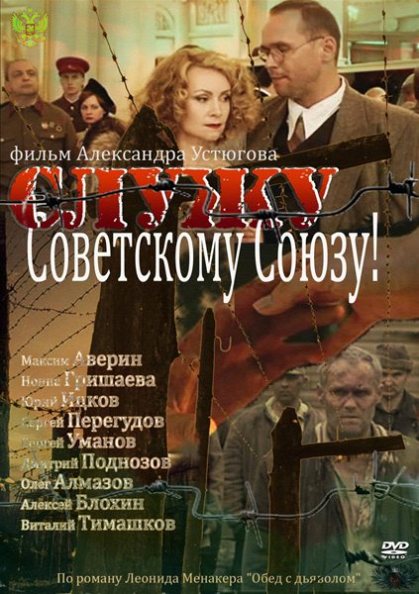
Remember from Soviet times a good conflict with the best? Any dramatic confrontation of a very good, but in some places the wrong director of the workshop with a very good plant party in all respects? About the same thing demonstrated to us NTV with the show of the film “I serve the Soviet Union”. The traditional Soviet conflict arose between the "good" NTV and the "best" Minister of Culture Vladimir Medinsky.
The Minister of Culture, who was designed to protect Soviet values from all kinds of encroachments and the “right” view of history, entered into a serious conflict with the NTV channel, who thought to slightly rethink the Soviet view of the war in a several non -traditional perspective. No, God forbid, we are not talking about historical truth, but only about the unauthorized and unauthorized replacement of one myth to another. The former myth said that in the face of fascist danger all Soviet people rallied as one and did not think about anything other than victory. The current myth establishes that everything was so, with the exception of the camp Vertukhaev and personally, Lavrenty Pavlovich Beria.
Of course, all art is conditional and the feature film is not a movie documentary. You can not find fault with the authors of the film, demanding from them accuracy and reliability in the little things. You can ignore the fantastic episode of escorting the convicts of the propaganda Brighad in the common car of the passenger train. You can marvel at the fact that the prizes are leading political discussions, tearing up with the last strength in the forestry. What you can't do for the sake of a beautiful picture! You can attribute to the conventionality of art the ease with which the heroine of the film on the first attempt is dawn from the northern wilderness forgotten by the god of the miraculously revived telephone line to the omnipotent People's Commissar of the internal affairs of Lavrenty Beria. You can forgive the authors even that incredible stretch, when, by the perfect ignorance of the customs of the criminal world, they leave live camps, who were entirely in the power of the prisoners. Well, this does not happen in the camp world!
However, what can not be forgiven for the authors is an ideologically colored fiction that the prisoner chose a war between freedom and war. The whole film is being built on this myth. There is nothing surprising in the fact that the Vertukhai of the NKVD was draped at the first opportunity. It is unlikely that anyone is surprised. But the fact that the prisoners took up weapons to fight for the state, and not for their own freedom, is beyond reality. It can also be assumed that the most durable of the 58th could go for it. The fact that the Soviet journalist and communist Mikhail Koltsov, who served as the prototype of the movie hero Mikhail Dontsov, could really decide on such resistance, present with some difficulty, but still possible. Fanaticism sometimes pushes into desperate acts. But that normal criminals, and even a thief in law, go to fight, neglecting the opportunity to run - beyond all understanding.
The most incredible scene in the film is the most, in my opinion, a careless anticipation of prisoners after a fight with the Germans of the return of camp guards. The prisoners themselves call the NKVD management, reporting the situation and waiting for the order. Everyone sings together, dance and read poetry to each other. The cop complains to the prisoner of his bonded life, and does not lie with a broken stomach or a shot head at the camp gate, as it would really. A thief in law dances with a prisoner-actress and admits to her that he is happy for the first time in her life. God, what a cheerful cranberry! A new myth of patriotism of the camp world!
The authors of the new mythology should recall that during the war, from 4.5 to 6 million Soviet military personnel fell into German captivity - an incredible amount comparable to the army of a large state. Of this amount, about 2 million people are prisoners of 1941, who had developed weapons at the very beginning of the war. Many historians agree that mass desertion in the first months of the war was caused not so much by military defeats as by unwillingness to protect Soviet power. Later, when the Nazis began to fully atrocity in the occupied territories, the number of such deserters naturally decreased, the partisan movement began. 2 million prisoners of war are ordinary military personnel who survived collectivization and dispossession, artificial hunger and mass repressions of the 30s. The desire to shed blood for the Stalinist regime, they did not burn. What can we say about the camp population who dreamed of breaking out of the Gulag at all costs - at least through penal battalions, at least through desertion, at least through the occupied territories. Until now, in the criminal world, a joking proverb is alive "sooner war and surrender."
I do not discuss the moral side of events here: priests did well or badly, correctly or wrong. There are different opinions on this score, and this is a question for a separate discussion. But the fact that everything was not at all as presented in the film is obvious. It is necessary to completely not understand the customs of the criminal world in order to make a mistake. However, this is hardly a mistake. An attempt by the authors of the film “I serve the Soviet Union” to portray the prisoners of the Stalinist camps by the patriotic link of universal Soviet unity is another myth designed to surpass Soviet myth -making.