
Translated material
In chronological dust
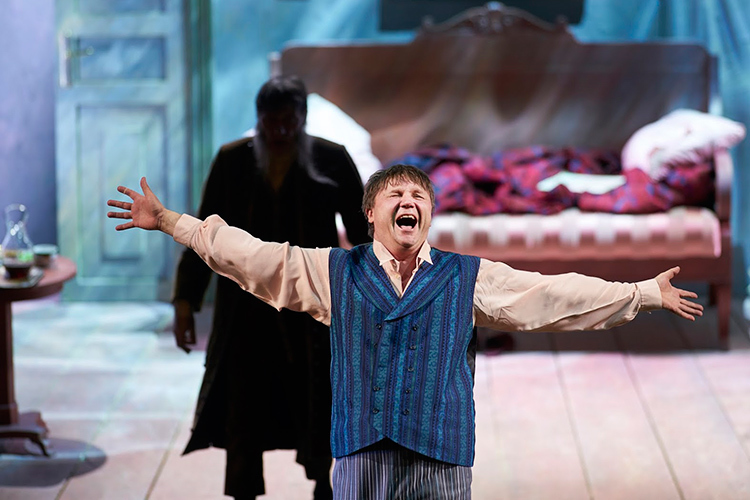
What to expect from the performance? Corporate Karbauskis . If you love everything that he does, how I love it, you should wait a bit of sleepy whirl at the beginning of the first act - and it should be there, there the author himself has an exposition. But then theatrical heaven, thunder, lightning, screams, love will open! “And you will laugh and cry like a child.” And then it is wise to sigh when Oblomov’s sneaky and betray himself, living, reverent, exchanging love for salmon with acidic cabbage. This is life, the director tells us. And we are: yes-and home, to salmon.
In the beginning the doors creak. Carbauskis's signature handwriting is that he first shows the viewer a musical notation. Each gesture is a topic, a note. Not an illustration, but the movement of the soul. Its theatrical language in this sense is inaccessible and simple, out of the text itself, outgoing music. Theater sciences call this “Krulychki loops”-but few people know how to really weave in this sense.
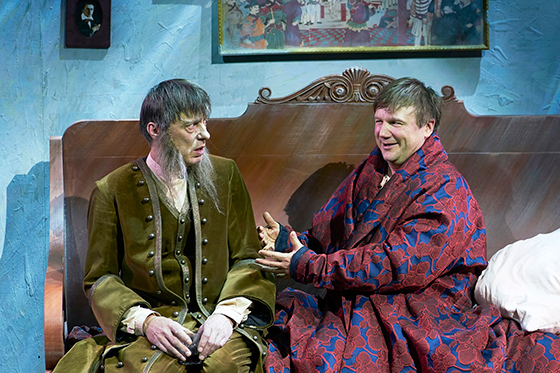
Zakhar (Anatoly Lobotsky) creaks the door, but does not come in - the note to, for example.
Zakhar squeezes the door and comes in with the news, and even unpleasant: they demand money, greenhouse, butcher, accounts, all in a rumor - this is a note re.
Zakhar, who talks about bugs and mice, is already some kind of Mi-Bemol.
All this, of course, is carefully woven into the score of the composer Faustas Latenas.
 © Sergey Petrov
Karbauskis introduces us to the techniques that will tell us about life - always based on the text: each gesture is born from Goncharov’s word. Thin, ironic, bitter.
- Mole starts up from dust! - Oblomov is indignant. - Sometimes I see a bug on the wall.
Zakhar and fleas have, and mice, but not he invented them. Here Zakhar is like an early Wittgenstein, but lucid: He is the god of this world, the lord of dust. You would, Barin, know from home, so I would have shook Anisia. And do not fit, so we do not sweep away. Some eternal law of Russian life: servants-a parasite on the body. The bottoms are adapted to the monstrous bulges of the hosts.
Dust is a powerful chord of this symphony. First, dust is represented as the heroine of Russian literature - tremolo! Oblomov discovers her in a scarf that has fallen over the sofa. Zakhar blows her out of house books. Dust as a barometer of Oblomovskaya hibernation. Dust as Russian weather. Dust as fools and roads. Like conservatism. Like Russian values. And finally, dust is like a companion of the old repertoire theater. Oblomov shouts: why do you have dust - syncope everywhere! - Well, you will order revenge every day? And both look at the powder cloud of dust in the air. "Beautiful!" - both say fascinated.
 © Sergey Petrov
In the climax, the dust will go from all the cracks-thanks to the smoke-machine. And we will see this overflow, patterned Russian dust - majestic, like the Gothic cathedral.
Beautifully - says the artistic lights of lightning about the imperfections of a person, admiring him. Also the handwriting of Karbauskis.
From the dust that accumulated on the books of dust, Olga finds out that Oblomov does not love her.
Oblomov (Vyacheslav Kovalev) at Karbauskis in a special robe (costumes of Maria Danilova). Although, it would seem, how many robes did the costume artists over the past century have? In Karbauskis, the bathrobe, like a liana, has a separate organism, symbiotic with Oblomov and Oblomov from the body is supplanting.
Oblomov inside the dressing gown is a child who rushes from corner to corner of the sofa, thumping with his head against the pillow and calling Zahar, like a mother. And Zakhar with voluptuousness scares him with bugs, mice, debts. Then he will scare the wedding, changes - toxic, abusive relationships as they are.
And this centaur-wrap, which has grown through a robe with a sofa, cleverly inhibited and captivating, already having no will, as often happens with an average Russian man, suddenly transforms.
This is life, the director tells us. And we are: yes-and home, to salmon.
Carbauskis carries staging as a bracket of staging - there is no more sensible person. All impulses are in Oblomov himself: he changes from one thought about Stolz - and this is also a statement of human nature. I want, they say, I’ll get up from the dead myself. And then Olga appears. Woman-vulcan, woman-pitch, female war.
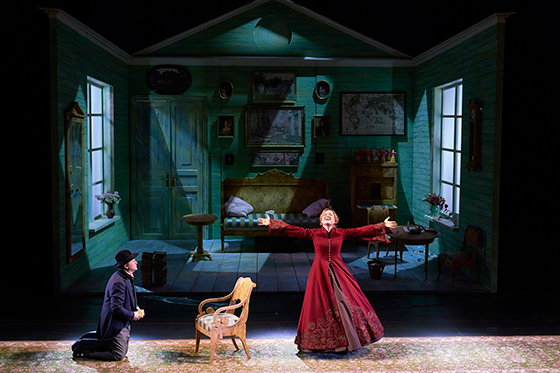
This is the assembly point of the performance. The decoration of the great Sergei Barkhin is a theater box, furnished rooms that are in the city, that in the country is the same: a sofa, a table, a bureau made of Palisandry. In this detailed theatrical setting, the whole dead occurs. The entire Morok of Oblomovskiy life. Sleep, bugs, mice, dust.
And on a narrow strip of advanced, where all conventionality is nothing - real life. The music of life, fear, trembling. Everything happens here. Oblomov, getting rid of the robe, touching and helpless, says: I feel love. The legs tremble, covers his face with his hat. Notes of fa and salt.
Karbauskis puts a love scene as a storm-again strictly according to the score. Heroes walk along the line of advance, from the left backstage to the right - and this is an alley in the park. Olga threw a branch of lilac. To feel how she feels, Oblomov lifted the branch - and also threw it. The love of another - how is it? Goncharov mentions Bellinyevskaya “Casta Diva” - a whole sound landscape is built in Karbauskis. As soon as “Casta Diva” begins to sound - she, love.
 © Sergey Petrov
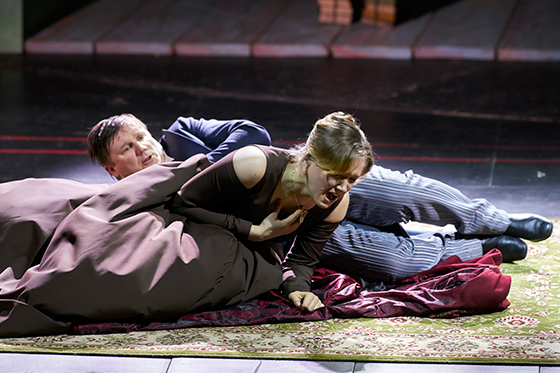
In the climax, they go along the alley. Olga (Anastasia Mishina) has a seizure - she is scared, burns in her chest. Young, impulsive, everything moves and rings from such people in Russia. And the excited loose donut of Oblomov, which is led - either to the abyss, or to bliss. Whether he is worthy of the love of a young creature - this is torment. For what, why do they love me? What will happen? A woman leads a man along a new, beautiful path. The most scary, the shadows seem to be ahead. But love, we have to go. And what does the man answer to this?
Let's go home, Olya. Olya, soon home. Come, Olya.
This is very true about Russian men.
From these passions, from this life, from changes, from everything - let's go home.
Why is there only a single moment to burn, worry, worry and live in life-a big question. "Is it possible longer?" - I want to ask. “You already decide it yourself there,” Goncharov answers with Karbauskis.
Oblomov does not die. He jumps from this conditional space, where everything lived and burned - into the house, a cozy house, where again dust, sleep, oblivion, sweet nothingness. And he finds his wife to match - it’s always curious how men fall, get fat, smaller, ble down under the influence of their wives. And in this Karbauskis is also ironic - what ambitions, such a woman. And now, a solid mistress (Olga Ergin) is already firm nearby, like a rocker, like a rocker. It has decreased, but alive. And in the kitchen they are already fried salmon. Soon it will be served with acidic cabbage. This is a calmer for a Russian man. Dust. Beautiful. The doors creak. Symphony.
Subscribe to the COLTA.RU channel in Yandex.Zen to miss nothing