
Translated material
Spanish quarter
Climbing a high degree of madness turned out to be a very difficult thing
Climbing a high degree of madness turned out to be a very difficult thing
“Long live jealousy! Jealousy for a word does not climb into his pocket. ”
P. Bomarsha "Mad Day, or the Marriage of Figaro."
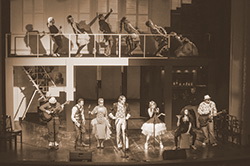
A week before the premiere of the Pskov Figaro, I asked the creators of the new performance: “Explain to the audience, why should they watch your performance? There are so many interesting events around. Why should people quit everything, pay money and spend three hours in the theater on October 15? ” The performer of the role of Count Almaviv, Sergei Popkov, replied that this should be done in order to "see beautiful women and beautiful men, and also in order to relax." “The performance will help to distract from everyday problems,” promised the most experienced artist who was participating in this performance, staged by the St. Petersburg director Oleg Prayer on the famous Bomarsha play.
"The grain of the performance is that this is a crazy day"
| | | --- | | 
In one of the intermission, I realized that it turned out for me in this play “Crazy Day, or the Marriage of Figaro” the most important. Intermission. During him in the buffet, the conversation came about another performance “Figaro”, staged in the Pskov drama theater in 1975 by Henrietta Yanovskaya [ 1 ]. Experienced spectators recalled the sensational performance to which spectators came from Leningrad to Pskov. In that performance, the main roles were played by Sergey Mochenikov, Vladimir Rozhin ... In what words will the current performance of this year 2055 recall? Will they remember him at all?
In February of this year, the director Kama Ginkas, speaking at the Pskov Theater, recalled the production of the Henrietta of the Yanovskaya mid-70s of the last century: “She staged two performances in Pskov in Pskov in Pskov. These were fantastic performances that could not be in Leningrad - because in Pskov they strangled less, there was a wonderful director ... ”[ 2 ]
It was interesting to know how director Oleg Prayer used the experience of his predecessors. After all, so many famous directors were put by Figaro, even more celebrities participated in these performances.
“When you put a classic work, there is always a load of previous productions,” the director answered. - We did not set ourselves the task of repeating or fearing. First of all, I was guided by today-on how relevant the play is now, how much the problems are of interest to us, whether they are worried ... Based on this, the interpretation of the characters, images arose ... Probably, this is some kind of autonomous story ... "
“What happened before? - Following the director, the answer was continued by the artist Sergei Popkov. - Of course, some pictures arise. But we have our own rules of the game, our proposed circumstances. ” “It feels that, given the modern directing, many performances can be called almost the same:“ Crazy day, or cherry garden ”,“ Mad Day, or Hamlet ”...” ““ You have noticed correctly, ”Sergey Popkov agreed. “The grain of this performance is that this is a crazy day.” “Do you think this is important in our time?” “Yes, in our life there is so much absurdity, so much madness in everyday life, in politics, in business ... a continuous madness. And here - the relationship of a man and a woman. "Turning the blankets." It seems to me that we work in this plane. We will try to convey this meaning to the viewer. ”
Indeed, the creators of the performance focused on "tug of blankets." It was a real sports competition: tug of blankets for a while. Men and women.
It was promised that the play “Figaro” would turn out to be more complex and large -scale than the “stingy” Moliere, set in Pskov by Oleg Prayitin last year [ 3 ]. And it really turned out to be like that. It goes with two intermission (very convenient for those spectators who want to escape ahead of schedule, but is shy). The performance - with different color and light solutions, with switching moods and genres ... But this does not mean at all that the complex structure is equally mobile. The mechanism of the performance is still needed to set up.
The strength of the director Oleg Prayer is that his artists do not disappear. Pale shadows do not roam on his stage. They always have something to take themselves. These are interested parties. And in Figaro this is still so. Oleg Prayer gathered in the play in the play of almost all his peers - young artists of the Pskov Theater - and distributed among them the roles, including the roles of the elderly (as in the case of Vitaly Biserov and his gardener Antonio). Although I would not dare to say that the Figaro is already a completely finished performance. It seems that he was released earlier than it should.
"To pretend that you do not know what everyone knows"
| | | --- | | 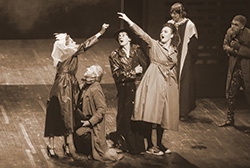
The first review, which I heard immediately after the performance, sounded like this: “Disappointment, disappointment ...” An elderly man apologized to the woman for bringing her to the theater that evening. And at this time in the hall, the audience continued to persistently applaud the artists and director who went to bow.
I remember the last year’s reaction of some spectators immediately after the final of the play “The Church”. It was a bewilderment. Moreover, even some artists were perplexed when they listened to the words of gratitude. They sincerely did not understand - why gratitude? And at the same time, most of the viewers were satisfied. It was especially impressive that the artists who had finally played mainly on the Pskov stage finally played and did not play.
In "stingy" everything on stage worked more coordinated than in Figaro. The "stingy" looked more integral. There are enough springs in Figaro, but not all of them are still unclenched. This is especially true for the middle of the performance.
“Figaro” as a play is interesting in that there is an abyss of all meanings. For example, Vladimir Mirzoev at the Vakhtangov Theater with Maxim Sukhanov as Count Almaviv “The Marriage of Figaro” [ 4 ] is presented as a foreboding of the Great French Revolution. (Historically, this was just like that. Pierre-Oigen Caron de Bomarsche wrote the French version and realized that censorship did not miss it. I had to redo the play, transferring its effect to the usual Spain, where the action of the Seville Barber took place. But this did not deceive the censors).
I reminded Oleg a prayer about historical prohibitions and alteration. The director of the Pskov “Figaro” of the autumn of 2015 replied with a smile that he would be happy if his performance had been banned.
Of course, the chances that Figaro will be banned, now there are not the slightest. Moreover, the political side in the current production is not completely affected. Unless there sounds the phrase: "How bad it is that we have sold positions."
After all, what was the time forbidden by the Bomarsha comedy for? Just for politics. The count in the play says: "You should have started under my leadership of politics." Figaro replies: “Yes, I already know her,” and then he demonstrates his knowledge, telling what it is - to be a politician: “To pretend that you do not know what everyone knows and that you know what no one knows, to pretend that you hear what is incomprehensible and not to listen to what everyone is heard; The main thing is to pretend that you can surpass yourself ... ”It sounds like an instruction written by a modern cynical political strategist. And then the final self -disclosure occurs: “Often to make a great secret from the fact that no secret is; To lock yourself in your office only in order to purify the feathers, and seem thoughtful when, in your head, it is called “the wind walks”, is it bad, is it good to play a person, produce headphones and feed the traitors, melt the wax seals, intercept letters and try to justify the goal of justifying the squalor of funds. Here you have the whole policy, I will not get off this place. ”
I do not leave this place if Oleg Prayer is completely different. And there is nothing wrong with that. The classic work should be multi -layered. It lives for a long time only when the directors find something close to them in the play.
The heroes of the current Figaro are also constantly pretending, but the driving force of their deceit is jealousy, only jealousy and nothing but jealousy.
If this performance is “Figaro” and a premonition, then the foreboding is not a revolution, but of love. It seems to be not in the performance, especially in the first half. Instead of her, jealousy dominates - the dark side of love. The fee for jealousy is an endless pile of lies, to which all the heroes resort to, despite age and position.
If it were necessary to highlight only one person on stage, then I would call Ksenia Khromov in the role of Suzanne. The performance could well be called "Crazy Day, or the marriage of Suzanne."
"So the days pass, and I am in despair"
Spain here, in Figaro, is such a fabulous country in which everyone is singing in Spanish (the benefit in the troupe of the Pskov Theater has someone to sing, even in Spanish). And they sing nothing, but Quizas, Quizas, Quizas and La Cucaracha. "Siempre que te Pregunto, Que Cuando, Como Y Donde ..."
For approximately the same purpose, Martha Fayns, the Soviet song “Oh, blooms viburnum”, emphasized the conventionality of what was happening in the American-British film “Onegin”, extended the borders of time. That is, they combined Eugene Onegin and Kuban Cossacks, Alexander Pushkin and Isaac Dunaevsky. And for the completeness of the “Russian picture” they added the song “Oh, full of box” to the verses of Nikolai Nekrasov. Theoretically, Lensky could also be laid after a duel on Red Square in the Mausoleum, but they resisted. And without that “Russianness” it was excess.
In the Russian performance, the same role is played by the Spanishness. In this Figaro, on the one hand, she is a tribute to the declared madness, and on the other - the calculation for the audience response. At some point, the action for some time turns into a pop concert with the performance of the notorious incendiary comic "Cukarachi" - songs about a cockroach in the Corrido genre (very popular during the Mexican Revolution). To the fiesta, siesta, corrida, Paeli, Hamon Iberico (Pata Negra) and the like, however, does not come. Like a football match with the Seville club. The case is limited to a short batch in table tennis. Plus, the conversation on the phone and the electric metrodrel necessary in the farm of any Spanish Count (in the "stingy" were megaphone, bicycle, phone and refrigerator).
Madly adds that Quizas, Quizas, Quizas - the Cuban song, was written in 1947 by Oswaldo Farres. The degree of madness reaches the necessary mark. And here there is another turn, but not the plot, but the genre. After all, Oleg Prayer promised that he would demonstrate: the play, on the basis of which the performance was staged, "not as entertaining as it seems at first glance."
This seems to be already becoming a tradition. Oleg Prayer and in "stingy" tried to arouse pity for the harpagon. With Figaro (Maxim Plekhanov), something similar is happening. Closer to the final, Figaro also urgently needs spectator pity. And even more than the harpagon. Still, he is not so mean.
* * *
In the Cuban song Quizas, taking place in the play with a refrain, sings: “Every time I ask you: //“ When? How? And where? " // You always answer me: // "Maybe maybe it may be."
It seems that this song is able to become the anthem of the Pskov drama theater for some time. The audience all the time expect something special from their artists and directors, but "this is how the days pass, // I am in despair, // And you, you answer: //" maybe it may be. "
Quizas.
Maybe the audience will ever wait for their own. Separate lucky ones were already waiting.
Alexey Semenov
1975 P. Bomarsha "Crazy Day, or the marriage of Figaro." Pskov Drama Theater. Director G. Yanovskaya. Artist A. Kozhenkova.
See: A. Semenov. At the intersection of Pushkin and Lenin // "PG", No. 6 (728) dated February 18-24, 2015
See: A. Semenov. Not a step without money // "PG", No. 38 (710) dated October 1-7, 2014
In this performance, the artist Alla Kozhenkova, famous for the Pskov Theaters of the past, worked.