
Translated material
Ionich
A concert of the son of the famous musician Pskov celebrated the 99th anniversary of Mikhail Ionovich Rivkin
A concert of the son of the famous musician Pskov celebrated the 99th anniversary of Mikhail Ionovich Rivkin
Paradox: the names of the great Russian musicians are associated with Pskov and Pskovshchina: Rimsky-Korsakov, Mussorgsky, Vladimir Dukelsky, Maria Yudina were born or lived here for a long time. At the beginning of the twentieth century, Chaliapin and Plevitskaya sang on the stage of the people's house. In Soviet times, buckets, Richter and Monighetti were touring with tour. But Pskov musicians still cannot be called.
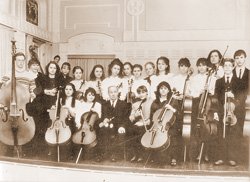
| | | --- | | 
In a series of sad news, there was a message about the death of Mikhail Ionovich Rivkin - a violinist, a conductor, a wonderful person and a musician.
On January seventh he would have turned one hundred years without one year.
As usual, on the anniversary of the death of his father in Pskov came from Bremen the son of a conductor. As usual, he gave a concert with the Pskov Symphony Orchestra, the entire string group of which is, without exception, either students or his father’s perennial colleagues. As usual, those who reverently and with love honor the memory of this person came to this concert.
The scale of the personality of Mikhail Ionovich and his trace in the history of Pskov culture require that his memory live in our city. And I would really like this publication to become the first step in public preparation for anniversary celebrations.
* * *
Mikhail Ionovich Rivkin was born on January 7, 1907 in the city of Starodub of the Bryansk province in the family of a military orchestra conductor. It is necessary to imagine what the garrison chapel in the life of a provincial city meant at that time: it was the center of local musical life. The parades and solemn trips in the days of the namesake of their majesties, balls in the noble and merchant meetings, the noble congresses, meetings of the City Duma dedicated to important events ... The century Borodin and the three hundredth anniversary of the Romanovs house ... Summer public concerts in the city garden ... and so on, and the like - what to list here.
The military orchestra of that time is not current cold pipes. This is a fierce team with a highly professional conductor at the head.
Such was the environment where Little Mikhail received the first experiments of high art.
There was another experience - also wonderful and important. At that time, in that area, the so -called “Clezmerbandy” also existed - Jewish orchestras who played at weddings, dances and funerals. It is not necessary to think that these were some hackmarters-it was extremely difficult to become a member of the Clezmer-Open, this work was prestigious and highly paid, and their musical level was simply transcendent: it was real virtuoso-universals that played each on several instruments.
In the films of Emir Kusturitsa, the music of the Balkan Clezmers sounds. By the way, the team of Goran Bregovich, the world-famous author of music for the film of Kusturitsa, is called: “The Wedding and Funeral Band”-“Wedding and Survey Orchestra”.
This is so, for the completeness of the picture. But I was distracted.
So, in one of these “gangs”, having received a wonderful home musical education, and young Moisha Rivkin began his career as a musician. He played - attention! - The violin, pipe, clarn and drums. Arrangements were born on the go. Each musician had to know dozens of topics and be able to improvise. It was a real jazz - in spirit, the requirements for performers and the place that this music occupied in life.
And it was a great school.
Already in the 1980s, during the rehearsals of the Symphony Orchestra of the Pskov Music School, Ionich sometimes said to the musicians:
- After all, you are cool Labuhs! You can do everything! All Europe will look at you! ..
Old Clezmer Hochma. Everyone laughed. And the old and venerable musician tradition was blew.
* * *
But the father decided that it was necessary to study further, to get a real professional diploma, and Mikhail enters the Moscow Musical College, and after its end, the Leningrad Conservatory, where he is improving in the game on the violin by Arkady Immortal (who, in turn, with the Jacob Haifets was a student of the great Leopold Auer) and symphonic dialigation at the legendary Ilya Musin, founder of the St. Petersburg conductor school, future teachers Yuri Temirkanov and Valery Gergiev.
By the way, at the same time, his acquaintance with young Dmitry Shostakovich, with whom they were almost peers, started.
... at the rehearsal, Ionich could suddenly say something like the following:
- Bach, when his being, did not write a batch of double bass. There was a bass party, which was performed by the cello and duplicated the octave below the double bass-therefore, one of the names of this instrument-double-bass. And sometimes the bass was not discharged at all - then the musician had to be able to improvise the party by digital.
A real short lecture on the history of music. And what we did, suddenly realized not just as a mechanical “performance of notes”, but - ideally, of course - as a thoughtful and meaningful experience of the great heritage of the world classics.
* * *
After graduating from the conservatory, serious professional activities began - young conductor Mikhail Rivkin receives an invitation to Minsk. He works in the Minsk Philharmonic, heads the orchestra and, together with Joseph Zhinovich, takes an active part in the creation of the first orchestra of Belarusian folk instruments. It was actually the Tsimbal orchestra - when the school received in Clezmerbande came in handy.
Now this orchestra is assigned the status of national and academic. He bears the name of Joseph Zhinovich. The role of Mikhail Rivkin in his creation is undeservedly forgotten.
... When the war began, Minsk almost immediately ended up on the front edge of the defense. In one of the first bombing, the wife of Mikhail Ionovich died, the children were evacuated and ended up in a shelter. Father was able to find and pick them up only after the war. Rivkin himself was drafted into the army, miraculously escaped captivity and death, participated in the partisan movement, after the liberation of Belarus was enrolled in the army, became a military conductor and, together with his orchestra, reached Berlin.
Everyone knew that Ionich fought. On May 9, the orchestra always congratulated him. Sometimes (very rarely) he put on awards.
But I do not remember that he once spoke or recalled the war.
* * *
After the war, Rivkin returned to Minsk, found children, and began to work again. This lasted until 1953, before the beginning of the "case of doctors." When they “took” several acquaintances, his friends warned him that he, like many Jews, was in danger. It was urgent to do something, it is advisable to leave somewhere to a new place. It was urgent to find a vacancy in Tomsk.
When in the late 1980s, in the midst of our perestroika disputes about politics, a “Jewish” topic arose, the last and most effective argument was sometimes like this:
- Listen, but how do you feel about Ionchu?
Everyone was good. It was impossible not to love him. And in the "enemies of Russian culture" it - well, no way! - It was impossible to enroll.
And Ionich never said anything about this. Although I understood everything, I saw everything, I heard everything.
... Having received a new appointment, Rivkin urgently rushed to Moscow, from where he took the twin-year-old school at the conservatory of his son and they went to Siberia together. Tomsk and Novosibirsk - both then and now - the largest cultural centers, the capitals of Russian science, cities with intensive artistic life, willingly accepted the musician. Then the “thaw” began, the danger of repressions passed, but working with local orchestras was so exciting ...
And then Pskov enters the life of Rivkin. And - on the contrary - Mikhail Ionovich enters the life of Pskov.
* * *
The fact is that in 1960 the Pskov Regional Musical School opened. Before that, there has never been professional musical education in our city. Specialists who could organize training began to be invited to a new educational institution - yes, in fact, the musical life of the city - almost “from scratch”.
One of these people was Mikhail Ionovich.
Is it possible to imagine this: the conductor and musician of this class come to the city, in which there is neither the Philharmonic nor the concert hall. There is no music community. The music school is barely organized. There is no tradition of classical music concerts. There is nothing that you are used to for your professional life.
But they gave the apartment to Yana Fabriasius, 26. And - the opportunity to work.
Ionich was looking for and found students. He picked up tools for them, agreed with familiar masters. He followed their fate, recommended friends and colleagues in the capitals. He delved into details of fate, could help with advice.
In general, he was very human. And he possessed enormous charisma and charm - without this, the conductor is impossible. In fact, from scratch, he created a violin and orchestral school, exclusively thanks to him, his symphony orchestra appeared in Pskov, in the repertoire of which were the “dawn on the Moscow River” and the overture of the “Sorochinsky fair” of Mussorgsky, the “carnival of the animals” of Saint-Sansa and the “Snegurochka” of Tchaikovsky.
To do this, he brought a huge musical library. I copied the orchestral parties - I still remember his handwriting, and it was clear how he changes over the years: from a clear and clear to ... also clear and clear, but - the handwriting of an old, very old person.
In 1993, Ionich was gone. He is buried on Mironositsky. The grave is visited, it is remembered. Soon a new monument will be erected there - through the efforts and dependency of his son, Alexander Mikhailovich, who comes from Germany.
Memorable board on the house on the street. Fabriasius, where a man lived, who gave thirty years of his life to make Haydn, Tchaikovsky and Mozart in Pskov.
Yuri Strekalovsky.