
Translated material
Around enemies
If the Janissaries suddenly begin to build, trade, engage in transport, education, culture, manage the state, then do not wait for anything good
If the Janissaries suddenly begin to build, trade, engage in transport, education, culture, manage the state, then do not wait for anything good
Go - and do not be afraid to stand next to him.
Your loneliness is to match the eyelid.
You look around - and around the enemies;
You will hold out your hands - and there are no friends;
But if he says: “Salt,” the Salga.
But if he says: “Kill,” kill.
Eduard Bagritsky. "TVS".
On the monitor screen, a familiar rally bustle, but simple clothing gives out the time of the rally: not our time. The last century.
| | | --- | | 
But the slogans are not much different from the current ones. People require honest elections.
Only we are talking about honest elections in 1989.
A rally in the city, which was then called Leningrad, was arranged on March 12, 1989 right on Nevsky Prospekt, near Kazan Cathedral. A thousand and a half gathered gathered.
A man is carved on the foot of the monument to Field Marshal Kutuzov. In his hands he holds a Russian tricolor, in Soviet times - a sure sign of “anti -Soviet”.
The police are reviving and grab the man by the leg.
At present, police officers look completely harmless - in overcoats and caps. They are not yet like astronauts.
Kagestshniki in civilian clothes - so they generally seemed to have left the screens of a cooperative comedic perestroika cinema. Some have knitted hats-strokes on their heads.
Although the scene of detentions is not very different from what is happening when they disperse the current opposition: their legs are in the hands and carried it to the autozak, in the sense - to the bus. The travel travel on the bus was discharged in the "Big House" - on Litein Prospekt.
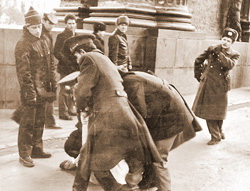
The most famous photograph from this rally is the moment of detention of the leader of the Democratic Union Valery Terekhov.
In the photo - it seems to be nothing special. Against the backdrop of impressive columns of the Kazan Cathedral, three zealous policemen are felled on the asphalt and wring their hands to the “anti -Soviet”.
However, the photo has been in demand among readers of the Internet, because in the book of human rights activist Julia Rybakov “My Century” it is signed unequivocally: “V. Putin oversees the capture of the leader of the Democratic Union Valery Terekhov. Kazan Cathedral. 1989 ". [ 1 ]
Everyone can decide for himself - whether it is Putin, who, in twenty -five years, will delightly kiss the pike and soar in the sky, like a crane listed in the Red Book.
An incredulous readers will say: what do you want to squint at Putin? But the Putin that kisses the pike today, at that time, worked in Dresden at Dresden.
Even more incredulous they will answer: in the official biography of GDP there are too many white spots, and this is not the most white.
However, now it is not so important-this or some other Putin stands above the soul of the leader of the Democratic Union.
But another thing is important: the Chekist's caring look for the well -known GDP is very characteristic.
After all, who is a Chekist? Guardian. If there is an installation to disperse, “clean”, then how can one not fulfill it? It is desirable - to control personally. To make sure that the enemy is neutralized.
Approximately the same thing happened in Pskov in perestroika-meith times. Only the scale was smaller.
Once, in spite of the Chekists, a Russian tricolor was illegally posted in Pskov at the House of Trade Union Culture (the current family center in Lenin Square). In response, the search for enemies of the people began.
A few years later, the same people who considered waving a tricolor Russian flag will solemnly celebrate the Flag Day. The very one is a white-blue-red flag, which until recently was torn and trampled into mud.
Along the way, in 1989, in Pskov and other cities of Russia, they continued to look for “subversive literature”. Solzhenitsyn's books, for example. The Gulag Archipelago in the journal has already officially printed in the New World, but the Red Wheel is not yet.
Then the same people who recently still chased the tricolor and books of Solzhenitsyn will quickly swear allegiance to the new government. And they do not lose at all. Solzhenitsyna will meet with bread and salt. The most important will come to him to bow.
Only a change of gate will occur. In the best case, the change of team. But the goalkeeper needs any team.
The installation is different, but zeal is not less manifested.
The grave reflex did not dull.
... Meanwhile, on the screen in the old newsreel, the police methodically leads away from Nevsky Avenue "Anti -Soviet". Similar music sounds. Saundrek's songs of Bulat Okudzhava were unmistakably chosen and, above all, this one:
While our crazy sultan
promises the way to us to the prison
We’ll take hands, friends,
We’ll hold hands, by golly ...
Friends, meanwhile, take hands themselves. And by the legs.
Sultans exist for that to promise the road to the prison.
Sultan's madness sings a song.
And if there is a sultan, then the Janissaries [ 2 ] should be. It’s impossible without them.
But when the Janissaries suddenly begin to engage in a business that is not characteristic of them, sooner or later a disaster sets in.
If the Janissaries suddenly begin to build, trade, engage in transport, education, culture, manage the state, then do not expect anything good.
The Janissaries involuntarily pulls to do the usual business - to punish.
And then a problem arises - there are not enough enemies for everyone. We have to invent them - in construction, in transport, in education, culture.
Enemies are quickly. The Janissaries sigh calmly. But their peace is not enough.
The state, led by guards and punishers, is developing somehow one-sidedly. The sultan is nervous. He is the former Janissaries.
But there are no former Janissaries.
These people of more than twenty years ago thought that it was only necessary to guard better, and everything would be fine. Tower, prickly wire, prohibitions, blows from stealthily, control and accounting ...
The towers are a little higher, the prickly wire is thoroughly. Then prosperity will come.
When they wanted, they were punished when they wanted to have mercy. It would seem that everything was under control.
But one control was not enough.
The prosperity did not come.
It was necessary not only to rebuild, but to build again.
Only concentration camps are used to building these people. And if not camps, then still build under a strict supervision, at their discretion, using the whip and the gingerbread.
Gingerbread cookies. Knuts shook.
In the late 1980s, this familiar number did not pass.
So the Janissaries did not follow the ward of the people, and safely raped the whole country.
But the old truth that the enemies, the aged Janissaries did not forget, and those who forgot have now resemble at the first opportunity.
And indeed - enemies. In any case, not friends, because there are no friends for them. Except for the narrow circle of the Janissaries with the manners of the sultans.
* * *
There are many monuments in Russia. From Kutuzov to Karl Marx, from Chizhik-Fuck to Lenin.
But in this motley chain there is not enough very important link - the monument to the toptun [ 3 ].
Toptun does not sow and does not plow. He is following the trail. He is watching, he protects peace. He personifies a decaying state that has learned to track and ban, but has forgotten how to build normally.
This monument should personify the confused toptoon that has lost the mark. And scent.
You can’t keep track of everyone. You can’t forbid everyone to live.
Once these people have already missed the country. They already know how to lose.
Alexey Semenov
1 See: Julius Rybakov. "My century." St. Petersburg, 2010. S. 426.
2 Janissaries (Tour. Yenchers - a new warrior), part of the regiments of Kapikula (the personal guard of the Sultan, consisting of slaves and prisoners). Yanychar troops also performed police and punitive functions in the state.
3 Toptun - a secret agent, filler, a topnier, a surroundings, a cop, a fidget, a detective.