
Translated material
Strong share
Galina Vishnevskaya: "I sought to sing, go on stage - at least a few minutes to leave real life"
Galina Vishnevskaya: "I sought to sing, go on stage - at least a few minutes to leave real life"
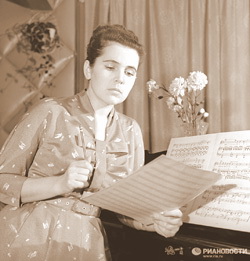
To understand what abyss had to cross Galina Vishnevskaya, [ 1 ] it is advisable to read its autobiography. [ 2 ] She was immersed in a teenager in the Ludoyed Leningrad Blockade Hell and miraculously remained alive. However, this did not guarantee that the soul would remain safe.
| | | --- | | 
“The city is full of military, and sailors are always crowded near our building - they are waiting. We had by no means the “Institute of Noble Maidens” - there was a bad glory about the “Blue Division”. - This is one of Galina Vishnevskaya’s most severe confessions of her youth. - In those terrible years, when such an exorbitant severity fell on the shoulders of women, there were many mutilated lives. Women drank on a par with men, smoked a flyer. And I went through this - I drank alcohol and smoked ... "
Thus, Galina Vishnevskaya recalled how at the age of sixteen she served in parts of the air defense during the Great Patriotic War.
“I can either sink to the very bottom, or get out of this mess of inaccessible and strong”
Today, many, including the General Director of the Bolshoi Theater Anatoly Iksanov, do not understand: what did Galina Vishnevskaya cling to the “avant -garde” performances on the opera stage? Why did it horror from them?
Vishnevskaya was violently indignant at the fact that modern directors forced the opera soloists to sing, sitting on the toilet, upside down, undressing the donaga or expectorantly.
For her, the opera art was something exalted, capable of lifting a person from the bottom or not to give him the bottom to fall.
Galina Vishnevskaya in his early youth felt the real power of art.
“Provided by himself in this cycle of human passions, seeing a nearby debauchery and sublime love, friendship and betrayal, I realized that I was left either to sink to the very bottom, or to get out of this mess of inaccessible and strong. And I felt, I knew that only art could help me, ”she wrote in her autobiography“ Galina ”. “Therefore, she sought to sing, go on stage - at least a few minutes to leave real life, to feel the power to lead people behind me into my special, into my beautiful world.”
Many current opera productions are the same debauchery, betrayal, the bottom, from which young Galya Ivanova fled, fleeing in a beautiful opera world.
The modern opera industry in the search for spectators and money pulls on the stage everything that is not hit, persistently replacing the beautiful world with disgusting - in order to equalize real life and art. In other words, to lower art to the level of the bottom of life.
"I have nothing to do with this theater"
| | | --- | | 
Galina Vishnevskaya was supposed to come to Pskov at the opening of the 18th All -Russian Pushkin Theater Festival in 2011. But at the last moment she fell ill. So the singers of the center of opera singing Galina Vishnevskaya on the stage of the Pskov Academic Drama Theater was represented by her daughter Olga Rostropovich.
On that February evening, the center of opera singing Galina Vishnevskaya showed the opera Evgeny Onegin - one of Galina Vishnevskaya’s favorite works.
The director Andris Liepa did not argue with Pushkin and Tchaikovsky, did not humiliate the artists and spectators. The Pskovs saw a full -fledged classical performance.
Lensky was not scored with their feet, they did not slam a fly -slam, they did not tear off, like Muammara Gaddafi.
The living energy of Evgeny Onegin was in young voices and in the emphasized unwillingness to follow perverted fashion.
The complete feeling was created that Galina Vishnevskaya nevertheless arrived and was in the hall.
After that performance, I asked Olga Rostropovich: "Do you also think that the directors kill the classic opera?"
“This is a hundred percent fact,” answered the daughter of Galina Vishnevskaya and Mstislav Rostropovich. - There were so many versions of Eugene Onegin, and one other gaze. You wait all the time when something else will happen, and every time you are surprised. For example, in one of the productions, Lensky dies in a drunken fight, someone almost hits him with a bottle. He dies, and then his broom is thrown out of the stage. Well, is it not a murder? "
Six years ago, Galina Vishnevskaya, having visited the premiere of Evgeny Onegin in the production of Dmitry Chernyakov, [ 3 ] refused the anniversary evening announced on the stage of the Bolshoi Theater.
As a petty revenge of Vishnevskaya on the same number, the leadership of the Bolshoi Theater put “Eugene Onegin” in the version that the singer called “defiles of national shrines”.
Having visited the eighty -year anniversary shortly before the premiere of the updated Eugene Onegin, Galina Vishnevskaya made a ruthless conclusion: “I have nothing to do with this theater ... I was covered by despair from what was happening on stage. I did not sleep for two days and wrote a letter to the director. The fact that I refuse to celebrate the anniversary in this theater. It turns out that life has been living in vain and why to teach further even if the Bolshoi Theater releases this ... ”
The whole life of Galina Vishnevskaya was connected with the opera Eugene Onegin. She learned to sing on a pestephon plate on a ten -year -old girl, on which Elena Kruglikova performed a party of Tatyana, and Ivan Kozlovsky was performed by Lensky.
Sixteen years later, Galina Vishnevskaya debuted with the party of Tatyana on the stage of the Bolshoi Theater, and after 46 years, in 1982, in exile, she last went to the opera scene in the play. And it was again “Eugene Onegin”, which was specifically staged for eight farewell performances in the Paris Grand Opera.
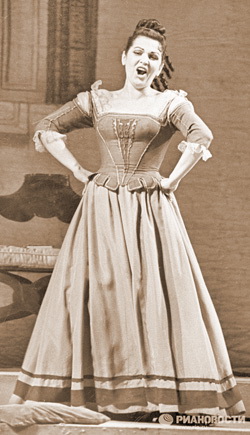
And in her anniversary year, she comes to Eugene Onegin at the Bolshoi Theater and sees: “The choir, like a herd of stallions and mares, laughs over how Onegin and Lensky quarrels. In a duel scene in a goat sheep, Lensky sits, Zaretsky snores a drunk on the couch. Lensky sings: “Where, where did you retire, my golden days of my spring,” and the aunts with dirty rags remove the floor after a booze, that is, the Larinsky ball. What is this? I shuddered. I could not fall asleep for two nights ... This is hooliganism. ” [ 4 ]
This is a description made by Galina Vishnevskaya herself.
"This is a fall in art, the fall of the nation"
| | | --- | | 
At the same time, it must be understood that she was not at all retrograde. The innovations were not alien to her. She was also ready for risky experiments and from time to time took part in them (one of the most noticeable - the main dramatic role in Alexander Sokurov’s feature film “Alexander”, which was shot in Chechnya).
However, Vishnevskaya was able to share innovation and militant mediocrity.
Small hooliganism on the big stage is explained very simply - the directors have no original ideas and the original high -level music attached to it. For this reason, a popular classic is used, on which shocking theatrical techniques are mechanically applied.
“It is much easier to put such a“ modern ”performance,” explained Galina Vishnevskaya, “and it is very difficult to make the classic: with interesting mise -en -scenes, without inventing anything on top, without preparing“ neighing ” - so that the orchestra is not heard. I think: what is happening is the fall of art, the fall of the nation, if you want. When Lensky sang: “Where, where did you retire ...”, I could not restrain myself, my tears flowed from humiliation that I see the artist in such a situation. He sings the divine, ingenious aria, and people walk around and they wipe some vomit around him ... ”[ 5 ]
Similar direct statements of Vishnevskaya could not forgive. Hence the Demarch of the Bolshoi Theater, on the day of the canceled anniversary of showing not something, but "Eugene Onegin" Dmitry Chernyakov.
This was a special savory - to wave in the face of the Vishnevskaya dirty mop with the “Blue of the Lensky” and thereby supposedly put Galina Vishnevskaya in place.
It is no accident that the response letter written by the Vishnevskaya general director of the Bolshoi Theater ended with the words: “Everyone has the right to decide where to celebrate his birthday. Some generally celebrate the anniversaries at home. ”
In general, Vishnevskaya unequivocally made it clear that her place is not in the theater, but in the kitchen.
It so happened that Galina Vishnevskaya all her life constantly wanted to put in place. Remove. Up to deprivation of citizenship.
From the first minutes of birth, it turned out to be superfluous.
“When I was born,” Galina Vishnevskaya recalled, “my mother looked at me and turned away:“ Take her, how ugly! ”
When Gale Ivanova turned six weeks, her grandmother took her to her grandmother, her father’s mother was Daria Alexandrovna Ivanova. With living parents, the grandmother called the granddaughter "orphan".
But this "orphan" already had a strong voice.
“I am only three years old, and my voice is like an adult,” wrote Galina Vishnevskaya in an autobiography. -I was born with a voice set by nature, and it was strange to hear such a strong breast sound, reproduced by the throat of a very little girl ... "Eye is black, the eyes are passionate, the eyes are burning and stop-a-a-A-S-SO ..."
In the summer, grandparents brought Galya from Kronstadt to the "cottage" - to the village. It was just a time of brutal collectivization.
So her first childhood impressions: running people, a scream, incomprehensible word “Herodes”, who seized the hem of roaring children, skinny horses, horned in a cart of pots, blankets, pillows, a copper samovar, which two healthy men tear out of the hands of a crying woman ... collectivization.
Many years later, when Galina Vishnevskaya and Mstislav Rostropovich will settle in their real dacha of disgraced Alexander Solzhenitsyn [ 6 ], then there will be nothing surprising in this. She did not know about the cannibalistic essence of the communist regime from books.
And 1937 Galina Vishnevskaya recalled in detail. And these details in Soviet times were completely impossible to publish, because the singer compared two regimes - Nazi and Stalin, whose mortal breathing she felt fully. And did not find a fundamental difference.
“As German children were taught to convey to their parents in Nazi Germany,” said Galina Vishnevskaya, “so in Russia they began to deliberately educate the generation of informers, already starting from school. No, even much earlier - in kindergarten ... First, voluntary informers appear in this atmosphere - the villains are the first to smell, where the wind blows, and the first to climb to the feeder. Then, at the Pioneer and Komsomol meetings, we are explained to us that we are surrounded by enemies, that we are obliged to bring about any suspicious situation to school or the police. Every denunciation is encouraged, informed from the informers - all the other guys should be equal to them. ”
"I am already a potential enemy of the Soviet state for them"
In the spring of 1942, the fifteen -year -old Galya was found depleted during the bypass of Leningrad apartments. She lay on the couch and could not rise.
By that time, she remained alone in Leningrad (her father served Kronstadt, in the food department, and her mother had left with her new husband before the war).
High art helped to stay alive. That art that avoids meaningless dirt and vulgarity. In any case, for the future soloist of the Bolshoi Theater, it was more important than a piece of bread.
It was especially inspired by the American film "Big Waltz", staged by the director Julesen Duvivier with the music of Johann Strauss in the processing of Dmitry Tsemkin
“I lived in some half-time,” Galina Vishnevskaya recalled the days of the Leningrad blockade. - The one swollen with hunger sat alone, wrapped in blankets, in an empty apartment and dreamed ... not about food. Castles, knights, kings sailed in front of me. So I go through the park in a beautiful dress with crinoline, like Militsa Coryus in the American film "Big Waltz"; The handsome duke appears, he falls in love with me, he marries me ... Well, of course, I sing - how she was in that film (I watched him twenty times before the war).
I did not even suffer from hunger, but just quietly weak and slept more and more. Only an eternal feeling of cold tormented when it was impossible to warm up with anything. ”
Blockade, hunger, front -line brigade, childbirth and death of the child, service, work. And, upon upgrading everything, the disease, which many considered the deadly: open form of tuberculosis. It was after the war, but the possibilities for treatment were minimal. Do not get drugs.
"Do not touch me, do not laugh, do not laugh! .."
It would seem that the only chance for survival was a murderous operation for the singer on a lung - to get rid of pneumothorax (gas accumulation in the pleural cavity).
The doctor has already prepared a tubular needle. Galina lay on the operating table. They wiped the left side with alcohol. In her head flashed: "Digging the lung is the end of singing, I can’t live without singing, then the end of my life ... It is better to die!"
At the last moment, Galina with a cry “Don’t touch me, don’t laugh, don’t laugh! ..” She jumped off the operating table and ran away.
It would seem that it was a certain death.
In fact, it was a faithful life for which a continuous struggle began.
Warm melted pork fat, honey with oil, 10 raw eggs per day, expensive medicines, which had to be chased in the black market.
The disease pulled back to the bottom, into dull hospital corridors, crowded with living people in gray robes, and great music called on the stage, where light, beautiful people and divine music.
Another test was waiting for Galina Vishnevskaya in 1952, when she entered the Bolshoi Theater - without even secondary, not like conservative education.
A gypsy came to the Bolshoi Theater (as she was called, referring to her mother - half a gypsy, half Polish), an opereta singer with seven classes of education.
She, contrary to the rules, seems to have already been accepted. The voice was stronger than education. Only the formality remained - to fill out the questionnaire in the personnel department.
“And then a knife slashed: Father! He has 58th-the enemy of the people! Stalin was still alive, and there was no such person in the country who would not know what the 58th article is. According to this article, millions of people were in prisons in prisons and camps. If they get to the bottom of the fact that my father is in prison under a political article, I can’t see the theater: I am already a potential enemy of the Soviet state for them. ”
The father, who quit her, was repressed. Galina knew about this for sure, but after some thought she wrote in the questionnaire that the father was missing during the war (“maybe they would not get to the bottom of the bastard”).
“A bullet flew out of there to the street,” Galina Vishnevskaya recalled. - A big theater! So, what are you, the “mighty colossus” ... You are standing on clay legs, and the insignificant dwarf hiding behind a cotton door can turn your neck with a light click. ”
Under the insignificant dwarf, Galina Vishnevskaya meant a faceless KGB officer, who determined the fate of large artists with a pink of pen.
At that time, the "insignificant dwarf" behaved humbly. Galina Vishnevskaya was admitted to the Bolshoi Theater.
"We do not recognize your right to an act of violence against us"
| | | --- | | 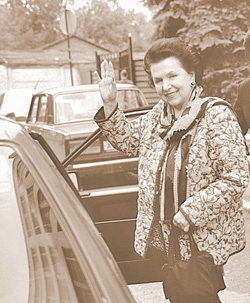
In March 1978, when Galina Vishnevskaya and Mstislav Rostropovich will be deprived of citizenship “because of anti-Soviet activity”, they will write a letter to Leonid Brezhnev, which began with the words: “Citizen Chairman of the Supreme Council of the USSR! The Supreme Council of the USSR, which you head, deprived us of Soviet citizenship. More precisely, you deprive us of the opportunity to live and die on our land, on which we were born and which we did not take away for almost half a century of our lives ... ”
As a result, the life of Vishnevskaya and Rostropovich was longer than the life of the Soviet Union. The CPSU and the KGB could not deprive the great musicians of the opportunity to die on their land.
“You probably think that they threw us into a landfill, where Rakhmaninov, Chaliapin, Stravinsky, Kandinsky, Shemyakin, unknown, Bunin, Solzhenitsyn, Maksimov, Nekrasov,” Vishnevskaya and Rostropovich Brezhnev in 1978, wrote. “In your power to force us to change the place of residence, but you are powerless to change our hearts, and wherever we are, we will continue with pride for the Russian people and with love for it to carry our art.”
This letter was a reaction to accusations raised by the USSR leadership against Mstislav Rostropovich and Galina Vishnevskaya. They allegedly “engaged in antipatriotic activities, defended the Soviet social system, provided financial assistance to subversive anti -Soviet centers, arranged concerts, fees from which they went in favor of white emigrant organizations.” [ 7 ]
As usual, the Soviet state did not bother to present any evidence, limited to propaganda plots in the media.
Some participants of that Chekist persecution of the mid -seventies are still in Russia with power (and with money), actively depicting patriots from themselves and, together with their students, looking for new victims. The methods in forty years have not changed at all.
Galina Vishnevskaya and Mstislav Rostropovich, referring to Leonid Brezhnev, announced: “We do not recognize your right to an act of violence against us until we have specific charges and gave us the possibility of legal protection against accusations. We demand a trial of us anywhere in the USSR, at any time with one condition so that this process is open. ”
Это было соперничество заведомо неравных.
С одной стороны – Брежнев и Андропов, умирающие вожди умирающего государства, а с другой стороны – Вишневская и Ростропович с их выдающимися талантами и бессмертной музыкой.
Официальным голосом СССР в то время был Брежнев с его заплетающимся языком. Куда ему было против голоса Вишневской?
Ни в каком страшном сне советские вожди не могли представить себе открытый судебный процесс. Открытая ложь – да, сколько угодно, но открытый процесс?
Клевета и удары исподтишка – это всё, на что был способен умирающий Советский Союз в борьбе с изгнанниками.
Бессильная огромная держава, лишающая гражданства своих лучших граждан «за действия, порочащие звание гражданина», была обречена.
* * *
В сороковые годы прошлого века Галина Вишневская, по ее собственному выражению, «вышла из месива недосягаемой и сильной». Недосягаемой и сильной. Такой она и оставалась до последних своих дней, прожив 86 лет.
У её бабушки Дарьи Александровны было две главные заповеди: не врать и не воровать. Об этом она своей внучке говорила постоянно. О том же Галина Вишневская говорила своим детям и ученикам.
Учеников у неё было много. В 76 лет Галина Вишневская создала в Москве на Остоженке Центр оперного пения.
Совсем недавно, в ноябре 2012 года, в Псковской областной филармонии с большим успехом выступил один из лучших выпускников Центра оперного пения Галины Вишневской баритон Сергей Плюснин. [ 8 ]
Галина Вишневская, когда речь заходила об оперном пении, постоянно обращала внимание на то, на что многие другие преподаватели внимания не обращают.
Голос, по словам Галины Вишневской, – это не только дар природы, но и нечто большее.
Голос – это опыт, голос – это те книги, которые ты прочел, это те чувства, которые ты испытывал. В общем, голос – это культура. Вокруг слишком много примеров того, как люди безропотно расставались со своим собственным голосом и переходили из света в тень.
Голос не дается раз и навсегда. Потерять его не так сложно.
Отсюда и неприятие Галиной Вишневской «бандитских постановок».
Певец, поставленный в неестественные условия, начинает петь неестественно. This is inevitable.
Прожив длинную и насыщенную жизнь, Галина Вишневская сохранила голос даже после того, как перестала петь.
Alexey Semenov
Сильная доля, тяжёлая доля (муз.), – в тактовой системе первая, метрически опорная доля такта, перед которой ставится тактовая черта. Регулярность сильной доли при неизменном тактовом размере – одно из организующих начал музыкальной формы.
1 Галина Павловна Вишневская (урождённая – Иванова; 25 октября 1926, Ленинград – 11 декабря 2012, Москва) – советская и российская оперная певица (сопрано) и театральный режиссёр, педагог, актриса.
2 Впервые изданная в 1984 году в США на английском языке, книга «Галина» стала бестселлером. Переведена на все европейские языки. На русском языке книга вышла в 1985 году в Париже. Получила несколько литературных премий. 24 октября 2011 года Галина Вишневская представила новое издание книги «Галина. История жизни», приуроченное к её 85-летнему юбилею.
3 Дмитрий Черняков – современный российский оперный режиссёр, лауреат премии «Золотая маска», обладатель премии Франко Аббьяти.
4 См.: И. Муравьёва. Клан сопрано // «Российская газета», № 4172 от 15.09.2006 г.
5 См.: И. Муравёва. Клан сопрано //, «Российская газета» №4172 от 15. 09.2006 г
6 См.: Л. Шлосберг. Страна без праведника // «ПГ», № 31 (400) от 6-12 августа 2008 г.; L. Schlosberg. Поворотный день // «ПГ», № 45 (617) от 21-27 ноября 2012 г.
7 См.: Редакция. «Идейные перерожденцы» // «Известия», 16 марта 1978 г.
8 См.: А. Семёнов. «Верни мне музыку» // «ПГ», № 47 (619) от 5-11 декабря 2012 г.