
Translated material
Self -combuster
Requiem on Boris Yeltsin
Requiem on Boris Yeltsin
On June 12, 1991, I voted for Boris Yeltsin in the election of the President of the RSFSR. We were 45 million 552 thousand 41 people - 57.30% of 79,498,240 citizens who came to the polls - 74.66 percent of 106,484,518 voters of Russia. For the first and last time, my choice coincided with the choice of most citizens of my country.
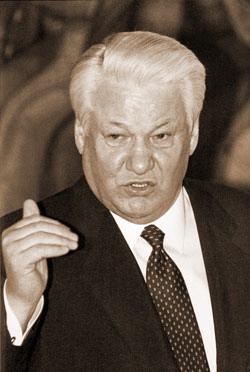
| | | --- | | 
Mikhail Gorbachev did not dare to hold direct elections of the President of the USSR. And he received the power of only several thousand people - deputies of the Congress of People's Deputies of the USSR. This was the beginning of his defeat.
Boris Yeltsin achieved the introduction of the post of president of the RSFSR, went to direct elections and won them. He became the first ruler in Russia, whose powers were saturated with the immediate will of the people.
The voters of Boris Yeltsin became a unique community of people.
These 45 million 552 thousand 41 people were a public base of reforms in Russia. These 45 million 552 thousand 41 people were ready to change themselves and change the country, part with a totalitarian structure, make their homeland a country suitable for a civilized human life.
And all these people at that moment believed Boris Yeltsin.
They believed the person who, in their eyes, publicly and consistently, parted with the communist past. Only a person who parted with the CPSU could become the leader of the new Russia, and Yeltsin did this by putting his party ticket on the table of the Presidium of the party congress. Nothing then talked about the imminent death of the Soviet machine. I am sure that at that moment he overpowered fear. And everyone (not even a member of the party), who watched these personnel on already free television thought: could I be the same? And - what should be done, how to act now for all those who do not agree with the CPSU?
There were no parties. There was the CPSU and was Yeltsin.
Now, when Yeltsin’s political path can already be comprehended at least in the first approximation, it is obvious that he fought all his political path with himself - a party bureaucrat, the boss, the iron gear of the slave -owned communist machine.
He anticipated his mission in an interpretation, but was not prepared for it. The whole previous part of his life prepared him for another path, and on this path he achieved a lot. And the abundance throw by him, a throw in search of the true path, which resulted in the result of the tragic consciousness that the path (more precisely, assigned to him by the system) is a path to a dead end, a road not leading to the temple, has become a huge inner shock for him. He began to free himself from the slavery of the system - to break, to collect again, to humanize. It was as if each bone pulled out each bone from his own skeleton and was looking for a new place, a new application. I think that he often hurts very often. Because, having freed human in himself, he could not help but learn to feel pain.
Boris Yeltsin, the first person to whom we deliberately delegated our right of representation, inevitably became part of the political creature of each of us. And everything that happened to him happened to us, inside us, with our conscience and our inner world. We saw everything that was happening to him, and we suffered with him, because for all those who voted for Yeltsin on June 12, 1991, it was - our Yeltsin.
Therefore, every time the first secretary of the regional committee and secretary of the Central Committee of the CPSU woke up in it, we suffered physically and morally - the particles of our personal political will handed over to us resisted every arbitrariness, each rollback, every retreat.
It hurt us, we were ashamed, as for ourselves.
He often lost than he won. And with him the country who entrusted him, the people, each of us, who believed him on June 12, 1991, lost. A year after year, he lost almost all of us. We stopped believing him.
Yeltsin itself was a field of political battle, and this battle went daily. Yeltsin had to fight every day, because he himself did not have the strength to stay at the height he had taken in 1991. A child of public will, he could not act without public support, just without oxygen. He lost this support very quickly, was left without air and suffocated all his subsequent years of presidency.
All eight years of his reign, he led this struggle with him almost alone, because almost no one withstood the wild tension of this battle - to fight Yeltsin for Yeltsin.
But there were more than enough wishing (and able) to manipulate Yeltsin on the psychological fractures. And they successfully dragged Yeltsin into political hell in front of the whole country. And the country with him.
I think the greatest tragedy of his life is also that he understood everything that was happening to him, understood that, in the end, he lost to himself yesterday. That he did not build democracy in Russia. He did not become what he intended to become. And until his last days he suffered from this, suffered and repented.
He put all his last political will into his last and decisive step: resigning and transferring power. He, who once defeated the system, was convinced of the need for an operation “successor”, was blackmailed by the collapse of the country. He would not be afraid of personal risks, the courage never cheated on him, but well -known all his fears calculated everything correctly: fear for the country and guilt for the mistakes made finally paralyzed free -thinking in him, and he agreed. Surrendered.
He somehow convinced himself that he needed to believe these people who flicker at the throne. Because he did not see anyone else nearby. And, probably, I no longer wanted to see anyone. He was very tired, the burden of power was already completely overwhelmed, and he parted with her, because he was simply afraid to accidentally drop it. He broke up, because there was no longer a trace of that huge and omnipotent public wave, which carried him to the highest point of the life path and made it the ruler of Russia. Nobody needed him anymore. Only your relatives. And he understood that.
Later he made only one attempt to speak out as a public politician: when his successor Vladimir Putin already returned the anthem of the USSR in 2001 and threw Glinka’s primordially Russian music aside. This anthem was his pride. This was his personal achievement of August 1991, it was a symbol of the new state, a symbol of his Russia. This return was a full shock for Yeltsin. He spoke publicly. Putin did not react. No way. The anthem was cold -blooded replaced. The USSR returned. And Yeltsin understood everything completely.
He was silent for all subsequent years, until his death. He was more than once blamed that he had never criticized Putin. Yeltsin was silent. He never supported Putin. And Putin understood this.
And the solemn, unexpectedly completely adequate and worthy farewell to the first president, a sudden, sudden, sudden and fleeting return to the long -casted all -Russian media of the words “Freedom” and “Democracy”, this is all a tribute to Putin Yeltsin, an impulsive and belated evidence that he still remembers what they spoke one by one for one on December 1999. And yet-clear confirmation that Putin himself wants him to once say goodbye to him, humanly. Still mortal.
Historically, politically, energetically, Yeltsin could not survive Putin. And he did not survive. There was no strength for this. Probably, he really wanted to survive to the new shift of the ruler of Russia. But he has not seen any prospect. And when the prospects are not visible, the light is not visible at the end of the tunnel, then it becomes absolutely no need to live.
But, I am sure that it was he, who renounced the throne after two terms of the reign of the last king of all Rus', who now holds Putin, the emperor and the autocrat, from changing the constitution and the third term. Because if Putin goes for a third term, then he will forever lose Yeltsin historically, go down in history as a usurpator and a coward. But after Yeltsin, not a single president of Russia can afford to do this. Even now, moving to another world, the old Yeltsin holds tightly by the sleeve of his successor that was untied according to the full program and does not let him in the last line, after which the collapse of the country. And Putin does not dare to disobey. After all, after some years you will have to meet. And which of the living knows what it is - a court of predecessors?
Boris Yeltsin knew that he was sinful, much sinful. And he did not hide this knowledge. His dying trip to the Holy Land is the last attempt to silence sins, ask for forgiveness, bring repentance. Not just before God - before His country, His people.
And God heard his prayers, and called him to Him. Because Boris Yeltsin did not have things left on earth. And the Lord will console relatives and friends.
Having freed his fantastic energy from himself and returning his fantastic energy to the world, Yeltsin provided the story of the opportunity to choose the heir to his genuine political will - the successor who was never found.
He will doze, looking through the half -closed eyelids beyond his greatest passion, his Russia - whether the one whom he could not find will appear, could not see, could not bless on the exploits and to correct his mistakes. Now he can wait a long time. The time on its watch is spared the hustle and bustle.
And Rostropovich will play him on the cello Stradivari.
Lev Schlosberg.