
Translated material
Boris Stepanovich
This April, Boris Stepanovich Skobeltsyn would have turned 80 years old. But for 5 years now he has not been with us. It is difficult to believe in this, if at all possible: there are albums, from the pages of which the ancient beautiful Pskov, seen by Boris Stepanovich, appears again and again, there are photos in the collection of our museum, there are entries in his personal archive, telling about dozens of architectural monuments.
Having lived in Pskov for four decades, he made so much effort to preserve and restore his architectural values, which is only possible for a person who was convinced of his rightness, the following principles contrary to all circumstances. He always - in any situation remained himself, and for this the right paid at the highest price. He left us 5 years ago. But thanks to his wife, Elena Ivanovna and daughter, Nadezhda Borisovna, our meeting happened - with Boris Stepanovich Skobeltsyn, architect, restorer, and photographer.
Nadezhda Borisovna
Looking at the photographs made by Boris Stepanovich, again and again, you ask the question: how did he manage to find the only point of shooting, thanks to which the corner of Pskov, the Church, the monastery ceased to be silent and began to speak with the viewer and to this day forced to reflect on the theme of eternal and transient, high and vain?
I searched, that's why I found it. Although, of course, the pope’s talent was undoubted. He was generally a man generously gifted by nature. In his youth he entered the Academy of Arts, but it did not work. And it’s a pity: it seems to me that studying at the Academy would become a good school for him. And so much he had to comprehend himself.
Painting was replaced by photography?
Not really. He began to engage in photography not by inspiration, but for working necessity. After all, each step of the restorer is fixed with a camera. And the attitude to photography as art came later. As a technician-architect, the father never received a lot of money, mother’s salary of a museum art critic also left much to be desired. The photograph in certain periods of life became an additional source of the livelihood of family. I would not want the impression that photography took a photograph for my father something like a slight hobby. All that he has achieved, dad owes exceptional hard work. He could see for hours, for days to look for the very point of shooting that you mentioned. And found. After the father, there was a huge photo celebration - at least 10 thousand already selected, ready to print personnel. And how many working options there were!
He only shot monuments, and only in Pskov?
Nothing of the kind. Pskov and its surroundings are only part of what the lens of his chamber, although large, stopped. But his landscapes seem no less significant to me. He was also fond of portraits, shot people known in Pskov and pretty to him. Maybe it is these works that open daddy talent to a greater extent than the types of Pskov. In any case, people turn out to be beautiful not only externally, but their inner world is transmitted to the visual series very brightly. Look: Father Zinon, Father Tikhon (rector of the Pechersk Monastery), Father Nikolai from the island of Zalit, architects Smirnov, Semenov, surgeon Skryabin, Maimin-scientist, museum workers of the first post-war years, cottage cheese, ...
But for some reason, it was this part of the heritage of Boris Stepanovich that remains unknown to the Pskovs?
One exhibition took place in the museum a year after his death. Something was exhibited before. Probably, the needs to submit these works on the display did not arise. You are right: although the father during his lifetime did not lack personal photo exhibitions, he presented mainly the types of Pskov, his environs, and other regions of the region. He traveled a lot, he seemed to know all any memorable and valuable corners of the Pskov land. Selecting his work for the next exhibition, he pursued a very definite goal - educational. He sincerely wanted his love for the monuments and beauties of the ancient land to be divided by the audience, touch history and left the exhibition that beauty needs human attention, protection and restoration. He spoke this language of photography. And his voice reached many, he was heard.
But with the departure of Boris Stepanovich, interest in his photographs somehow faded. Are you offended?
Firstly, I do not think so: another time has come, other opportunities have appeared for other modern photographers. And they are in Pskov, and I would like to hear new names, see their work. And secondly, I do not think that the activity of the father, his work is forgotten. Yesterday an exhibition of photographs - the types of Pskov from the collection of our museum -reserve, opened. I hope that closer to the date of his birth (April 30), I will be able to organize another exhibition that will introduce the unknown to most of the Pskovicians Skobeltsyn. I take landscapes and portraits for her.
Nadezhda Borisovna, your father’s work is shocked not only by the image, but also with a purely technical performance. Some of them are incredibly huge in size. How did he solve large -scale tasks to print such pictures? Did he have a special laboratory, did he resort to the services of professionals-photographs in the technological process?
Never. He printed all the photos himself, attracting as assistants to my brother. And he did everything without leaving the apartment - on a huge table, which occupied almost his entire room. He himself verified the recipe of reagents, he printed himself, he himself designed into the framework - all himself. This is also his character. He was a very independent person.
All his works are performed in black and white. Boris Stepanovich did not work in color?
No, I did not fundamentally do this, did not trust the color, believed that the paints in color photography look unnatural, distort reality.
Boris Stepanovich had so much strength to restore temples in Pskov and around him, but the churches became the heroes of his photographs. All this could not but affect his worldview. Tell me, was he a believers?
No, he did not consider himself a believers. Although he was not an atheist either. And he treated the temples as the works of Russian architecture, as the unique creations of a person’s hands.
Did Boris Stepanovich have a dream that was not destined to come true during his lifetime?
Yes, I know for sure what was. He dreamed of creating an architecture museum in Pskov. And not because he wanted glory, although dad was an ambitious man and, to a certain extent, he wanted fame, gratitude. The point is: in Pskov there were always architects who left a significant trace in the guise of the city - both in the preservation of the ancient Pskov and in its modern development. But there was no place where all the achievements of specialists could be stored in anticipation of their worship, where one could see and trace the path of recreation of a particular monument. I know that some personal archives of dad's colleagues after their death turned out to be simply ruined by the heirs: projects, sketches, descriptions were sold for nothing. Yes, of course it is good that there is a museum of the Spegalsky. But during the years after the war, he was not alone in Pskov, many other talented architects, restorers worked here. But which of the Pskovichi knows their names - the names of those to whom we owe the modern type of Pskov? The father imagined that the future museum could be located in the house of Pechenko or the Church of Nikola from the Usokhi.
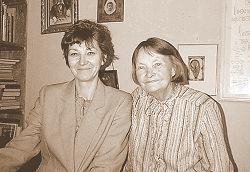
Elena Ivanovna
Elena Ivanovna, however, that Boris Stepanovich recreated the pedigree of Skobbletsi, and that the history of his ancestors goes roots in medieval Russia?
True - this kind has been known since the end of the 16th century. Boris Stepanovich worked on the tribal of 20 years. Initially, the aunt helped him - collected materials that mainly concerned the source of the genus. But the history of the last century and even more so the branches of the descendants who were abroad were recreated by Boris Stepanovich.
If we talk about family traits, what would you call among the main and characteristic of all Skobeltsyn?
Purposefulness in life and honesty in relations with people. These are strong personalities, persistent and - beautiful.
Everyone who knew Boris Stepanovich notes his absolute uncompromising in that concerned the preservation of historical monuments. Did you try to keep it from excessive activity, think about the consequences?
The time then - in the 60s - the terrible for monuments, especially the cult ones, under the Khrushchev, was simply ruined and physically destroyed under Khrushchev. Boris Stepanovich could not put up with this and protested with all available means. It was impossible to convince him otherwise. And I knew about it, I did not even try to influence. She knew that he is not the person who would listen to such requests and persuasion.
As for the photograph, Boris Stepanovich had students?
No. He did not seek to teach others. He was repeatedly offered to lead both mugs and sections, but he invariably refused. And not because he kept his secrets. It was just that he had no time to engage in public training, the impression that he tried his best to have time to make as much as possible. To stop, to be distracted from the main thing is not in his habits. Although he loved to talk about his work and did it wonderful.
How did you have an art critic to work with your husband?
But how. In the same 60s, a passport was created for each monument of history, culture, which includes absolutely all the characteristics of the object, ranging from the appearance and ending with precisely verified sizes. I remember, then we, together with Boris Stepanovich, amounted to about a hundred passports: a tremendous volume of work. I think that they are still stored in the center of protection of monuments as sources of the most reliable and complete information.
How did the work of Boris Stepanovich began as a restorer?
You need to see on his notes. All the years, without a break, he conducted a detailed diary of his work, a unique collection of information on the restoration of many Pskov monuments was unique. And by the way, in a word he possessed brilliantly, could well write some serious interesting things. Look, he began with the restoration of the wall of the roundabout city - from the Olginsky bridge to the Profsoyuznaya Street. Then there was a chapel of the casual of the Church of the Myrrh-bearer. The Cathedral of John the Baptist in the Ivanovo Monastery, the temple of Nikolai the Wonderworker from the mouth is one of the most beloved places in Boris Stepanovich: so much strength was invested in the creation of a restoration project and its implementation. He also participated in the study of the Monastery, which was then completed by conservation and partial restoration, worked in the Krypeetsky monastery, in the Volyshevskaya estate of the graphs of the Stroganovs ...
Is there a place in Pskov that Boris Stepanovich would especially love?
He loved the whole old city. Could go to the Kremlin several times a day to “catch” the necessary lighting. He loved the Mirozhsky monastery. But the Church of Nicholas from the boat highlighted specially. He believed that it was this temple in recreated form that most accurately represents the features of the Pskov architecture. Boris Stepanovich worked with students from Samara at his restoration and was proud that he managed to restore the interior of the ancient temple.
Elena Ivanovna, is there staging personnel in his photo archive, that is, those where the plot, composition, main images and secondary details are thought out in advance, are set in a given order and only then recorded in photographs?
No, that you, he did not work in this way: never put anything on purpose. He possessed the gift to see what was hidden from the usual gaze, as if things or people discovered something very important about himself alone. Maybe because his photographs are perceived by something more than an ordinary image.
And Boris Stepanovich himself loved to be photographed?
Yes, he did it willingly - and always turned out perfectly in the photographs.
Talked Natalya Bobrovskaya.
Photo: Natalia Bobrovskaya