
Translated material
A year has passed
The authorities in Russia in 2008 took advantage of the people once again and moved away from it at a distance of the maximum security for itself. But the crisis confused all the plans and revealed almost all the cards
The authorities in Russia in 2008 took advantage of the people once again and moved away from it at a distance of the maximum security for itself. But the crisis confused all the plans and revealed almost all the cards
2008, saturated with political, economic and social events in Russia, did not go completely as the Russian authorities saw him at the very beginning. He was supposed to be the next year of the Great Triumph, and was a year of great anxiety and even greater fears. The power was completely not ready for this. As a result, her reaction was completely inappropriate: first - to silence the problems, and then, when it was already impossible to hide what was happening - to blame anyone except themselves - in the hope that the people will once again “believe” and will not ask the authorities the only necessary question: then why are you? With all the consequences arising from this issue.
The election, so to speak
| | | --- | | 
1 To such a parliament, the corresponding president was also needed.
According to one version, Vladimir Putin at the last moment changed his mind to transfer power to a group conventionally called the “security forces”, whose head and the most likely candidate of the presidents from which Sergei Ivanov was considered until the last minute, and with the treachery of the mother intelligence handed over the “brothers of government” to Dmitry Medvedev, who had already entered the side of the television screens.
Sources in the Kremlin said that the “security forces” intended to master the power in full, “turnkey” - just as they master the federal budget and other financial flows. This intention, apparently, became fatal: Putin was not going to go to political peace, or be content with decorative functions, he firmly decided to remain the head of the country de Facto, for which a very special design of the authorities, which had never existed in Russia, became necessary: the actual dual power, when the president of the country, “voluntarily” reducing his political space, leaves the “national leader” and the leader and the leader ”and the leader The ruling party is any field for maneuver and the opportunity to take a direct part in resolving all the main issues of domestic and foreign policy.
So to speak the duet
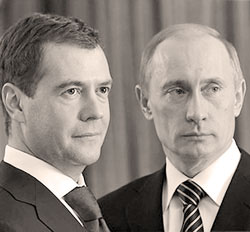
The design received the ironic name "tandemocracy". With this design, the balance of the authorities is kept on informal personal agreements of the first persons of the state and cannot be formalized: to submit an agreement between Putin and Medvedev about the “division of powers” and “additional restrictions” in certain issues - such a document does not and cannot have any legal basis; Moreover, such a document could not in principle provide for all possible situations of disagreements and contradictions, but, on the contrary, would make these disagreements and contradictions visible, which is absolutely unacceptable for the Russian ruling group.
Who is making the main decisions for the country now? For whom is the last word? How does this happen? One has a nuclear suitcase, does the other have the right to order? It is just dangerous. One has official law (and obligation) to form the country's foreign policy, and for the other - the real helm of the Ministry of Foreign Affairs? This is similar to the truth, given the volume of communication of the chairman of the government, responsible exclusively for domestic policy, with foreign correspondents throughout the last year. Foreign delegations are generally lost to whom and on what issues to go to the reception. They go just in case to both. This “Freud reservation” sounded at the federal television journalist who is sensitive to the trends of the time of the time: “President Medvedev and President Putin”.
The structure of power in Russia is becoming more and more (and painfully) similar to the Russian coat of arms: the double -headed eagle looks in different directions of the world. But the fact that can be considered an sophistication or a quirk of a heraldic style is fatal both in living nature (you just imagine a two -headed eagle) and in public administration.
So that there are no unnecessary questions (including the people), Putin and Medvedev try not to show at the same time in one place: so that it was not possible to compare how they sat down (one of the two in the chair of the chairman), who was the first to speak, who was more showed to whom to whom.
The meeting one on one at the beginning of the Russian-Georgian conflict, when Putin, who arrived from North Ossetia to Moscow,, out of habit of sitting from the “presidential side”, set all the relevant tasks before Medvedev, did not go without a trace for PRs: these persons are now communicating through the TV screen, as a rule, in absentia, so that at one time there was only one sovereign face in the frame. Miraculous tasks are solved by Russian state power due to the money of Russian taxpayers ...
Stability, so to speak
Such a configuration of power, even in a peaceful and calm time, would be risky, meanwhile the country had to pass the period of the most severe economic crisis against the backdrop of the complete stagnation of the political system. But at the beginning of 2008, the impression was created that the Russian authorities see the horizon extremely cloudless. Meanwhile, already on January 23-27, 2008, at the World Economic Forum in the Swiss Davos, it was recognized that the world economy was already experiencing a financial crisis, which was followed by economic. The Russian authorities pretended that this does not concern them (us).
Oil prices continued to rise in sky -high heights, above $ 150 per barrel, the involved authorities of the “analysts” aloud dreamed of prices above 200 and even $ 250, and accurately persuaded the expensive oil in every sense. All this would be ridiculous when it would not be so sad: in the conditions of the economic crisis, reduction in production and reduction of consumption, raw materials can only get cheaper. Namely, on the sale of raw materials, the entire notorious Putin's “stability” was held until 2008: the budget and other pockets of the state (the pension fund, for example) were filled with more than half oil and gas income, the country continued to sit on the raw material needle, and the authorities pretended and said that “stability passed into development”.
To manage falling from the sky (more precisely, crawling out of the ground) with money is important, but simple: to share-not to earn money, here the authorities will always be “in white”. But the "white" ended. Absolutely for them suddenly.
So to speak the chairman
The coming of Vladimir Putin was not at all the duty officer (but by that time for many years is purely technical), the post of Prime Minister very quickly showed a very serious thing: Putin cannot manage the economy. It cannot, because he does not know how. He does not understand her nature, her laws, her rules and customs, her habits. He-the embodiment and the first person of the new, modernized at the beginning of the 21st century, absolutely pernicious for the country, because for a long time not a modern administrative-command system-began to behave in the economy in the same way as in public administration: to order and shout. The economy heard, I quickly understood everything and crawled down.
Only the mocking and obviously he liked Putin’s phrase about the “message of the Doctor” to the owner of the company “Mechel”, if he does not leave immediately from the hospital and does not appear before the highest eyes to explain the issues of pricing, cost the campaign itself in one day of the capitalization, and this collapse pulled along the cattle of all the leaders of the Russian business, which was tormented publicly: Putin was Putin. It is demonstrated that the country is not just unfavorable, but critically unfavorable for doing business, a political climate. And this brings always and everywhere to one thing: to the flight of capital from the country. So against the backdrop of the approaching crisis, the Russian economy, and with it the whole country, received “acceleration” from the “national leader”. By the end of 2008, the outflow of private capital from Russia amounted to, according to official data from the Central Bank of the Russian Federation, $ 129.9 billion. This has never happened.
Statistics, so to speak
Meanwhile, both the leader and his partner in the political tandem, even in the summer, seemed to have not seen anything and did not understand anything. Only in this state could it be borne by the military conflict with Georgia, to question one of the basic principles of the United Nations - the principle of territorial integrity of states, vital, critical for Russia itself, and go to the recognition of the “state independence” of Abkhazia and South Ossetia [ 2 ], which have now hung with an unbearable burden on the weak budget neck of the Russian Federation.
After this conflict, it is impossible to talk about Dmitry Medvedev as a liberal. The war was successful for someone. The necessary political format of the president, in any case, was received in just a few days - faster than even in elections.
There were a lot of lies around this conflict - historical, military, political. But the largest and most cynical lie is a lie about losses among the civilian population. A suspiciously “round” figure of 2000 was voiced by even a shadow of confidence (including in the Kremlin), the puppet leader of South Ossetia Eduard Kokoita, with no less suspicious readiness, was picked up by the Russian official media, and this figure against the background of the “military picture” became the main “evidence” of the “evidence” of the Genocide of the Ossetian people. The fact that at the same time did not mention the Georgian villages in Ossetia and the ethnic Georgians who were killed there are another bloody silence of those days. But the Russian Investigative Committee processed the largest lies was revealed the largest lies: in December 2008, he announced the official results of the investigation: 162 dead civilians during the conflict in South Ossetia - from among the Ossetians.
The death of one person in the war is a tragedy. The death of 162 people in the war is 162 tragedies. But 1838 publicly falsified deaths in war are cynicism, provocation of blood and demonstrative neglect of the value of human life as such.
Where, by the way, reports on the restored from the Russian budget and collected by the whole world of charity assistance to Tskhinvali? Restored Ossetian villages? Silence. But it is known that tens of billions of rubles of Russian taxpayers who left Moscow, to the ordinary residents of South Ossetia, seduced by Russian citizenship in the peak of the Kremlin of Georgia, did not reach the peak of the Kremlin. Residential buildings are restored by the people themselves (it is also interesting at the expense of what money, but this is another question), construction companies say that they have not seen money at all, but they can’t work anymore. That winter has come. Russian gas in South Ossetia enters a pipe from Georgia - there is no other pipe. Georgia is no longer scolded. The theme is "worked out."
So who and what was this war for? These billions? And - the most important thing - for what and for whom were these irreversible human life - Ossetians, Russians, Georgians have now forever already given to the cynical sacrifice? Because it was these people who paid the largest, exorbitant and actually unjustified price for the only thing - the next public combination of imperial acne of Russian new glovers. Combed. To blood. Alien, of course.
So to speak a quiet harbor
The August war in Georgia, met with schizoid enthusiasm of the Russian imperials of all stripes, was fatally coincided with the peak exacerbation of the financial crisis: the collapse of the stock market, the collapse of the credit system, the drop in oil prices.
Everything was already clear, but the first persons of Russia began to pronounce incomprehensible phrases about the “world financial center”, “quiet harbor for investors”, “island of stability”, “the third reserve world currency” (the unfortunate ruble was meant). The secret remains the answer to the question whether the Lord himself believed in what they said. If you believed, then what information and decision -making are used to draw up an opinion, issuing assessments and decision -making? Who supplies them such information? And you don’t even know what is better - you believed or did not believe? What is more honest - to be deceived by yourself or deceive others? Or were they happy to be deceived themselves? Then what did you hoped for? What will resolve yourself? Or resolve by order? But, one way or another, everything said, if we speak diplomatically, was not true, but not to speak diplomatically, with stupidity. It was obvious to everyone who did not lose their heads from the very beginning. Including within the country. And this only worsened the situation of Russia. Both economic and political.
Dr., so to speak
When it was time to take inevitable measures to save the national economy, then the measures of the Russian authorities shocked the whole country. Because they exactly, on the contrary, corresponded to what you did at the same time (completely openly, you could read the press, watch TV, finally call the leaders of other countries on the phone) the entire civilized world.
Civilized countries set themselves one goal - to save the economy (business) and save the consumer (ordinary citizen). For this, they are reduced and continue to decrease to never previously not seen accounting rates of central banks - both national and European: the lower the center rate of the Central Bank - the lower the percentage of the interbank credit market, which allows banks to credit each other; The more accessibly, respectively, bank loans for economic entities, the more chances to maintain production, minimize workplaces, to prevent mass unemployment, preventing a collapsible fall in citizens' income and, accordingly, to maintain their purchasing power.
When the task is to survive, the smart and responsible government helps almost everyone - because either everyone or no one will be saved. The matter came to the betting rates at a level of less than 1%, which is lower than the official inflation level (in developed EU countries in annual terms it amounted to 1.8%) - that is, the merits on loans became negative. This led along with a decrease in fuel prices and an unprecedented decrease in inflation, and to reduce prices, which already saves consumers in a situation of partial falling of their income. And the consumption of consumption is the main condition for saving the economy. This is called - communicating vessels. This simple physical law acts both in the economy and in politics. It is well known and proved in practice.
What did the same in the same situation (and now it has the same) Russian government? The refinancing rate of the Central Bank has already exceeded 13%. The official level of inflation in annual calculus (which no one believes in) is 13.3%. Inflation of the minimum consumer basket on average in the country is more than 15%. The interbank credit market in Russia is a pile of ice congestion, and no atomic icebreaker “Arctic” will overcome them. Banks simply lay down with money. The real sector of the economy, which largely kept on lending and re -will, as well as partially on operations with securities, was in a stupor.
The “captains” of the Russian business reached the Prime Minister in Novo-Ogravo (where, according to sources in the government, Putin spends more time than at his workplace in the White House) and began to knock out budgetary assistance from it. Highborn. Help was provided. The amounts amounted to hundreds of billions of rubles. In general (including the support of several leading banks) - more than a trillion of rubles. As soon as the help took place, the following turned out: the banks were not given, they did not give loans to ordinary business entities, and the outflow of capital from a country where no one seems to have much money has grown many times - approximately the amount of assistance provided by the government. It was impossible not to find out about this. Putin found out. He even said something about the need to control the transfer of money abroad. But - not a single investigation, not a single criminal case, not a single named name. The question "Why?" It’s even somehow a shame to set. But on the other hand, they are not ashamed to do it. Moreover, it is not a shame on this background to talk about the fight against corruption. And even declare to the whole country that they are fighting with her. Who fights and with whom? - Not a single name.
But-the second wave of petitioners in Novo-Ogarsevo went. But there was no more money for them. And this “second” was simply said: go to NN, they already gave him, he will buy a package of shares from you, so you will survive. But buying a package of shares is a change of owner.
It is this process that is now in Russia-the process of colossal, unprecedented since the mid-1990s, redistribution of property against the background (using) the global economic tragedy, exorbitantly burdened by the cave Russian political way, which was adapted, and remains adapted in the economy only for one thing-“cut” budget and extra-budgetary money, withdrawal of someone else's property and the ownership of someone else ruin the rebellious owners. Yukos vaccination continues to operate. Business, unlike politicians, does not need to be repeated twice. The entrepreneur, like a sapper, is mistaken once.
Стало ясно, что единственной реальной целью действующей власти и оказывающих на нее полное влияние приближенных к ней и обслуживающих ее олигархов (а других в стране не осталось) является спасение собственных капиталов, личной собственности, шкурных подкожных запасов. At any cost. Если бы они были умными, то понимали бы, что в такой ситуации спасутся либо все, либо никто. Но корысть и жадность делают человека глупым.
В итоге все те процессы, на борьбу с которыми и должны быть направлены антикризисные меры, не сократились, а возросли многократно: ставки по кредитам растут, инфляция растет, ипотека убита, производство уже не падает, а рушится, безработица растет, как на дрожжах, реальные доходы граждан тают на глазах.
Так сказать деньги
Такого эксперимента над страной не выдержало, что совершенно при такой политике неизбежно, ее главное финансовое достояние – национальная валюта – та самая, которую еще три месяца назад собирались превратить в третью мировую резервную валюту. Угробив в топке бирж на ее бессмысленное поддержание десятки миллиардов из валютных резервов, Центробанк и правительство, начиная с 22 декабря 2008 года, планомерно и практически ежедневно опускают курс рубля по отношению к доллару и евро.
В чем выражается доверие к национальной валюте, к национальному правительству? В том, что граждане покупают именно валюту своей страны, в ней делают сбережения, в национальных банках хранят свои вклады. Доверие не может быть виртуальным продуктом. Доверие – совершенно конкретная экономическая категория. Вот и настал для российской власти в конце 2008 года момент истины, час правды. Это еще – не судный день, но массовая скупка долларов и евро – это доверие к валютам цивилизованных стран, за которые отвечают цивилизованные (то есть де факто, а не только де юре ответственные) правительства. Потому что в отношении российского правительства к российскому рублю отражается на 100% отношение правительства к своим гражданам, к народу, 99% которого получает зарплату именно в этих денежных знаках.
И получается, что даже на фоне разбухшей до чумных масштабов антизападной истерии Джорджу Бушу как главе государства граждане России доверяют больше, чем Владимиру Путину и Дмитрию Медведеву. И Федеральной Резервной Системе США, и Европейскому Центральному Банку верят больше, чем Центральному банку России.
Потому что граждане России понимают: если власти США угробят доллар, то американский народ сметет эти власти на первой же демократической процедуре, которая в цивилизованном мире соответствует своему изначальному названию – на выборах. А если власти стран ЕС угробят евро, то с ними произойдет то же самое. Immediately. На внеочередных выборах.
И даже арабские страны, ненавидящие «американскую военщину», не спешат переводить расчеты за нефть из долларов в другую валюту, как это предлагает Россия. Потому что такой валюты нет. И граждане России убедились в этом в очередной раз. Что весьма похвально для Соединенных Штатов Америки и стран Европейского Союза и очень печально для Российской Федерации. К слову, и пресловутый российский Стабилизационный Фонд хранился не в рублях, а на 40% - в долларах, на 40% - в евро и на 20% - в английских фунтах стерлингов. Ни одного процента – в рублях.
Так сказать послание
Speaking of elections. 2008 год, так уж распорядилась любящая «странные сближенья» история, подкинул гражданам России многосерийный приключенческий фильм «Выборы президента США». Фильм пользовался большим успехом и завершился крупным по американским меркам поражением действующей республиканской администрации: Барак Обама, демократ с темным цветом кожи, сначала победил на внутрипартийных праймериз ставленницу традиционной партийной бюрократии Хиллари Клинтон, а потом на самих президентских выборах – ветерана классической американской политики Джона Маккейна.
Буш очень хотел, чтобы его сменил преемник. Но американский народ решил иначе; он не захотел, чтобы политика Буша была продолжена. И Джордж Буш, президент США, спокойно и достоинством (это надо признать) подчинился американскому народу. Потому что другое в цивилизованной стране невозможно.
Словно будучи уязвленной этим явно неблагоприятным для себя сравнением одних президентских выборов с другими, российская власть организовала 5 ноября, на следующий же день после выборов президента США (фактически в ночь после американских выборов по часовым поясам), послание президента России к Федеральному Собранию. Послание президента России – это когда тысяча «избранных» в блистающем золотом зале внимает одному «самому избранному», заранее зная, где надо аплодировать.
Картинка из Кремля только усугубила печальные отличия от другой президентской процедуры. Но – мало того – именно в этот день власти решили объявить о том, что сроки полномочий Президента и Государственной Думы России должны быть увеличены с четырех до шести и пяти лет соответственно. Об этом объявили как о решенном вопросе, который не является предметом для дискуссии. То есть ответ властей России на кризис внутренней и внешней политики был – увеличение сроков нахождения у власти той группы лиц (это же для себя, это не для кого-то другого), которая этого кризиса – и внешнего, и внутреннего – колоссальными и многолетними усилиями добилась. Это примерно то же самое, что тушить пожар подкладыванием в огонь дров.
Даже в 1993 году, на фоне общенационального системного политического кризиса и глубокого провала в экономике, у властей России нашлось время и для многомесячной работы Конституционного Совещания, и для общенародного обсуждения проекта новой Конституции, и для экспертных дискуссий, и для всенародного голосования, которое при всего его известных статистических издержках, все же состоялось. А власть между тем тогда реально висела на волоске. И в стране пролилась кровь, в том числе невинных граждан. И денег практически не было, а были многомесячные долги.
В 2008 году информация о внесении изменений в Конституцию прозвучала как приказ, как тест на лояльность, как имперское и не подлежащее обсуждению решение. Это означает только одно – то, что современная российская власть боится сейчас народа больше, чем российская власть в 1993 году. Ибо современная власть знает цену своей «стабильности» и своему «развитию». И хочет, чтобы встречи даже с отформатированным за 15 лет народом на выборах происходили как можно реже.
То, что происходило после 5 ноября, иначе, чем общенациональным политическим позором, назвать нельзя: это был непрекращающийся в течение семи недель приступ публичной политической проституции во всех 83 субъектах Российской Федерации. Оказывается, президенту России не объехать страну за 4 года и не понять, как живет народ, а парламенту не хватает времени, чтобы вникнуть в суть законодательного процесса и рассадить помощников на места. То есть Путину дважды по 4 года не хватило, чтобы показать себя в полной мере, а если бы вместо 8 лет он правил 12 подряд, было бы в России счастье. Что это, если не глумление над народом и здравым смыслом? [ 3 ]
Так сказать правда
Ближайшее время покажет, кому и как достанутся эти дважды по шесть и сколько-то раз по пять.
Но 2008 год уже показал, лучше сказать, доказал, что ключевое слово в российской политической и экономической жизни – имитация. Имитация выборов, имитация полученной в результате таких выборов власти, имитация денежной системы, имитация управления экономикой, имитация уважения к народу.
Все, что не вписывается в эту имитацию, выдавливается за пределы официального политического поля. Только один российский телеканал (РЕН-ТВ) показал жестокий разгон специально доставленным из Подмосковья во Владивосток на самолетах (денежки в бюджете нашлись) ОМОНом мирных митингов протеста против повышения таможенных пошлин на иномарки в декабре 2008 года. Народ вышел на улицу сообщить власти, что отечественный автопром надо спасать не поднятием пошлин на качественные иностранные машины, а повышением качества отечественных машин. За эту простую, понятную и – главное правильную – мысль, высказанную публично, людей 21 декабря за волосы таскали по асфальту, били дубинками и ногами по голове. За их же – налогоплательщиков – деньги. И это не стало достойным информационным поводом для официального российского телевидения, в том числе существующего за счет налогоплательщиков.
Но правительство предпочло выделять деньги налогоплательщиков на то, чтобы стимулировать влезание гражданами в долги банкам при приобретении отечественных автомобилей ценой не выше 350 тысяч рублей. Цены на большинство российских автомобилей немедленно стали приближаться к этой планке. Без какого-либо улучшения качества. И никто – ни один – чиновник из правительства до сих пор не ездит на отечественном автомобиле. То есть себе – приличные автомобили (наверно, их от пошлин освободят), народу – неконкурентоспособный отечественный металлолом, за которым стоят не желающие ничего менять в экономике приближенные к правительству России лица. Кушай, Ваня, тюрю. Другой еды у нас для тебя нет.
Ваня кушает. Но начинает воспринимать уроки. Грубо сказано, но есть два способа понять происходящее – через голову и через другое место. Жизнь так устроена, что второй способ часто оказывается действеннее. И быстрее работает. В конце 2008 года он стал работать в России. Уже на следующем после 21 декабря митинге во Владивостоке совершенно логично прозвучали требования отставки правительства и лично Владимира Путина. Вот это уже похоже на цивилизованный подход к делу. А то – «по-прежнему слуги народные лучше хозяев живут». Зажились, однако.
Эти митинги тоже не показали по официальному телевидению, но у таких митингов есть свойство распространять информацию о себе, минуя контролируемые властью СМИ. И быстро распространять. Потому как почва становится благоприятной.
Так сказать праздник
По новогодним телепрограммам было незаметно, чтобы власть как-то отреагировала на первые перемены в общественных настроениях. Официальная картинка изо дня в день многосерийно и крупным планом показывала вполне успешных деятелей уголовного мира, которые на уголовной фене решали на виду у десятков миллионов людей свои уголовные проблемы. Подсознательно эта картинка считается властями, очевидно, наиболее комфортным отражением российской действительности, идеалом уклада жизни, в котором надо воспитывать народ, уважающий паханов и «правильных пацанов».
Логично, что одних паханов и «правильных пацанов» на телевизионном экране меняли другие паханы и «правильные пацаны», которые изображали на смурных лицах негодование украинским произволом (неправильными паханами и «неправильными пацанами», ненависть к которым должна занять все мысли телезрителей) и сочувствие «братским» европейским народам, но ни разу не вспомнили при этом про экономического ублюдка – удивительную посредническую структуру «РосУкрЭнерго», созданную в свое время при их же непосредственном участии для расчетов между Украиной и Россией за этот самый газ, обосновавшуюся немедленно не где-нибудь, а в славящейся налоговыми преференциями и закрытыми для посторонних глаз банками Швейцарии и получающей многомиллиардные (в долларах, конечно), прибыли. Намного большие, чем сумма украинских долгов. Структура выглядит как классическая финансовая «прачечная». Рано или поздно мир узнает имена ее реальных бенефициаров. То-то будет шума…
Без так сказать
А пока российские власти продолжают производство имитации. Имитации заботы о гражданах, имитации ответственности за судьбу страны, имитации уверенности в себе.
У этой имитации – очень дорогая цена. Эта цена – здоровье и жизнь страны, от граждан которой скрывают реальное положение дел, скрывают правду о политике и экономике, скрывают правду об окружающем страну мире.
Это не может длиться вечно. В ХХI веке это не может длиться долго. Это закончится не потому, что кто-то этого специально захочет, а потому, что по всем законам экономики и политики эта система нежизнеспособна – ни в спокойной, ни в кризисной ситуации. Но кризисы хороши тем, что помогают людям быстрее думать и лучше понимать происходящее. И тогда появляется шанс на то, что на смену имитации придет реальная жизнь – трудная, но честная.
Прошел один 2008 год. 366 days. Но это был очень важный год для понимания сути и цены происходящих в нашей стране событий. Этот високосный год, забравший с собой многих людей, бывших честью и совестью страны, всего ее народа, уже заставил и еще заставит многих граждан (возможно, кого-то – впервые в жизни) задуматься о цене вранья и о цене согласия с враньем. И о готовности народа России и дальше платить эту цену, отдавать эту дань.
Мы стали на один год ближе к правде и к свободе. Потому что, когда мы плутаем, мы все равно идем по этому пути. So the world works. Даже если сейчас многим жителям России свет в конце тоннеля кажется светом фонаря летящего прямо на нас неуправляемого поезда.
Lev Schlosberg
1 See: L. Schlosberg. Что случилось с Родиной и с нами // «ПГ», № 48 (367) от 12-18 декабря 2007 г.
2 See: L. Schlosberg. Кавказские пленники // «ПГ», № 34 (403) от 27 августа – 2 сентября 2008 г.; L. Schlosberg. Понуждение к безумию // «ПГ», № 36 (405) от 10-16 сентября 2008 г.
3 See: L. Schlosberg. Обращение к источнику // «ПГ», № 50 (419) от 17-23 декабря 2008 г.