
Translated material
The boundaries of the dispute
The Governor of the Pskov Region Andrei Turchak is forced to refuse to force the approval of the borders of the security zones of the Spaso-Eleazarovsky Monastery
The Governor of the Pskov Region Andrei Turchak is forced to refuse to force the approval of the borders of the security zones of the Spaso-Eleazarovsky Monastery
On September 3, 2009, the second meeting of the Public Council on the protection of cultural heritage under the governor of the Pskov region was held. “We are all happy that the council gathered a second time, is a rare case,” the Patriarch of Russian Archaeological Science did not fail to celebrate, Professor Anatoly Kirpichnikov, who, during the first meeting of the new organ, complained about the fragility of such formations [ 1 ]. Meanwhile, already during the second meeting, members of the Council managed to make significant contribution to the consideration of the scandalous question about the project of the protection zones of the Spaso-Eleazarovsky Monastery.
| | | --- | | 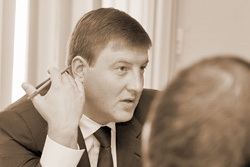
2 As for those who unleash the discussion, without waiting for “individual hearings”, they were subjected to derogatory criticism from Mr. Turchak, who said: “All these discussions are premature, and I have been interpreted in such a way that this once again made certain political forces to show my anti-citizenship position, nothing more.”
Thinking a little, Andrei Anatolyevich decided to put the points on the “i”, perhaps fearing that representatives of the cultural public far from politics would not immediately understand, who he was talking about: “When it comes to the improvement of the city, these forces, political parties would better take the lawnmands, brooms, went to their communist subbotnik, put the city in order.”
"The head of Professor Dowell, attached to what is incomprehensible"
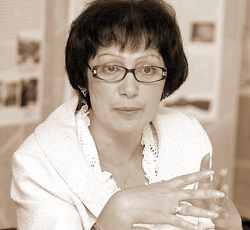
After that, the meeting of the Public Council returned to the working direction. The first to the report on the problems of preserving the historical and cultural heritage of the Pskov region was the director of the state institution “Archaeological Center of the Pskov Region” Elena Yakovleva. “While we are acting on hot spots, on some conjunctural issues,” Ms. Yakovlev complained, adding that “the issues of preserving the cultural heritage should be systematic” and that “the public council should approach this in terms of developing systemic, conceptual, provisions, programs and plans of action.”
Elena Aleksandrovna entered into a polemic with the adviser to the Governor on Culture Igor Gavryushkin, at the first meeting of the Public Council of the members who called him to forget about the word “problem”: “I think that it is necessary to manage the problem, break it into tasks, and try to solve them,” said Ms. Yakovleva. Moreover, in her opinion, “there is nowhere to retreat further, you need to make a decision: either to forget about this historical and cultural heritage, or take on it, try to save, use, popularize-you need to do something with it. It just physically ages and loses its appearance! ”
Having said this, the director of the Archaeological Center of the Pskov Region began to list numerous problems facing the defenders of the historical and cultural heritage. The most important of them, in her opinion, is the imperfection of the regulatory framework: “The existing law [FZ-73“ On objects of cultural heritage (historical and cultural monuments) of the peoples of the Russian Federation ”-Ed.] Withstood ten resections-there are rarely such laws! Hands, legs, tongue, and head cut off him - now it is generally the head of Professor Dowell, who was not clear about what. They open food somewhere, then they are closed somewhere, but he cannot do anything. ”
According to Elena Yakovleva, the federal law “not like that, he is not able to manage the situation in this area at all. We are promised that a new edition will appear, we very actively participated in the discussion of this bill, made a lot of proposals. While the question is hanging in the air. We follow the path of editing, and, of course, we need a new law, ”Elena Alexandrovna summed up.
In addition, the archaeologist emphasized, “the law on archaeological heritage is very important and timely. Archeology is, among other things, the Earth is also. And the 73rd Federal Law considers cultural heritage objects primarily as real estate objects-this is already dangerous in itself. ”
Developing the topic of legal vacuum in matters of preserving the historical and cultural heritage, Ms. Yakovleva emphasized that there is currently no connection between 73rd law and industry legislation: “For example, cultural heritage objects are not taken into account at all, and 70% of the mounds are in the forests. There are ancient monasteries and settlements. ”
At the regional level, in her opinion, the new law of the Pskov region “On the Protection of Cultural Heritage”, as well as the by -law base taking into account local specifics and interagency regulations, is urged. “And then the Construction Committee or, for example, for nature management, is not very interesting to our decisions,” Elena Yakovleva led the example. “Because there is no legislative basis for interaction in matters of preserving the cultural heritage, and officials who say: we understand, of course, as citizens, we agree, but we have no grounds for action.”
An equally important task, in her opinion, is the development of a regional system of approvals and permits: “It is necessary to prescribe clearly and intelligently what stages the urban planning documentation should be held, design. Because the existing law allows everything that is happening now. Our projects have been going on for a very long time for different instances, the project documentation has no criteria: maybe this, and maybe that way, ”said Ms. Yakovleva.
| | | --- | | 
"It will be endless!" - Anatoly Kirpichnikov expressed his opinion. “Maybe this was so conceived,” Elena Yakovleva agreed with Matr.
Given this, Ms. Yakovleva expressed the idea that "the Pskov region with its richest heritage needed a special authorized body in the field of protection of monuments."
At the same time, the director of the Archaeological Center did not advise excessive expectations to this body: “He will not solve all the problems. And we will say in a month in a month: so what has changed? Can these seven to five people do something? - She outlined in passing the possible staff of the future structure. - They cannot. But, nevertheless, the targeted area of activity will be, and the results will certainly be. ”
“Everything is clear with financing ...”, Ms. Yakovlev did not even dwell on this hopeless issue, proposing, however, “in the city of Pskov, try to pilotly conduct the corporatization of some socially significant object or event, try to attract folk money. This may not give an economic effect, but it will be indicative. Or maybe it will give some means ... ”, she suggested.
The “outdated information base”, which are forced to use cultural defenders, deserved a special mention. “The monuments are not taken into account anywhere, we do not know whether they are, or no longer. The last inventory was in 1990. By law, it should be carried out every 4 years. The federation finances no more than 20-40 monuments every year. The pace of study of five and a half thousand objects of cultural heritage of the Pskov region is clear to you - we will be engaged in these decades, ”said Ms. Yakovleva a frightening perspective.
The reason for many troubles, according to Elena Alexandrovna, lies in the activities of a "powerful construction and economic lobby." “It is clear that the development of cities is very important, but still there is a golden middle,” said Elena Yakovleva in the hall, whose windows overlooked the notorious “golden embankment”, on which “interests of development” just entered into an irreconcilable fight with the interests of the protection of cultural heritage. - “Our task is to defend the interests of the monument. The task of the developer, investor is to take into account these interests. ”
However, the efforts of lobbyists from construction, according to Ms. Yakovleva, can be opposed to the lobbying of scientists: “We are in a unique situation: the first person of the administration of the Pskov region says that it is interested in resolving these issues,” she said. “Administrative support is very important, and we need to use it.” “First Person” did not argue with the voiced thesis.
Elena Alexandrovna ended her speech with a question, “about which everyone is bashfully silent: about the transfer of objects of cultural heritage of the Russian Orthodox Church. The question is absolutely logical, absolutely fair, ”she said. “In my opinion, for believers, this is the only way to preserve the shrines, and for atheists it is also a way of preserving cultural objects, because they have an owner.”
“I think here you need to go to meet each other more actively. It is necessary to create a permanent meeting with representatives of the diocese. It is necessary to exchange opinions, develop some typical requirements. When the owner appears, he does not know where to start, where to go. He reads the law, goes to the offices where very long speeches are told, and in the end begins to act himself, ”continued Ms. Yakovleva. The abbess of the Eleazarovsky monastery, the abbess of Elisaveta, who was sitting nearby, with all her appearance expressed full consent with this thought.
"For these crazy ones, it’s easier to look inside"
Andrei Turchak was clearly impressed by the volume of problems posed to him. As for the federal law, the governor promised, "we will try to reach the federal level - we will use both our deputy corps and senator." The head of the region also agreed with the need to develop a regional bill, recognizing that this is "of course, the issue of a nailed", since "such an area as Pskov can not exist without this law."
As for the new regional structure designed to act in the field of protection of the historical and cultural heritage, Mr. Turchak promised to present it to the next meeting of the Council.
Expressing Ms. Yakovleva’s gratitude “for the idea that we must reckon with the church in matters of protecting the historical and cultural heritage”, the abbess of the Spaso-Eleazarovsky monastery hastened to speak out on this occasion.
Mother Elisaveta complained that “complete confusion in the laws, complete irresponsibility of state power leading to deplorable results,” and, remembering the good word of the employees of the regional scientific and practical center for the protection of monuments and Rososhranulture (“These people helped me to defend myself from all kinds of shopkeepers, merchants ...”), complained:), complained:). “Today, there is no one to protect our holy monastery ... We now have a store of Pskov Raipo at the historical congress to the lake.”
The governor, on the rights of the moderator, tried to avoid the consideration of the next “point problem” on the council, but the abbess insisted: “I ask for advice: to stop this construction, or after all ...” she said.
Let's take it like this: with God's help, you do not have this store on the territory of the monastery, ”Andrei Anatolyevich tried to console the abbess.
You know, it’s better for me now that it is on the territory, because these crazy people are easier to look inside! - retorted Mother Elisaveta.
This is a different concept ... - the governor was surprised, - the first time I hear about it ... The store is being built, and it should be built. The fact that it is not on the territory of the monastery is our common victory. And if there is something wrong with the design, then you need to correct it, ”said the head of the region.
It is built on the facade of our building and blocks this facade! - the abbess did not let up. “But no one agreed with us!”
Mother, do you have a project of zones approved? Approved?! - the governor could not finally stand it.
Not approved ...- Igumen was forced to agree.
All. The end of the conversation! -Resolutely set the point of Mr. Turchak.
| | | --- | | 
The question arose of whether it was possible to involve the work on the restoration of the Poles Tower, who wished to provide assistance to the city, which the troops of the Polish king Stefan Batoria unsuccessfully besieged four centuries ago. “Why not jointly build with the Poles? We would help them build something ... And then, the recent performance of Putin together with the angel Merkel, when they said that they needed to understand and forgive ... ”, - architect Vladimir Shulyakovsky suggested. But his colleagues were adamant: “You know, this business seems to me to restore it on his own ...” said Inga Labutina.
"So it is decided - we restore the tent ourselves!" - the governor summed up a short discussion.
“As an alternative to the Poles ... Cossacks came to me!”, Elena Yakovleva said, causing a friendly laughter. According to her, representatives of the Pskov Cossacks want to erect a monument to their first chieftain, who died in a battle with the army of Batoria. “It is difficult to erect a monument in our city, and maybe not. But to take part in this case, including financially, of course, they must be attracted, ”Ms. Yakovleva suggested.
But the governor was not at all located like this, immediately, to share the glory of the restorer of the Pokrovskaya tower with some sown Cossacks: “Believe me, as soon as the tower appears, the circle of these people will be inexhaustible!” He said confidently.
"I am interested in what they will write then?"
Finally, the members of the council approached the discussion of the issue of the project of security zones of the Spaso-Eleazarovsky Monastery. Recall that this document was submitted to the court of deputies of the Pskov Regional Assembly in June 2009 and summoned a real scandal: the people's chosen ones saw a lot of legal errors and logical contradictions in the bill, and only a link to the governor, who, according to the officials of the regional administration, personally asked to solve the issue positively, forced them to accept it in the first reading, creating a working group for elimination of inconsistencies [ 3 ].
The speaker on the issue was Irina Golubeva, the chairman of the Pskov Regional Branch of the All -Russian Society for the Protection of Monuments of History and Culture. Ms. Golubev briefly told the history of the document under consideration: in 2003 it was fulfilled by the very respected workshop in the Russian scientific world of Vladimir Kesler of the Moscow Institute of Special Project stress.
The authors developed a project of security zones as part of the security zone, the regulated building area and the zone of the protected natural landscape with a total area of 3077.5 hectares. At the beginning of 2005, the project was considered by the experts of the Ministry of Culture, who recommended that the Spaso-Eleazarovsky monastery be applied to the status of a landmark place and expand the boundaries of the landmark place, taking into account the new objects identified by the project.
“I must say right away that here there is a moment of contradiction in the project,” Irina Borisovna agreed. - Since it was not ordered by the culture committee, but directly by the investor and the monastery, then, of course, the designers took into account the interests of the monastery. Therefore, in the list of objects they identified, they wrote: "Holy Historical places." I must say that such a “holy historical place” as a “forested” or, say, “fields in the village of Zalnichye”, of course, cannot be objects of cultural heritage. This list requires adjustment, ”said the chairman of the Pskov Vopiyk.
“After the examination, the project was considered by the federal methodology and adopted,” continued Ms. Golubev to state the history of the project. - In fact, the same remarks were given. The recommendations were partially made. The boundaries of the landmark place were determined, but it continued to remain the territory of the monument. ”
The last remark demanded more detailed explanations: “The territory of the monument is a land plot, a single monument with itself. This territory should eventually enter the cadastral plans. A delighted place is a legal concept. It can have its own boundaries, but in it, as a subject of protection, individual objects are considered with its territory. Thus, a delighted place in itself is not related to cadastral land accounting, ”Irina Borisovna tried to explain.
According to her, “since the Federal Council always advocates increasing the size of the security zone, he decided to recommend the external boundaries of the protection zones for coordination. On the basis of this decision, Rososhranchkulture in August 2005 issued an approval for security zones and cultural heritage objects ... Museum-reserve included in the museum. "
Irina Golubeva could not explain the last fact: “If this is a technical mistake of Rososhran culture, then it just needs to be replaced. But I am interested in what they will write then? “Objects that make up the monastery”? No, because the monastery in this case is not transferred to the security functions, they lie on the culture committee, ”she spread her hands.
Впрочем, констатацией факта г-жа Голубева не ограничилась, предложив два варианта выхода из ситуации: «Переработать проект с учетом пожеланий депутатов, - хотя я пока не знаю, какие у них пожелания, страхи и предложения. («И есть ли они!» - подали реплику из зала) - Тогда можно уменьшить границы охранной зоны. Она сейчас расширена даже по отношению к историческим границам монастыря, хотя их возврат не являлся в данном случае задачей.
Второе предложение - учитывая, что проект прошел экспертизу и федеральный совет, принять за основу предложенные границы охранной зоны, но присвоить этой территории статус достопримечательного места, внутри которого были бы отдельные объекты охраны».
| | | --- | | 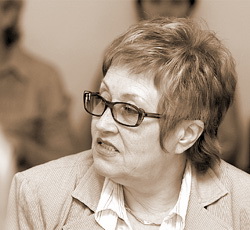
Та была вынуждена оправдываться: «Архитектор проекта уже не работает в мастерской, документация в электронном виде утрачена… Официальный ответ «Спецпроектреставрации» такой: вносить изменения в этот проект нельзя! Если он нас чем-то не устраивает, надо заказывать новый».
При этом, заявила председатель комитета по культуре, «в областном Собрании как раз с границами никто не спорил. Предлагаю этих вопросов не касаться. Мы имеем документ, серьезно сделанный ведущим научно-исследовательским институтом России, со всеми необходимыми согласованиями. Мы должны найти возможность решения юридического казуса: привести в соответствие наименование основного документа с тем, что мы выносим в повестку дня областного Собрания».
План, предложенный г-жой Ивановой, выглядел следующим образом: 10 сентября внести две новые статьи в действующий закон Псковской области о «О государственной охране и использовании объектов культурного наследия» и сразу же после этого распоряжением администрации включить монастырь с список объектов культурного наследия. После чего на очередной сессии 25 сентября рассмотреть и утвердить проект охранных зон.
Пока что же Зинаида Иванова обратилась к членам Совета с просьбой «вместе поработать над формированием создания позитивного общественного мнения по этому вопросу».
Но Андрей Турчака такой темп работы не устраивал. «Пусть рабочая группа собирается хоть завтра, хоть в субботу, - они отдыхали все лето, - чтобы все эти вопросы были рассмотрены до моей встречи с фракциями. Дальше они принимают поправки, идут по повестке дня, я за это время подписываю распоряжение, и в конце сессии мы принимаем проект охранных зон. Возможно это?» - поинтересовался он тоном, не подразумевающим особых вариантов. «Мы готовы к этому!» – с несколько преувеличенным оптимизмом поспешила ответить г-жа Иванова.
Правда, эти планы пришлось тут же подвергнуть корректировке: заместитель председателя ВООПИиК Лев Шлосберг напомнил, что законы области вступают в силу лишь после их опубликования, а, следовательно, спешка ни к чему не приведет: «Нужно ли нам фиксировать содержащиеся в проекте ошибки? Надо оценить риски, которые могут возникнуть при форсировании решения данного вопроса», - предложил он.
В результате, губернатору пришлось скрепя сердце согласиться с необходимостью отложить принятие законопроекта об охранных зонах монастыря как минимум до конца сентября, когда состоится очередная сессия Собрания депутатов.
Maxim Kiselev
1 See: M. Andreev. Brick on the lack of culture // "PG", No. 27 (448) of July 15-22, 2009
2 See: M. Kiselev. Стой здесь! // «ПГ», № 33 (454) от 2-8 сентября 2009 г.
3 See: M. Kiselev. Transportal movement // "PG", No. 25 (446) dated July 1-8, 2009