
Translated material
Witnesses of happiness
This exhibition, which has just ended in the hall of the Union of Artists, leaves a strange double feeling. Rather, many - often mutually exclusive - feelings. Surprise of a miracle and despair. Joy and heart pain. Higan sadness and enlightenment.
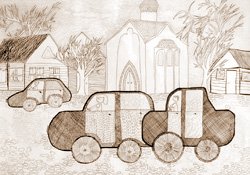
When children are drawn, it's great. It is touching and everyone likes it. Glorious pink -cheeked kids with brushes and pencils. Naive stories: mom, dad, airplanes, boats, animals, princes and princesses ...
Dear and prosperous, happy world of childhood.
When sick children are drawn, it hurts right away. Just because you know - these children are sick. Because it is terrible when children are sick.
The exhibition in question is called "such our summer." Almost 250 works are presented. Technique - watercolor, painting on fabric, origami, paper plastic, modeling. Genres - still life, landscape, portrait.
The authors are children. Hoply sick, no matter how terrible to realize, children. Children with disabilities, patients of the Korytovsk Center for medical pedagogy and the Rourtal school. Many cannot walk, cannot explain themselves, cannot play with peers. Their life is very difficult. It is impossible for us, “normal” people to imagine how difficult their lives are.
And the impression of the exhibition - as if he had been in a sunny and kind country. As if I had heard a good glorious joke. As if I saw a happy person.
* * *
For many weeks, since I read the "Dictionary of Regional Slang", I still can’t get rid of an unpleasant memory. There are many sad things, but I can’t forget one thing. As a knife in the heart was slaughtered by the fact that, it turns out, someone calls the Korytovsky center “Down-House”.
Human meanness is multifaceted and unlimited, but its most disgusting manifestation is a mockery of the weak and mockery of the sick.
In Nazi Germany, disabled people were poisoned by gas as “inferior” - they do not benefit Reich. In the Soviet Union, they were hidden in shelters and a special detention center - they do not bring benefits, they cannot be cured, too, too. Well - and remove from sight.
In our modern "normal" world, we suffer them, but we do not want to notice them. It is unpleasant to see a cripple, an unhappy, patient, not like me. Put alms and turn away - what else can I do?
And another vile question: what can he do for me? For society?
Much.
* * *
He may not be able to walk, run, jump, speak, hold a spoon in his hands. But always - always! - This is a person. And he is capable of, necessarily able to be friends, love, rejoice, laugh, be sad.
"I may not be so smart, but I have a heart." There is a heart. And, here it is, this heart - a good, soundless, children's heart - makes a person a man. And the world of this person is beautiful.
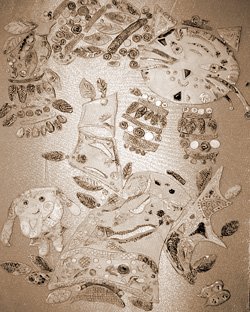
How beautiful the drawings of sick children are. There is a sea full of bizarre fish. There are funny clowns. Funny car, from which funny faces look around the streets there. There, countless cats sit at countless pipes on tiled city roofs, and it shines the moon, similar to the jewel.
Art is a document of the soul. A mirror in which a pure soul is reflected. Parchment on which a kind soul testifies to itself. And, in contact with such an art, one cannot but become better. It is impossible not to leave, without changing, from this exhibition, because it testifies to the best, pure and good world - the world of “sick children”.
Strange, paradoxical, but it is. And I came there tired and embittered - and went out, smiling and thinking about the good and his beloved. This amazing exhibition remained behind - as an inexhaustible well. Because the heart, shared by joy, will not be impoverished.
That's how they benefited me - these “sick children”, this “burden of society”.
And there are a lot of heartless wise men and jokers: turn on the TV, or look on the Internet. But are they pleasing to someone?
And-another question: who is really normal? Whose world - ours or these children are more correct?
* * *
I will not list the names of the authors of the work here - there are many of them, so it is impossible to name everything, but I do not want to distinguish anyone. Those who organized, arranged, defended, in a word, made this miracle possible, also a lot - in Russia and Germany, in Pskov and Westphalia.
And this is a miracle, a very difficult miracle, because in order to teach these children to draw so that they, with the help of colors, brushes, colored paper, scissors, can share the treasures of their hearts, teachers had to learn to understand them themselves - and many of them, I can’t say, hear, it is very difficult for them to move. For two years, training lasted, two years teachers and students learned to hear and understand each other before these drawings, figures, collages were born.
Before it became possible thanks to art to see the light that pierced a pure and happy soul.
The soul of a sick child who often can not even walk and speak. And this light testifies to the other world - the best and happier than ours.
Yuri Strekalovsky.