
Translated material
They returned
New Exposition in the exhibition hall of the regional center of folk art
New Exposition in the exhibition hall of the regional center of folk art
The hall on Nekrasov, 10 after some break, again pleases the non -banal and cognitive exhibition. This time-the author’s collection of the decorative and applied art of the Seto nationality, collected by Tatyana Ogarva, the mistress of the Private Museum of Seto, located in the village of Sivi in the Pechora district.
| | | --- | | 
A teacher of a music school from Leningrad, she moved to Siberian - a deaf village in the Pechorsky district. It was two dozen years ago, and then the village was inhabited. Residents almost did not speak Russian, led an amazing way of life: the men worked in the field and in the gardens, women walked behind the cattle and spun, there were traditional clothes, dishes and jewelry, folk songs sang on holidays.
Such a life, radically unlike the collective farm reality of the late Soviet Russian village, struck the visiting. It turned out that Sivov was part of the zone of compact residence of the Seto nationality - an amazing border phenomenon, the Finno -Ugric people who, in the language of the Estonians close to the Estonians, but who accepted Orthodoxy and thereby determining his fate and identity on the border of the cultural worlds - Russian and European, Orthodox and Protestant, traditional and modern.
At first, the inhabitants of the village reacted incredulously to the new neighbor, but over time, the ice melted. Life and communication began to improve. However, new times have come, neighboring Estonia proclaimed independence, the border and program of the migration of the set on that side appeared. First, the young left, then they took those who were older to them. The once flourished and crowded village in a matter of years was completely depopulated.
And when this happened, Tatyana Ogarva realized that a whole world collapses in front of her eyes, that these houses, empty, would never come to life if they do not preserve the memory of their original, generic inhabitants.
| | | --- | | 
About the collection of Tatyana Ogaryova, about the unique private museum, which was opened by her in Sigovo, where she has now left alone, a lot has been written. They wrote newspapers, took off television. The collection is rich and representative, the exposition is the original and artistically self -valuable: the fact is that genuine ethnographic objects are combined into complexes, the basis, semantic rod whose souls are specific people.
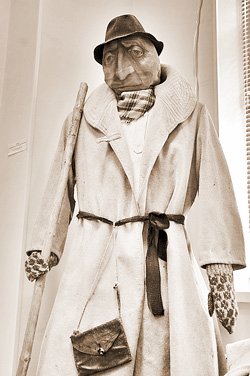
It looks like this: here is the Tersky man in a hat and in a traditional caftan sells potatoes in a bag and pots of his own manufacture. All objects, including the bag are genuine, and the man himself is a maneken figure with a living and expressive face, a portrait written from nature by the artist Maria Turina. The prototype of this character is known, this is Kolya Paystik, a working and laconic peasant who left Sivovo with his people. This person is not in his native village.
Or ... is there?
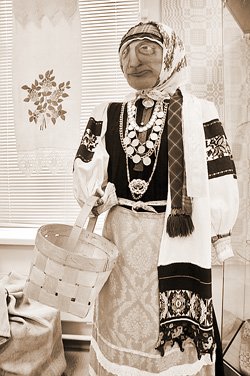
That's where he was near - his potatoes, his pots. His wife is Lepik, dressed up in honor of the bazaar day, carefully looks at the husband: will there be money soon? And what are you going to buy on them?
Here is Anna Rahulan near the spinning ground. She taught Tatyana spin. Now there is no Anna here, but a spinning wheel, weaving camp, the ability to spin and weave, an understanding of the meaning of this cosmic action remained.
Thanks to the museum.
Once the great Russian philosopher Nikolai Fedorov said about the resurrection of the museum. The museum stores the memory of those who have gone - to another world or another country. He left, but will return - because we need that remaining.
The world that has disappeared and disappears now, the world of traditional culture is designed to preserve for the future museums and folklore institutions. The exhibition hall on Nekrasov 10, belonging to the Pskov regional center of folk art, broadcast the memory of the set stored in the museum from the deaf and now snowy winter Sirovo, in Pskov.
And they returned.
Yuri Strekalovsky.