
Translated material
Communal descent
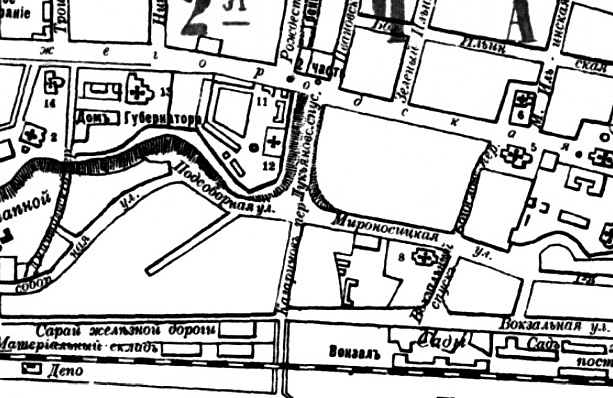
The communal descent (formerly Lukyanovsky descent) is located in the historical part of the city. It is a descent to the station.
It takes from Bolshaya Moskovskaya Street to the intersection of Uritsky and Karl Marx streets.
The toponym "Lukyanovsky descent" appeared in the 19th century and is associated with the merchant I.M. Lukyanov, the estate of which stood in this place. In 1927, the Lukyanovsky descent was renamed communal.
Communal descent. 1958. Photo: Offodin Nikolai Vitalievich
On the western side of the communal descent is the Virgin of the Mother of God, the Knritzen Monastery (more about the monastery here ). The walls of the monastery are located on the ancient defensive shaft, which was the eastern border of the Monomakhov city. Along the walls of the Christmas monastery, an asphalt pedestrian path is laid, which is part of the city tourist route.
The Virgin Monastery and Mirozotskaya Street. Photo beginning. XX century.
At the beginning of the XII century, Vladimir Monomakh erects a system of earthen fortifications here and puts his princely court. The fortified part was called the Kremlin (Pechersky or Monomakhs city). The city of Monomakh initially had a small territory (36.25 hectares). Along the entire perimeter, it was surrounded by powerful earthen ramparts, on the crest of which wooden walls were built. The total length of the earthen rampart was almost 3 km. The preserved fragments of these fortifications, about 7 m high and with a base of 20 m, indicate a significant scale of construction work, "required mobilization of thousands of people and hundreds of submarines" [1] . According to the assumption of the historian N.N. Voronin, the Vladimir fortress could be begun during Monomakh’s arrivals to the north at the turn of the XI-XII centuries and was completed on his last visit in 1108. Wooden walls and towers were placed at the top of the shafts. The preserved section of defensive fortifications, which goes to the communal descent, is currently called the Christmas shaft.
At the intersection of Bolshaya Moskovskaya and Communal Description Street is the Vladimir Hotel (B. Moskovskaya St., 74). On the site of the hotel before the revolution stood a large stone house in the Baroque style with a wide entrance and high windows, framed from the sides of the columns. For the sake of building a hotel, he was demolished.
The hotel was built in the 50s of the XX century. The project was developed by the famous Leningrad architect David Buryshkin in the second half of the 1940s. The designers had the task of issuing an entrance to the city from the railway station. The Buryshkin project was subsequently finalized. This was engaged in a group of architects of Vladimir "regional project", which included Nikolai Likin, Vladimir Avrutsky and Boris Shiganov. The project, which is called one of the most successful in the Vladimir architecture of the Soviet era, was ready by 1951, then construction began. The hotel was opened in 1956.
View of the hotel "Vladimir". Photo 2 floor. XX century.
The hotel building is organically inscribed in the historical environment of the city. Her tower with a four -sided roof contains a hint of an ancient fortress tower. On the roof there is a platform with a balustrade with a view of the casket Dali. The hotel had 115 rooms where up to 250 guests could accommodate. Many famous people, such as the French philosopher Jean-Paul Sartre and the first astronaut Yuri Gagarin, stayed in it.
[1] Voronin N.N. The architecture of North-East Rus' of the XII-XV centuries. T1: M., 1961, p. 41