
Translated material
A city that is not
July 23, 2011 became the day of victory over the day of the liberation of Pskov
July 23, 2011 became the day of victory over the day of the liberation of Pskov
July 23, 2011 I survived a shock that I can’t compare with something in my memory. Maybe this is like a feeling when a person was robbed or destroyed by his house. I don’t know, it is very difficult to compare. Here is personal, but not only personal. July 23 - the day of the liberation of Pskov from the Nazis, held in 1944.
In the morning, I walked by 11 o’clock to Victory Square through the Botanical Garden and already on the way something in the approaching usual form of area began to disturb me. A minute later I saw quite clearly that there was no one at the grave of an unknown soldier where the eternal fire was on. That is - not a single person. Empty.
Shock
| | | --- | | 
Meanwhile, the sounds were clearly distributed, and, going out on the square, it was not difficult to determine their source.
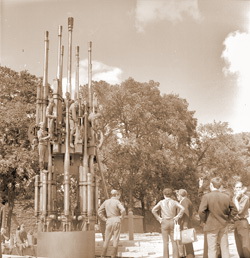
Officials first gathered people near a symbol of a new era - a primitive and pompous granite structure called the Steel of Military Glory. These exactly the same typical complexes with a coat -bearing column in the center (worth 25 million folk rubles) are mandatory in every city that received the title of city of military glory. There is no alternative to this construction. Twin monuments are already dozens. We received the title of city of military glory - fork out by 25 million and set yourself this sign. Production is organized at the same enterprise. Pskov was recognized as a city of military glory in 2010. A year ago, this stele was set in July.
Well, they put it and put it, at least they didn’t demolish anything, they didn’t spoil any panorama, it was already good for me a year ago.
As it turned out only today, they demolished. Spoiled. I could never have thought that.
They demolished the ritual of commemoration of the Pskov unknown soldier on the day of the liberation of Pskov from the Nazis.
This ritual is no more. He did not fit into a new rite of worshiping a newly -wailed granite column.
Today, July 23, 2011, for the first time since 1974 (the year in Pskov the memorial to an unknown soldier and eternal fire) ceremonial in honor of the day of the liberation of Pskov was not at the grave of an unknown soldier, but in a newly -minted granite product that has nothing to do with the memory of the war, about its victims.
At 11 o’clock on July 23, 2011, my four red carnations turned out to be the only colors at the eternal flame. It was impossible to believe in it.
I did not find the strength to get closer to the action at the column and looked (rather listened) from afar, from eternal flame.
Together with me, the janitor was listening to this site. I went around the eternal fire from all sides. I picked up every footping. I knew that people would come here.
Glamor
How is it all indicative and really symbolic.
How much the word order itself says in this "song".
“We are starting a ceremony ... To the stele of the city of military glory, ... Deputy Governor ... Head of the city ... Deputy Head of the city ... Head of the city administration ... Deputy Head of the City Administration ... Metropolitan Pskov and Velikoluksky ... Honorary guests of the holiday ...” And so until the seventh sweat, to the seventh official knee.
Almost the last was called the only (!) Pskov participant in Pskov, Pskov from the Nazis Sergey Mikhailovich Pavlov, Honorary Citizen Pskov, Chairman of the City Council of Veterans.
The moral freaks that prepared this cynical scenario could not have occurred to the fact that the person who freed the city, a participant in the war, should be called first.
I have not seen greater vulgarity, bad taste and mediocrity on the day of the liberation of Pskov.
Rotating fireworks ... colored balls ...
There, the Metropolitan served Lithuania. Over whom ???
The townspeople were offered to lay flowers to this dead stele! Put it.
The day of the liberation of Pskov, July 23, was turned into a feast of glamor and bureaucratic PR.
I have been living in Pskov all my life. I have never seen anything more shameful on this day.
On Kuznetskaya Street, where on July 23, since 1974, 37 years in a row, people gathered in front of the grave of an unknown soldier, placed military vehicles that brought the soldier to the action.
Having left the Victory Square after the solemn march, the units of all the branches of the troops turned to a free step and walked to the cars past the grave of an unknown soldier in the leg - as if there was just a city street to the right of them. Or a wasteland. To give honor by the march of an unknown soldier - all the millions of the dead, who are symbolized by this memorial, were not part of the script of the "event".
Wound
| | | --- | | 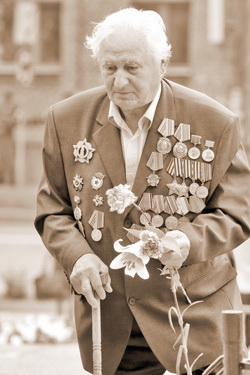
Standing by the eternal fire, I saw that a veteran with awards was slowly going to the memorial, leaning on a wand, he was accompanied by Fr. Evgeny, Rector of the Church of St. Anastasia, and an elderly lady.
Surprisingly, it is precisely to the long -known I am about. Eugene, I came up “in the backyards” of the action at the very beginning and asked: “Tell me, it seems to me that something is wrong, or someone else out of myself?” He instantly understood what it was about, and replied that he himself first came to the eternal fire. And there it turned out that he ... was mistaken.
The veteran said something energetically and excitedly about. Eugene.
We met.
The veteran was ... Viktor Georgievich Klimenko. This is mysticism. In 1974, it was he who worked as the head of the city communal department. He was entrusted with all the coordination of work on the construction of the memorial on the grave of an unknown soldier. He is the head of this Pskov folk construction site.
An elderly man (born in 1926) was beside himself, he almost cried, it even seemed to me that the tear glittered on his cheek. Maybe the heat.
“How, how could this happen? Who invented this?! Why didn’t they collect people here, why did an unknown soldier be forgotten? This is a real crime! It was a national construction, the whole city built this monument! ”
Viktor Georgievich has something to remember.
The work began in April and ended in July 1974. By the decision of the city authorities, all the Pskov plants were given to him. He had the right to call any director and demand everything that is needed for construction. Each enterprise allocated 100-150 people to work. The work went daily until late in the evening. Right to the construction site, in the shed, they extended the telephone wire, installed the city phone so that it could be called without moving away from construction.
They drained the territory of the fortress moat, carried out drainage, raised the level of the earth, piled piles, restored a piece of the fortress wall, and brought communications.
At the Pskov plants, they were prepared by Vsevolod Petrovich Smirnov in the warehouses of the written off weapons of 17 85-mm anti-aircraft guns for installation on the pedestal and made the pedestal itself. These works were mainly carried out at Pskovmash. There they also made a sarcophagus for the remains of a soldier.
A brigade of four campaign masters for work on the pedestal of the memorial was carried from Izyborsk every day on the Executive Committee of the Molga.
Vsevolod Petrovich Smirnov - architect, author of the project, chief chief - spent all days at a construction site. Klimenko liked the project of an unusual monument the first time - there was no shadow of rejection. Smirnov perfectly fell with his intention in the images of human memory of people who survived the war.
They managed to do it on time, of course, but at an expensive cost.
The tension was so strong that after the opening of the memorial on July 20, 1974, Klimenko fell ill and fell ill. He gave all his strength to the grave of an unknown soldier.
He still has a rarity at home - the key to the stove, which is tightly covered by the space in the lower central part of the memorial behind the eternal flame - where a small sarcophagus is installed with the remains of an unknown soldier. The plate has a vertical lifting spring mechanism, which can only be driven by this key.
Vsevolod Petrovich got a torch to memory, in which the eternal flame was delivered to Pskov from Marse Fields in Leningrad, and he gave the key to the tombstone the surviving stress of Klimenko - as fragments taken out of the wound were given to the soldiers.
Fate
| | | --- | | 
We stood for a long time and talked.
I was amazed at this meeting (we were not familiar before, although it quickly became clear that Viktor Georgievich knew both father and uncle) also because on July 20, just (so coincided - July 20, on the anniversary of the opening of the memorial) Pskov Province published an article by Marina Safronova “A known about an unknown soldier” .
An article in which there is such an excerpt:
“... The essence of the celebration of Pskov’s liberation from the Nazi invaders (namely, and nothing else is called July 23) disappears before our eyes, is eroded in countless dances and fairs.
Already many citizens believe that the night salute on July 23 is given not in honor of the liberators of the city from fascism in 1944 (not everyone already remembers the year of liberation), but in honor of its foundation, the date of which is actually unknown.
Perhaps the Pskov authorities will find out about this fact for the first time, but the Memorial “The Grave of the Unknown Soldier” in Pskov is still not on the balance sheet of either city or regional authorities, the memorial is not in the register of either municipal or state property. He is in the full sense of the word ownerless. That is, legally it is not there. ”
The letter of the newspaper’s number we made the phrase “a city that is not”.
Probably, providence exists, but far from always it concerns you so clearly, so personally and so clearly.
Here - touched.
I ran to the editor, the benefit that was nearby, and brought Viktor Georgievich a pack of newspapers with an article. He can no longer read himself, but newspapers and books read to him, and not all friends, thank God, went into another world. There is someone to share with.
... He began the war in 1944, in the Western Bug, at 17 years old.
At the front, when the Germans burned the whole street in the village where his family lived, about 20 houses. The front was approaching, and the people left the village, out of fear of being killed, into the forests. Victor went not to escape into the forest, but right to the front line, crossed her and found our soldiers. Then he was only 16. In all orders, he was supposed to be sent to the rear, but he was very persistent and somehow begged the front-line soldiers, the soldiers left him at home. Victor became the son of a regiment, and in a military specialty - a scout. The perfect scout is small and light.
On the Victory Day, to him, the gentleman of the two orders of glory (to the third, first degree, for the capture of the underground utilities of the Reich Chancellery, they presented, but did not give) and the Patriotic War of the 1st degree, there was no 19 years.
He underwent more than 30 operations.
Lives now alone.
Drives the car of the Russian representative class - "OKU".
In 2007, Klimenko wrote a book of memoirs “The Fate of the Front Intelligence”.
How many people died before his eyes, including a sanitary girl who saved his life at the cost of her. And the soldiers who sheltered him in the unit, not everyone survived until the day of Victory.
To them, these dead, and millions of unknownly dead, he built the grave of an unknown soldier in his native Pskov, where the eternal flame burns. This is his work, his pain and his memory, which became a memorial stone. He thought that forever.
“No one is forgotten. Nothing is forgotten. "
But no. Other times have come.
Memory
The beginning of the ceremony of laying out the garlands of military glory opened a sound on the program “What? Where? When?"
Indeed: what? Where? When?
Among the memorials with the burials of the Great Patriotic War, to which the garlands of military glory will be entrusted, the grave of an unknown soldier was called almost the last. Okay, I think I'll wait.
But they ... generally forgot about her.
15 minutes passed ... 30 minutes ... no one carried the garland of memory and glory to the eternal fire.
We were waiting.
Klimenko hoped that he would see at least the laying out of the garland to his eternal fire.
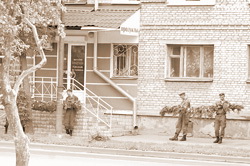
Three groups of soldiers came very close and stood opposite, on the other side of the street, with three spruce garlands (one large and two small ones). It seemed that they were only waiting for the team to cross the road, just something lost in the instructions of the bosses. It was uncomfortable for them to hold the garlands in their arms for a long time, but it was a shame to put them on the ground; They laid them on the ledge above the foundation of a residential building and leaned with their backs so that the garlands would not fall.
After half an hour, I still decided to approach the soldiers.
“Guys, will you lay a garland to the grave of an unknown soldier?” I asked all three groups the same question. "No. We are in the Dmitrievsky cemetery ... We are to the monument to the pilots ... We are in crosses. ” But the cars did not come behind them.
“And ... where is the garland for the grave of an unknown soldier?” I asked them. - “We don't know. They seemed to be standing on the other side of the square. ”
But the Victory Square was already completely empty.
Not a single boss approached the grave of an unknown soldier. Not one.
And the people began to slowly approach.
Not everyone had a brains and repulsed the memory.
... The soldiers were not from Pskov, on July 23, the first and last time here.
“... For the first time in 37 years, no one laid a garland to the grave of an unknown soldier and eternal fire. This monument was erected in 1974, ”I explained to them my question and returned to Viktor Georgievich.
They themselves made a decision.
Two garlands of three (large and small) paratroopers laid an unknown soldier to the grave.
Glory
I spent Viktor Georgievich Klimenko home and stood for a long time, thinking what I wanted to do. Call the bosses and tell them that they are finished bitch? If this could fix them, it would have a great sense to call. But there is nothing to fix there. You can call a person a bastard if there is a hope that after that he will cease to be. But there is absolutely no hope here. These subscribers are outside the zone of action of this network. They have another brain coding, and this is not only a cultural, but also a biological process. In this system, it is completely irreversible.
There is actually nothing surprising in the fact that in the ritual of the day of liberation of the city from the Nazis, the true symbol of the war, spiritualized by memory and created by the hands of shed blood, but survivors of the war -veterans survivors, was replaced by a soulless sign of great power, overwhelmed by a false pathos. And there is nothing surprising in the fact that it is precisely this symbol that the people are now gathering, trying to imprint his image into human consciousness.
It is not surprising that the jubilant gopot in the power wants to make the same jubilant gopota, not knowing, not understanding and not looking for the truth, the whole people, replace its key symbols, to transcode its genetic memory.
And now there is a “Popular Front” for the folk of the people.
Which of the scoundrels who came up with this “front” was at the front?
Symbols and rituals reflect the essence, correspond to the essence.
The action corresponds to the plan.
I called Sergei Mikhailovich Pavlov, the only living participant in the liberation of Pskov.
He did not pick up the phone for a long time, answered only in the evening, said that he left the phone on a holiday at home. I congratulated him on the day of the liberation of Pskov from the fascist invaders, apologized that he had not approached the square, explained why and asked what it was today and how he found out about it.
“I was very surprised,” Pavlov said. - “In the morning they came, but it is not clear where. They said that now they would celebrate here. This is so strange. I said at the holiday commission: look, you have all days in your schedule - not a single word about veterans, not a single meeting for veterans. Well, I have already left the liberators alone, and another participant in the battles under Pskov lives, but they could at least ask ... ” “And what did they answer you?” - "Nothing. They brought several invitations. ”
In the congratulation of the governor Andrei Turchak and the chairman of the regional assembly of Boris Polozov by the City Day - not a word about the liberation of Pskov on July 23, 1944 from the Nazis. They write that “for modern Russia, Pskov is a city of military glory, an actively developing tourist and economic center, the city of courageous, persistent and hardworking people, which are distinguished by patriotism and love for their small homeland, the Fatherland. Consent, social and political stability - these values Pskov are transmitted from generation to generation. ”
Not a word about the liberation of Pskov on July 23, 1944 from the Nazis - in the congratulation of the head of the city of Ivan Tsetsersky. The mayor reports that “it is proud of Pskov, because it amazingly combines the wealth of historical, cultural and spiritual originality, respect for the past and the desire for innovative approaches ... Thanks to the coordinated work of the authorities and the care of the townspeople, our Pskov is noticeably developing and transforming. I am sure that together we will continue to improve our life with you, preserving and increasing the spiritual heritage for future generations. ”
They also write about the fact that "the team of the Pskov city branch of the All -Russian political party" United Russia "beat 5: 1 team of the city administration."
Obviously, this symbolizes their "victory" over the city of Pskov.
So on July 23, now in Pskov - either the day of the vision of Princess Olga on the shore of the Great, or the day of the first mention of Pskov in the annals. But not the day of the liberation of Pskov from the fascist invaders. Мыльная опера с воздушными шариками и вращающимися фейерверками. Ярмарка тщеславия.
Нынешние дети будут считать, что так было всегда.
«…Я вдали вижу город, которого нет...»
Lev Schlosberg