
Translated material
Personal efforts
I already had to write about art projects that fall out of the usual logic of time, as it seems at first sight. Although, as signs, it is the present that they say more than the “noisy” events. This summer there were two such projects, one of them can be seen now.
North through the north-west
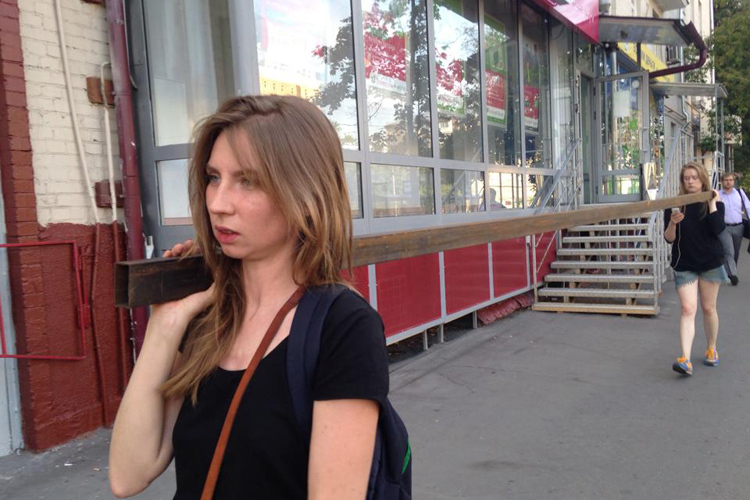
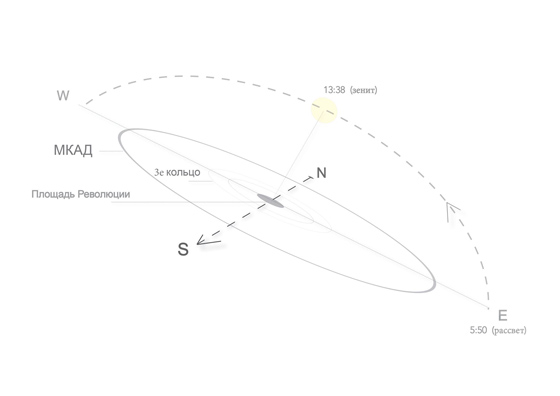
Two artists, Ekaterina Vasilieva and Ganna Zubkov, carried a metal pipe through everything Moscow from north to south, lining up the route in the sun. It lasted about a day. The day before the event, during the performance itself and a little later on social networks and on the media sites, a serious wave of discussion rose, although quite recognizable: “Why is this necessary?”, “Factories stand”, “What did the artist want to say?” And so on in the same spirit.
It immediately became clear that everyone tried to subtract something of their own, and therefore-disputes, noise, Gama. The artist Nikita Alekseev aptly noticed that they would carry a round pipe - everyone would have thought that the action was about the oil empire, and here is such a square thing: although a pipe, but still not quite that. Expectations were deceived, hence a kind of offense. Indeed, not "one, two, three." The performance “revolutionary axis” was called, and everyone was waiting for the revolution, but nothing of the kind also happened - just intentionally incorrect translation of the French Axe de Révolution or Axe Révolutionnaire , “Rotation axis”. Here are the regulars of the Facebook-SPORS and were upset. No violations, a call of power, nothing topical.
 © Revolutionary axis
The country has a request for a simple reading, primitivization of any artistic practices. And when this does not work, people begin to watch condemningly. “The performance itself creates an occasion for comment,” says Zubkova. “This is a form around which a field is created, absolutely open to hermeneutics - both iconographically and in meaning, as you like.”
The artists were scared by South Chertanov, Vasiliev recalls, but when they passed in this area, they reacted positively to them, and it was there, like in other sleeping areas, communication with the city worked through the pipe. In the center, everything was the other way around. “We walked eight hours along Altufev, there was nobody, but as soon as we crossed the garden ring ...” - Ganna and Catherine begin to deeply with a sigh. Photographers from federal publications flew into them, they followed them non -stop, not allowing them to relax for a minute. “But as soon as we went beyond the center, they immediately disappeared,” Vasilieva laughs.
“There was a fear that law enforcement officers or employees in civilian clothes would interfere with this action, but in reality an unpleasant clash occurred precisely with the media,” says Zubkova. Media pumps fear and, as in this case, it turns out, they actively create it. When the conflict without which the media forgot how to work is absent, it is invented. In any case, the reporters themselves are used to acting in such a nervous-aggressive way. “I do not want to fall into media criticism. This is just what we saw, ”says Ganna.
“It made sense to do it right now, because we realized that even such a harmless event causes such anxiety in seemingly adequate people,” adds Catherine. People expect repressions of power structures or, conversely, protest actions by artists. And they just carry the pipe, but fear takes its own.
Collector
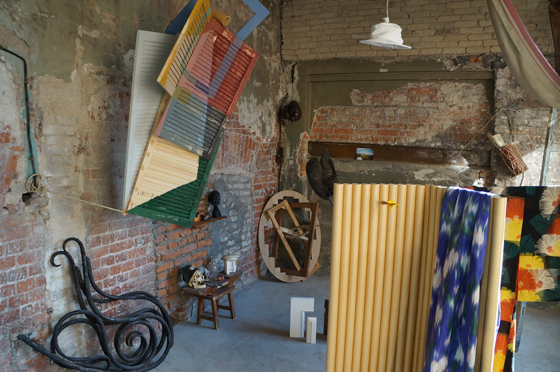
The project was in the sense of media contamination made in a completely different way - rather in the spirit of a "poet for poets." “Autonomous remarks” of Yana Tamkovich in his workshop at the “Factory” started in parallel to the Moscow Biennale of young art . This is a half -closed event, because after the vernissage, if I may put it, you can get there only by contacting the artist (for example, through the guard of the Central Executive Committee), which conducts copyright excursions at the exhibition, this can be done before September 11. “You see, the exhibition without my comment is like beer without vodka,” Tamkovich told me on the phone when I decided to see “autonomous replicas”. Actually, the only full report on the exhibition was built as such a tour.
One of the main characters of the project is the workshop. Not a specific artist - Yana Tambovich himself himself or Pablo Picasso, whose figure was initial in “autonomous replicas”, the fields of Cezanne, Marseille Dyushan or Georges of the marriage, whose shadows throw the objects presented here - but a certain collective character, not at all ideal. The workshop is the internal state of the artist, which was made outside, although there may be nothing inside - only a lot of things scattered around the room, which are the artist. Items hint at some events from the life of famous artists, the general atmosphere of the time of emergence and extinction of cubism, the First World War, but the unraveling of this rebus is a fraudulent maneuver, even if the artist is pleased to play with the audience.
 © colta.ru
Tamkovich is not just a guide, not just an audio guide for the exposition he collected. He is a collector. Items, whether it is an authentic newspaper of the 1910s or African mask, bought by an artist for his own money on online auctions. Excitement, expectation, fear of missing something, brilliance in the eyes of the collector-all this is felt when he talks about acquired things. Everything else - stories standing behind objects - turns out to be secondary to him: the main thing - his personal efforts, and this is in this case - collecting.
By the way, one of the most interesting exhibitions this year-if we talk about major institutions-was the project “Personal choice” in the “garage”: the collectors of modern art, mainly, as called the oligarchs, represented one work from their collections and explained-not without the help of their press services-why they are engaged in gathering. Such a sweeping and rich project is the only thing that the “garage” can do well, and it would be better if he did this. But here it is important that the story of collecting indeed, with all the problematicity of such activities in Russia, has prospects for the opposite, inspiring impulse for the art process, both the Garage and Jan Tamkovich demonstrated.