
Translated material
We lose and do not cry
Monuments of architecture of Pskov did not find their place in the UNESCO World Heritage List
Monuments of architecture of Pskov did not find their place in the UNESCO World Heritage List
The 36th UNESCO session, which at the end of June in St. Petersburg, took the consideration of the issue of inclusion in the list of the World Cultural Heritage of the Kremlin nomination as part of the architectural monuments of Moscow, Kazan, Novgorod, Pskov, Astrakhan and Uglich. To the next annual session of UNESCO, art history, analytical and urban planning materials were additionally requested. This reflects the doubts of UNESCO experts about the validity of the arguments of the applicants. And - what is important to us - shows the state of protection of historical and culture monuments in Russia.
| | | --- | | 
The artificial nomination “Kremlin of Russia” invented in the Russian National Heritage Committee in the Russian National Heritage Committee initially did not have any chances for UNESCO support, since it does not meet the main criteria for including cultural heritage objects in the World Heritage List.
In the nomination of the Kremlin of Russia, six ensembles of Kremli were presented at once: Moscow, Kazan and Novgorod (while they are already on the World Heritage List) as well as Astrakhan, Pskov and Uglichsky, which are in the so -called preliminary list.
An attempt to attach to three to the selection to large ensembles of the other three, experiencing significant difficulties in preserving both architectural monuments and cultural landscapes, was similar to an attempt to “disguise” the relative gleam of some and the problems of others.
It didn't work out. UNESCO is not an international Olympic committee, it does not consider presentations about the future with fantastic pictures, but undergoes a meticulous professional analysis of the state of history and culture monuments. In addition, UNESCO is not corrupt.
Under objects of cultural heritage, subject to inclusion in the list of world heritage, the UNESCO Convention believes “Monuments: works of architecture, monumental sculpture and painting, elements and construction of an archaeological nature, inscriptions, cave dwellings and combinations of topographic elements, which are part of the outstanding world property from the point of view of history, science or art; ensembles: groups of separate or interconnected buildings, which, due to their architectural structure, unity or harmony with the landscape, represent an outstanding world property; Interesting places: human creations or joint creations of man and nature, as well as territories, including places representing archaeological interest, which make up an outstanding world treasure with a historical, aesthetic, ethnological or anthropological point of view. ”
The main six criteria for the inclusion of cultural heritage objects in the World Heritage List have been formed by UNESCO since 1978, have been specified several times and look very tough today.
The monument, ensemble or attractions represented for inclusion in the World Heritage List can be considered part of the outstanding world property to determine the Convention if the object fully satisfies at least one of the six criteria, and also withstands the authenticity verification.
The cultural heritage object should (I quote the official translation of the Convention):
"1. To be the creation of a creative genius of man; or
Reflect the impact that the alternation of universal values exerts within a certain period of time or a certain cultural area of the world, on the development of architecture or technology, urban planning or landscapes; or
To be a unique or at least exceptional evidence of the cultural tradition or civilization that existing or disappeared; or
Represent a visual example of the type of structure, architectural or technological ensemble or landscape illustrating the important stage (stages) of the development of human history; or
To represent a visual example of a traditional human settlement or land use, characteristic of culture (or cultures), especially if they are destroyed under the influence of irreversible changes; or
To be directly or to a large extent related to events or life traditions, ideas or views, works of literature and art, representing an outstanding world treasure, as well as:
To satisfy the criteria for authenticity and integrity in relation to their design, the material of manufacture, skill of execution or a harmonious combination with the surrounding background, and in the case of cultural landscapes - in relation to their originality and elements;
To use the protection provided by legal and/or contractual and/or traditional mechanisms for the protection and management of the object, so that the preservation of the represented object of culture or cultural landscape is ensured. The presence of legislation that protects objects at the state, regional or municipal level, and/or firmly rooted contractual or traditional forms of protection, as well as adequate management and control mechanisms. It is also required that the applicants present guarantees of the practical action of such laws and/or contractual and/or traditional mechanisms. Moreover, in order to maintain the integrity of cultural objects, especially those who are open to a large number of visitors, it is necessary that the parties representing them - the parties to the Convention can demonstrate the presence of administrative measures to manage, preservation and accessibility of the object to visit. ”
These are now the principles of forming the UNESCO World Heritage List. They are well -known.
These criteria withstood only 24 cultural heritage sites located in Russia (47 - in Italy, 43 in Spain, 40 in China, 37 - in France, 36 in Germany, 31 in Mexico, 28 - in India, 28 in the UK). In total, in the world, as of June 30, 2011 (the date of the previous Congress of UNESCO) there were 936 objects in the World Heritage List.
Cultural heritage objects when discussing the issue of their inclusion in the list are analyzed separately for each monument, and the very idea of “wholesale” of six diverse and complex objects of Russia's cultural heritage in one nomination to include them in the World Heritage List is, to put it mildly, unprofessional.
For the same reason, the “cultural wholesale” is experiencing high risks of obtaining a negative conclusion of experts and the refusal in 2002 to the preliminary list of the UNESCO World Heritage List of “Big Pskov”, which, in my opinion, included a whole complex of history and culture monuments located in Pskov, as well as the monuments that are part of the Izborsk Museum-Reserve. All of them are in different situations of authenticity, safety and restoration. In almost all these monuments, the situation worsens.
The UNESCO Committee emphasizes that "reconstruction is acceptable only if they are executed on the basis of full and exhaustive documentation related to the original, but not on assumptions of any degree of reliability."
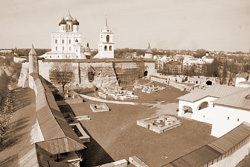
And in Pskov, the reconstruction without a comprehensive, documented, information of the churches of the Dovmonov city in the heart of a historical city is still in seriousness. What are we talking about?
UNESCO's special convention notes that the World Heritage List can be the exception of “historical cities that retained the population, which, due to its nature, developed and continue to develop under the influence of changes in the socio-economic and cultural field” and calls this a situation “in which the assessment of authenticity is difficult, and any policy of protecting historical monuments becomes problematic.”
Making the World Heritage list implies that federal, regional and local authorities have already taken legislative and administrative measures to ensure the protection of not only monuments, but also the area surrounding them. An important factor for UNESCO is also the “education of the population of this city, since without its active participation it is almost impossible to ensure the preservation of the object.”
Pskov, with his barbaric urban planning policy of recent times and the demonstrative neglect of ancient monuments, will not be able to prove either the authenticity of the historical landscape (it is destroyed before our eyes), nor the professionalism of the pseudo -storage, nor the effectiveness of the state policy of protecting historical monuments as a whole.
What urban planning preservation of the historical Pskov can be discussed after the appearance of remodels and asphalt directly in the Kremlin, parroting so -called. The “Golden Embankment” on the site of the fishing and the cultural layer concreted there, a 35-meter residential building 180 m from the Pokrovskaya tower at an extremely permitted height of the buildings in this territory of 17 meters, architectural trinkets on the banks of the Pskov and much more.
And if the new project of the monuments of history and the culture of Pskov, coupled by the reinforced concrete bastard parapet of the Velikhi River, was sold by the Pskov River Embankment, is sold out by the Pskov Pskov Pskov Pskov Nomination Pskov Pskov, and a kind of mockery of international law (ratified Russia), and over greedy) will look like the Big Pskov nomination. meaning, and actually over the cultural heritage.
The main goal of the UNESCO World Heritage List is “to make it known and protect objects that are unique in their own way.”
The status of the World Heritage Service, according to the Convention, is an additional guarantee of the preservation and integrity of the objects included in it, increases the prestige of the territories and control of their institutions, contributes to the popularization of the objects included in the list and the development of alternative types of nature management (primarily ecological tourism), provides priority in the attraction of financial means to support objects The natural heritage, first of all, from the World Heritage Fund, contributes to the organization of monitoring and monitoring the state of safety of natural objects.
UNESCO notes that in order to confirm the “right to include the World Heritage List, the city must obtain recognition as an object representing architectural interest, and cannot be considered only from the point of view of the intellectual or spiritual role that it played in the past, or from the point of view of its significance, as a historical symbol.”
This is written as if about our Pskov.
In my opinion, the Pskov region must be highlighted among their cultural heritage objects a short list of monuments that really meet several UNESCO criteria, primarily criteria for authenticity and safety. In my opinion, this can be, in my opinion, the frescoes of the Transfiguration Cathedral of the Mirozhsky Monastery (XII century), Trudovorovo settlement (IX-XIV centuries) and part of the Izborsk-Malsky Valley, until the “pre-holiday” Izborsk in this list could be the hezborsk itself (the fortress of the XIV-XVI centuries).
Only monuments and ensembles can get into the UNESCO World Heritage List, which retained their genuine appearance, not crippled by barbarians, not covered with garbage of glossy remodels. We have a lot of them left. And all of them are under the direct threat of destruction or destruction.
The Pskov region is necessary, until it was already very late, to rethink and rebuild the entire system of state protection of historical and cultural monuments. Today, this system does not actually work, it constantly “misses blows”, rents out monuments to be torn to pieces by unzilized, illiterate businessmen and loses the last thing that makes our region a unique, attentive, involved culture.
The tough and sad lesson of the June 36th Session of UNESCO in St. Petersburg in this sense turned out to be very useful.
Lev Schlosberg,
Deputy Chairman of the Pskov Regional Branch of Veropiik,
Chairman of the Standing Committee on Cultural Policy and Tourism of the North-Western Parliamentary Association