
Translated material
The program of the program
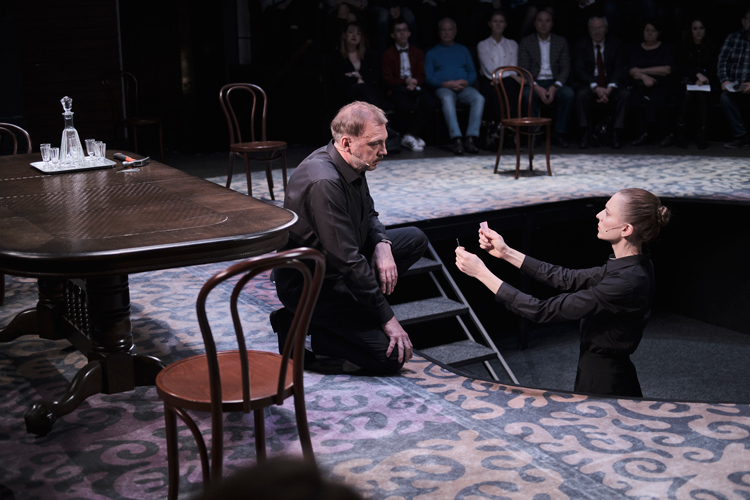
Roman Sorokina is a beautiful choice for the Taganka. In his best years, the theater was closely monitored by the new prose: Boris Mozhaev, Boris Vasiliev and Yuri Trifonov replaced Yuri Lyubimov of contemporaries-dramators, among whom no one particularly interested him.
True, fortunately, in recent years other priorities have appeared here - in addition to preserving traditions. Director Irina Apksimova imagines the Taganka as the MHT as the Moscow Art Theater from the times of Oleg Tabakov, who invites unlike directors, combines full -time artists with freelance and works for a different audience - from the audience of conditional “practice” to fans of the musical.
The last premiere has proved: the plan works. The visit of Konstantin Bogomolov is the most interesting of everything that happened on Taganka since the “Group of the Yubilee year” , a team that devoted a series of documentary exhibitions and performances to the 50th anniversary of the theater.
 © Sergey Trifonov
For Bogomolov himself, Sorokin is like Chekhov for Stanislavsky or, since it is about Taganka, Bertolt Brecht for Lyubimov. The author of “Norms” in his performances is greater than anyone from the theatrical predecessors. And although Bogomolov acted more delicate with the novel by the “telluria” than with the “idiot” and “Boris Godunov” - he did not add a word from himself - the viewer is easy to believe in the opposite: sometimes they and Sorokin are similar to confusion.
The novel "Telluria" consists of 50 novels united only by the common universe. The new world war shredded the political map no worse than the first two, the modern civilization was replaced by the futuristic Middle Ages, and the psychotropic metal of the telluric was the most valuable resource - it makes nails and clog directly into the brain.
Bogomolov selected 10 or 15 plots - for example, this: the German reporter illuminates the carnival in Cologne - the first since the city was repaid from the Islamists. Or this: the newly -made Ryazan prince explains to the Muscovite, that is, a foreigner, why a divided Russia is better than a whole. Or one more thing: people with fester heads grown in test tubes flee from the fortress theater to the Republic of Tvanuria - to the homeland of telluric nails.
 © Sergey Trifonov
All these episodes are so isolated from each other that the audience, without saying a word, applaud after the end of everyone - and this was probably part of the director's plan, because it was agreed with the spirit of the novel. After all, if something connects the text of Sorokin together, then this is just the idea of destroyed ties: large countries break up into small, cities into ghetto, languages into dialects, masterfully designed by the writer. Society - on the detached telluric drug addicts, and people as a biological species - for giants, liliputs and dog -headed ones. The world of "telluria" is too fragmented to tell a whole story about it.
Sorokinskaya prose each time pushes Bogomolov to cut the director's tools - it seems so self -sufficient to him. The Warsaw “ice” was much more strict by what he did then in Moscow, and “telluria” is much stricter both “ice” and all the current ones - such seemingly ascetic - works like “three sisters” or “glory” .
For Bogomolov, Sorokin is like Chekhov for Stanislavsky. Or, since it’s about Taganka, Brecht for Lyubimov.
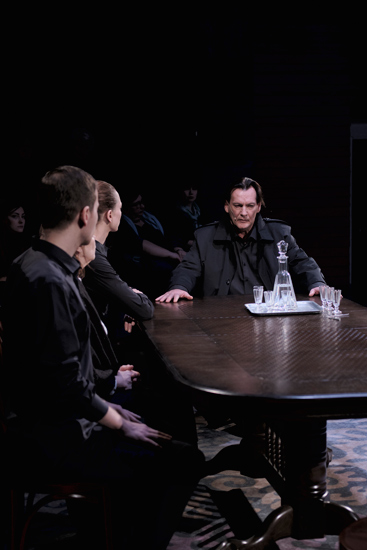
Simple misanserations, neutral costumes, discreet props. No video cameras, no musical numbers. Minimum of body movements. The main material from which the performance is made is intonation. It is no less diverse than the language of the novel. We hear workers, noblemen, and warriors, and fantastic creatures, and all as one amazingly reliable - despite the fact that Igor Mirkurbanov and Sergey Epishev worked with Bogomolov many times, and Irina Apksimova and the Lyubimovsky Theater Lyubov Selyutin never careed with him.
In essence, this is almost a reading - except for the radical transformation of space. In this regard, the “telluria” echoes the “flagship” project of the very “anniversary year group” - the performance of Dmitry Volkostroelov “1968. New World " .
In the theater, everything that is located outside the scene is by default - a blind area like advertising banners along the edges of the page. But the famous Taganka Hall, a former Enclave of Freedom, similar to the milking cabin of Noah's ark and externally and in function, is too bright that a good artist does not use it.
In the New World, Ksenia Peretrukhina blocked the scene of a false -walled, sheathed by the same tree as the real walls. The decoration continued the hall - thereby turning it into decoration.
 © Sergey Trifonov
In "Tedluria" Larisa Lomakin acted even more decisively: she took the old layout and drew a new one on top. The stands, built on the sino and scene, form a funnel, as in the circus (or as in hell of Dante): eight external circles - for spectators and two internal - for actors. The smallest circle is just a pit in the floor. Above the eighth, last, an empty throne rises nearby, replacing what has never been and could not be on a democratic Taganka - the royal box.
In general, the theater hall becomes a model of the world described in the novel: the boundaries are unceremoniously redone, and medieval values defeated. Of course, the audience in this model act as an actors of the extras. In general, to draw the audience into action without breaking the fourth wall, is the know-how Bogomolov: in Godunov, the director imposes the role of the people, in the Magic Mountain makes her patients of the tuberculosis sanatorium, and in the “telluria”-disconnected and not free people of the future. In fact, the immersion theater - it only works thinner than usual.
Subscribe to the COLTA.RU channel in Yandex.Zen to miss nothing