
Translated material
Coastal lines
Russian poets from the shores of the Great and Delaware committed the author-priest between Pskov and Philadelphia
Russian poets from the shores of the Great and Delaware committed the author-priest between Pskov and Philadelphia
We are sailing in Philadelphia,
Into a world without black secrets,
To let the line ...
Sailing to Philadelphia, Mark Nopfler. [ 1 ]
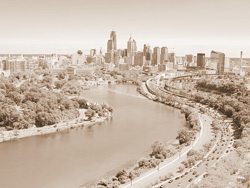
On the walls of the reading room of the Central City Library of Pskov, the work that depicts Mexico is still hung. [ 2 ] But in the evening of May 24, 2013, the views of the library visitors rushed not on the Acapulco species, but on the screen, with the help of which it was possible to look much north - to where the Delaware River flows, on the coast of the Atlantic Ocean, to Pennsylvania, to Philadelphia.
| | | --- | | 
The organizers, playing in words, called the poetic video conference between Pskov and Philadelphia as follows: the author-priest "Pskov. Russia is Philadelphia. USA".
On one side of the ocean (in Philadelphia) at that time, Vitaly Rakhman and Igor Mikhalevich-Caplan, on the other (in Pskov), Artyom Tasalov and Alexander Pitirimov were at that time.
All four write poetry in Russian. So the Day of Slavic Writing and Culture, celebrated on May 24, was their legal holiday.
In addition, May 24 is the birthday of the Russian poet Joseph Brodsky, in 1991-1992 awarded the title of “US Poet Laureate”.
“Joseph Brodsky” just became the password with which the connection between the two continents was established instantly.
"This Russian emigration in the entire history of the United States is the most successful"
| | | --- | | 
True, at the beginning of the meeting, it came from the ocean: "We live in such an isolated cocoon." But then from America a cheerful refutation came after America: "Nothing of the kind, do not listen to him ...".
“Here we have not a cocoon here in Philadelphia,” the publisher and poet Igor Mikhalevich-Caplanes began to develop the thought. - This is one of the wings. New York is one wing, Philadelphia is another wing. Many interesting writers live here. Some of them took place as writers back in Russia. For example, Philip Berman, a participant and compiler of the Anthology "Catalog", for which he was expelled from the USSR at one time ... ".
Philip Berman in Pskov is unlikely to read anyone, but many other authors published in Philadelphia The Coast (“Coast”) is well known here.
“We have two thick literary magazines, there are a lot of authors in Philadelphia,” Mr. Mikhalevich-Kaplan continued his story. - “Coast”, in fact, is not a magazine, but a society. We printed all our foreign celebrities: Vasily Aksyonov, Sergey Dovlatov, Joseph Brodsky and many other authors ... ”
To these names you can add Alexander Genis [ 3 ], Leo Losev ...
The texts of Vitaly Rachman and Igor Mikhalevich-Kaplan "Coast" also publishes annually. Now preparing for release No. 21. [ 4 ]
At the Pskov City Library, the author-priest "Pskov. Russia is Philadelphia. USA "is not the first international experience in video conferences. [ 5 ]
This time there were without technical and semantic failures.
Visibility and audibility was such that it seemed as if writers from Philadelphia were with Pskovichi on the same coast, perhaps in the next room.
| | | --- | | 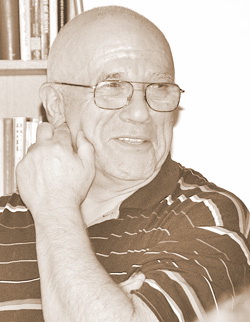
“During this time, we have accumulated a lot of interesting materials about abroad,” the editor -in -chief of the “coast” continued to introduce the American reality, “about how writers see abroad. And they see him differently ...
I published in Boston the collection "Stories of the Writers of the Russian Abroad." We have many very interesting projects. We published the anthology "Philadelphia pages" ...
The president of our society is Tatyana Stork, a world -class philosopher. I released her book in three languages. It is called a “Chinese letter”, published in Chinese, Russian and English. The name of this book was invented by Joseph Brodsky.
From a distance we were the book of Vadim Andreev - the son of Leonid Andreev and brother Daniil Andreev. Vadim Andreev was a hero of French resistance, took the manuscripts of Solzhenitsyn to the west ...
We have a good environment, but we, unfortunately, are not enough for the audience ... ”
“No, we go to Chicago, New York, Boston, and Washington,” Vitaly Rahman hastened to disagree. “This is not entirely as poor as it seems ...”.
The conversation smoothly switched from literature to wider topics.
| | | --- | | 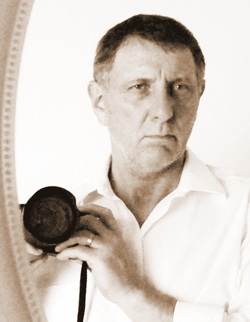
“This Russian emigration in the history of the United States is the most successful. The New York Times had a huge article, which says that she performed, performs and, I hope, will perform our emigration. Among us there are many professors of universities, directors of large companies, businessmen, doctors and so on ... Vitaly is one of these examples ... ”.
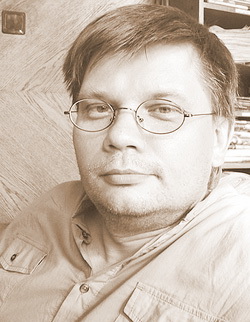
It was about Vitaly Rahman - a publisher of four newspapers, poet, artist, designer.
“He became a tycoon,” Igor Mikhalevich-Caplanes issued a verdict. “Magnet,” Vitaly Rahman smiled back.
Presumably, Vitaly Rahman is well known not only in the north-eastern part of Philadelphia, where emigrants who left the USSR and Russia live.
In any case, in Pskov, recently, his name is also known at least for those who visited the House on the Embankment in the Gallery of Modern Art (aka Safyanschikov’s house) Exhibition of the International Project “Alphabet of Art”.
The curator of the exhibition is precisely Vitaly Rahman.
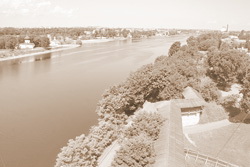
So the Delover River and the Great River, although far from each other, but not so much as not to be within the limits of visibility and audibility.
In America - the “coast”, in Russia - “House on the Embankment”. One to one.
As Vitaly Rahman wrote:
I live in the interval
In the crevice between ...
Between fears
Two continents,
Between the two languages,
Where there is a gap
Opens the nebula of the moments, ...
"Oh Lord, give the wings to my children, and they themselves will learn to fly"
| | | --- | | 
During communication through the ocean, Vitaliy Rakhman read several of his poems from the book “Oncoming Express” without closing on the same coast.
We can say that the “Chinese letter” arose in its poems - in road Chinese sketches:
Money - melting snow.
I live in the expectation of spring.
The more Vitaly Rahman read, the more saturated the irony was:
Oh, New York, Yo-Ke-Ma-Me-Nae.
On the 42nd, as in war ...
In the end, it sounded:
I slowly turn into a laboratory for processing American pharmacology ...
However, no matter how many ironic arrows fly in different directions, everything, one way or another, converges at one serious point - in the center of the target:
The whole thing is at the reference point, and she is in the daytime.
In this sense, the most indicative is the poem of Igor Mikhalevich-Caplanes “Praying for the extension of life”. He read it in the end.
His prayer ends with the words:
... Oh Lord, give the wings to my children, and they themselves will learn to fly,
Give them freedom of flight to live as long as possible,
Give them the scope of thought to love and be loved,
Let them grow old so that they do not notice this.
Let their hands and turn again into wings when I leave forever ...
Only you have the right to look at us from top to bottom and be sighted.
And only we have the right to look at you from the bottom up and be blind.
Oh Lord, our souls graze in the fields of your love.
And you are their watchman.
And do not reject them.
You taught me how to keep me near those whom I loved,
And let those who accidentally go into my house.
Forgive me, sinful, because I said so little the kind words that you taught me.
And do not judge in all severity - I have already given my wings to my children ...
"That crossroads was stolen by Brodsky!"
| | | --- | | 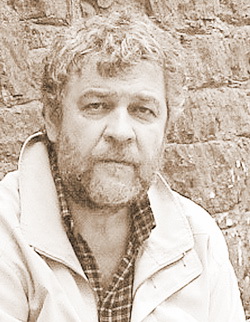
Pskov on this May evening was represented by the Pskov Muscovites - Artyom Tasalov and Alexander Pitirimov. [ 6 ] And this was an accurate choice that allowed to support the conversation at the proper level.
Artyom Tasalov chose “Russian elegy” for reading, that is, a letter-consult for “Roman elegy” Joseph Brodsky.
Artyom Tasalov recalled the existence of the poem by Joseph of Brodsky, the Pskov Register and briefly retold the history of the arrival of Joseph Brodsky in Pskov (in March 1963 Brodsky brought to Pskov from Anna Akhmatova for the book of the Hedgehog “Hedgehog and Lisa” who taught at the Pskov pedagogical Institute of Nadezhda Mandelstam.
When it came to reading Joseph Brodsky, woven into poems, Artyom Tasalov raised his index finger up:
"The shell of the domes, the spine is bell."
Split, interrupted ... The desert of the spirit.
How is it for a hill? Beautiful? Are you satisfied with everything?
Well, we, of course, have all the vigor!
"The light reapes more than he sowed" ...
As you say well, sometimes, buddy!
Well, and we have a hangover on a stranger at a feast,
There is big thousand today.
In our latitudes, but all the windows are in the sky.
The sky is our homeland, where the clouds are plain
It is just right to the people of the poor who is bread
The hand of the rabbi cannot serve life.
Mir to you! World! Can you hear? Because of the cordon
Time that stands, eagerly spreading hands,
I say: I love Elegy John Donna,
"Sitting", and yet ... do you hear? Hello to a girlfriend.
The editor -in -chief of the site Poetry.ru Alexander Pitirimov also did not ignore Joseph Brodsky.
Nobel laureate appeared at the exact address mentioned in the poem by Alexander Pitirimov:
Flying, 24 / Pestel, 27
At the corner of the foundry and Pestel
Does the vortex wise beast roam?
Drinks Duches? And soon there will be Pepsi! ..
The next arrow flew through the Atlantic.
A stingy facade with an autograph of discreet:
"That crossroads was stolen by Brodsky!"
Or trivial: “There lived in this house
Poet Joseph in the seventy -fourth. "
In this - with gypsum stucco floors
Leskov, Hippius, and the damn ...
It was about the famous literary house of Maruzi, in which Joseph Brodsky lived in Leningrad before emigration.
This is not such a trivial inscription, given that Brodsky was forever expelled from the USSR on June 4, 1972, flying away from Leningrad to Vienna.
Poets from Philadelphia asked: were there any young poets in the hall?
There were no.
I'm afraid they were not only in the reading room.
Of course, there are many young people who compose poems in Pskov. But to support a poetic dialogue at the proper level?
I'm not sure that this is possible now.
During a poetic dialogue, it became clear that the authors living in Pskov are closer to the Russian poetic tradition, and this is quite natural.
More age -related authors from Philadelphia were more prone to experiments.
Closer to the end of the poetic dialogue, the theme of Pskov arose.
It is characteristic that Pskov appeared in the verses of Alexander Pitirimov. Usually he reads something from the Moscow or St. Petersburg cycle to the public. But several years of life in Pskov finally made themselves felt:
... artillery psalms
Fasted fears and reproaches.
In the Binoculars - Pskov Plyos
And a sheet of bird cherry in Cheyokh.
Like in the palm of your hand - Porchov, the bottom,
Ludoni, Pushkin Mountains,
And we are on Pushkinskoye "but"
Alas, not too much yet ...
During the “Author-Trush”, the head of the reading room Tatyana Kotova asked: is it possible to get paper specimens of literary almanacs published in Philadelphia?
In general, everything happened like that of Joseph Brodsky in the “Mexican sabotage”: “Send almanacs and poems” (Mexico, mentioned at the beginning, should certainly appear at the end of this text).
No, here it is necessary to bring a more lengthy quote:
Opching that, I want to go home.
I miss the fatherly slums.
Send almanacs and poems ...
The Philadelphians, so be it, promised to send “almanacs and poems” to the Pskov, despite the fact that “the Russian post is clogged and does not miss any literature” and that “it is necessary to use the opportunity”.
* * *
When the “author-run” through the ocean ended safely, in Pskov a rally began-from the cuping in Zapskovye.
The listeners and participants got into the car and went to the “House on the Embankment” - watch the exhibition of the international project “Alphabet of Art”.
As the same Brodsky wrote:
Evening. The ruins of geometry.
The point remaining from the corner.
In general: the further, the more unacceptable ...
If it were not for the coastal lines, the indescribable art would finally absorb all living things.
Alexey Semenov
1 translation from English. Well Scrooge.
2 See: A. Semenov. Acute dish // "PG", No. 19 (641) dated May 15-21, 2013
3 See: A. Semenov. Law and Word Procedure // "PG", No. 35 (557) of September 14-20, 2011
4 The Journal "Coast" was founded in 1992 in Philadelphia, the USA.
5 See A. Semenov. The principality of crooked mirrors // "PG", No. 48 (620) dated December 12-18, 2012
6 See: A. Semenov. High density // "PG", No. 9 (631) dated March 6-12, 2013