
Translated material
The right to choose
Even with “controlled democracy”, the fate is decided by citizens
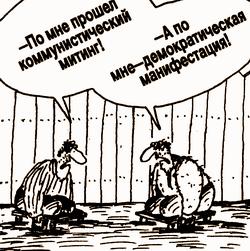
As you know, the law on parties adopted relatively recently forced many political organizations and associations to look at its future in a new way. In order not to disappear from the Russian political map forever and “do not“ go into oblivion ”, politicians have to live in strict accordance with this law.
Of course, not everyone perceived the appearance of this document “with a bang!”. You can argue about whether it is good or not. For example, there is an opinion that the new law is written primarily for the state (for the convenience of managing the masses) and only then for the citizens themselves. But, be that as it may, the law on parties is first designed to systematize active participants in Russian politics, to ask them the general rules of the game. This is probably not bad, first of all, for voters. After all, now political parties will not be able to sit out from the elections to the elections. They will simply need to work with their supporters, daily proving their right to life.
Analysts predict that in Russia there will be no more than 10-15 combat-ready parties. And, most likely, the leading positions will be preserved by those organizations that are now half a step ahead of all. These are parties with a representative office in the State Duma. However, what the future of the main Russian parties will develop largely depends on what they will go directly to voters. Whether the Russians will perceive goals, objectives, guidelines voiced by the leaders of various political movements.
Indeed, with all the similarity of the slogans, almost all parties without exception, proclaiming a worthy life for humans, there are significant differences in their views on how to achieve this. In the generally accepted classification, Russian political parties are divided into “left”, “right” and “centrists”. Expressors of left -wing ideas are traditionally considered by the Communist Party and close to it. The most striking representatives of the right flank are ATP and Yabloko. The rest - “unity”, OVR and others - call themselves centrists.
It is worth noting that the fashion for “centrism” arising two years ago radically influenced the redistribution of political forces. Being a centrist today is prestigious and profitable, it means to be near the authorities. It is no secret that a significant expansion of the Center base is due, first of all, by the desire to get into the fairway of the popularity of President Vladimir Putin. All attempts to develop the ideology of the so -called Russian conservatism have not yet led to anything. The ideological blurry of the centrists, of course, is their weak link. This once again allows us to say that the main goal of the centrist movements in Russia is not always disinterested support for the initiatives of the authorities in any endeavors. At the same time, genuine tasks of the political organization as such fading into the background for the sake of tactical and strategic interests of the ruling circles.
Russian “left” have a more structured ideological component. However, it seems that the Communists have not managed to adapt their ideas to the conditions of the new Russia. They act in the old fashioned way, adopting the Marxist-Leninist theory of building communism, closing with ideological dogmas from the present. The burden of the former greatness of the CPSU is still dominating them. The Communists need a "sip of fresh air", which they seem to be no longer able to find. That is why the outlined tendency to reduce the social base of the Communist Party is likely to develop in the future.
In contrast to the Communists, the “right” (ATP and “Apple”) are acting, which see Russia with a democratic state. The right ones have clearly formulated principles of liberal ideology, among which the most important are the freedom of personality, the right of private property, and the competitive market economy.
It must be frankly that at present the democratic camp is in a very difficult position compared to the representatives of the “left” and “centrists”. The Communists, despite the lack of modernized ideas, are still strong for their loyal and disciplined supporters. The position of the center with the creation of a new political monster represented by “unity”, “fatherland” and “all of Russia” seem completely unshakable. Based on the immortal and omnipotent Russian bureaucracy, the centrist "United Russia" (the so -called new association) expands the nearby area of the political spectrum, trying to take both to the left and to the right. At the same time, the declared democratic freedoms are no more than a well -polished external part of the established bureaucratic mechanism that has launched deep roots into Russian reality. The model proposed by the centrists was dubbed “controlled democracy”, according to the mark of Grigory Yavlinsky.
In fact, it is. The state, or rather, even the state apparatus, seeks to manage society. For this, pocket institutions are created: parties, public organizations, trade unions, media, etc. In words, everything is beautiful and smooth, in fact - the role of civil society, which is the basis of any democracy, is purposefully belittled. This is done not too intrusive, but persistently. An unconditional priority is given to the state, not a citizen. Manipulation of democratic concepts builds only the appearance of freedom, playing the authoritarian and bureaucratic system. In such a situation, a person can hardly be truly free.
Such a picture cannot arrange a similar picture, so they oppose. For them, personal freedom is above all. They reject the “controlled democracy”, advocating for the creation of an open civil society consisting of people with personal freedoms. From the point of view of common sense, few people will undertake to argue with this thesis. And the latest public opinion polls conducted in different parts of Russia indicate that the most part Russians see the future of the country in the development and strengthening of democracy.
So why are the right with their thoughts aimed at approving basic democratic values, can not win stable electoral sympathies? For example, in the current composition of the State Duma, the SPS and Yabloko faction occupy very modest positions, being the smallest. Right and great successes in the regions in the elections of governors and local legislative authorities cannot boast.
The reasons for such an unenviable position of the right are quite obvious. Over the past 15 years, the change in the socio-political structure of the state has been largely painful for the overwhelming number of Russians. She passed under the sign of democratization, but the ruling elite, which realized her to life, acted, to put it mildly, not by democratic methods. But a simple person was underway to understand all the intricacies and intricacies of the struggle for power in the post-Soviet period, when the ex-party nomenclatures, realizing where and where the wind blows, urgently rushed to try on new masks of democrats.
Thus, in Russia, “own” democracy, defective and perverted, democracy for the elected ones originated in Russia. And here we are not even about catastrophic consequences for many shock economic therapy, but about the principles of internal self -organization of power. Naturally, most citizens expected from the changes completely different, so in the beginning and middle of the 1990s the very concept of “democracy” had a certain rejection. In democracy, they simply lost faith, presenting it with something ideal and unattainable. From here, inertial passivity appeared in the progressively thinking part of society, giving additional points to the supporters of hidden authoritarianism. The soil for “controlled democracy” was prepared.
Do not forget that in 10 years the Democrats have not been able to unite and act as a united front, which very often reproach them. Objective circumstances, on the one hand, and the ambitions of some leaders, their inability to make concessions, on the other, are called the fault. However, the passionate desire of some to have one large democratic party may be erroneous. After all, the democrats differ in the fact that they cannot be driven into a herd, each of them acts based on their own choice. In principle, today in Russia there are two large right -wing parties - the “Union of Right Forces” and “Apple”. They represent two different directions of liberalism: radical and social, therefore their potential unification, even if possible, is unlikely to be productive.
It must be admitted that in the right -handed right -handed right, it is extremely difficult to convey to the consciousness of voters their vision of the future of Russian society. They need to prove that Russian liberal thought has the right not only to exist, but also to implementation. Given the nostalgic voices on the “strong hand” and skating authoritarian notes in the mood of the highest rulers, this will not be easy to do. That is why the right -wing struggle is a serious struggle to defend democratic principles and values.
Other political players mentioned by us will strive to conquer the minds and hearts of Russians. Each of them firmly intends to settle in the Olympus of the authorities. This is their right. But with all the inconsistency of the current state system, the paradox lies in the fact that it is still to decide who will be at the tops of the political Olympus. This is our right. The right to choose.
Alexey Golubev,
correspondent of Rosbalt IA,
Especially for the "Pskov province".
Figure Vyacheslav Shilov.