
Translated material
6 digital rights that we have
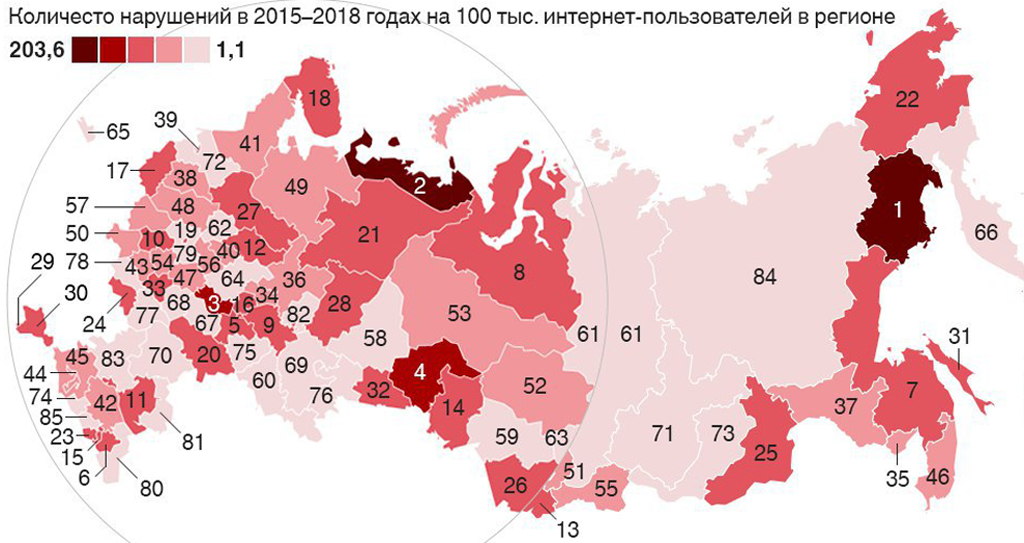
Freedom of speech is violated in Russia, this was shown by the study by Freedom on the Net for 2018 . In the rating of the non -governmental organization Freedom House, our country scored 67 out of 100 points, while China, where the most stringent censorship received 88 points. Julia Kalenkova, journalist of Teplitsa, understood what rights users have and why they are not respected.
Digital rights have not yet been enshrined in law. The bill , which is only at the stage of the second reading in the State Duma, introduces the new Article to the Civil Code. 141.1, which defines “digital law” as a set of electronic data, which certifies the rights of things, other property, the results of work and the provision of services. In addition, the bill proposes to introduce a new article 783.1 into the Civil Code of the Russian Federation, which legalizes the collection and processing of information (Big Data).
The right to access to the Internet
It consists in the fact that all people should have access to the network to realize their rights to freedom of expression, search, transmission and dissemination of information. In other words, regardless of your social status, financial situation and other factors, you have the right to access the network - both wired and wireless.
At the official level, not only this right was not recorded, but also the minimum data transfer speed that the state and providers guarantee each citizen. That is, there may not be technically tools for the exercise of law. By the way, the first country in the world where broadband Internet access was recognized as one of the human rights was Finland .
The right to search, receive and transmit information
The right to access information, or the right to know, is based on Art. 29 h. 4 of the Constitution of the Russian Federation: “Everyone has the right to freely search, receive, transmit and disseminate information in any legal way” (that is, actions will not contradict the freedoms, rights and interests of the individual, society and the state). Meanwhile, tools for the exercise of this right (the same right to Internet access) have not yet been spelled out in the legislation.
There is only an ethics code for the information society (UNESCO, 2010). It is enshrined: “People should have free access to all the information presented to them by others. People should also have convenient tools that allow them to easily, quickly and effectively produce information, exchange it and gain access to it. The authorities should not deprive the public of access to information and other communication products on the Internet by overall blocking or filtering information regardless of borders. ”
The right to use, creation and publication of digital works
It should be borne in mind that the work is digital if it has a numerical nature available for interaction with computer digital technologies. It is not only about reproduction on a computer, but also, for example, in MP3 players, cell phones.
The universally recognized standard for the presentation of information about digital objects is the system of the digital identifier of the object ( Digital Object Identifier , Doi). It allows you to register content and subsequently check the conditions for its use according to the assigned number. These can be text works, music, audiovisual works, photographs, tables, preprints, drawings, as well as other works presented in digital format. The domestic analogue of the DOI is the national platform for the accounting, storage and turnover of rights to intellectual property n'ris (National Intellectual Property Register). The service protects all types of copyright, working on a blockchain.
The right to privacy on the Internet
This is the right to store, transfer, provide third parties and display information to anyone via the Internet. First of all, we are talking about protecting personal data. Confidentiality concerns the collection of user information from various sources, such as accounts and consent to the processing of personal data. However, in practice, this right is not legally fixed, which creates serious risks. We examined more about who and how collects information on the network about you in a separate article .
The right to anonymity
It includes the right to anonymous search for information on the network and anonymous sending personal messages (e-mail, messengers), posting (publishing information on the Internet), the right to anonymous payments (including the use of cryptocurrencies), as well as the creation and distribution of works.
Currently, anonymity on the network, like privacy, is at risk. For example, the bill No. 184222-7 on the ban on the anonymity of messengers users is in force, which actually violates the rights of citizens. The authorities block the VPN services and try to follow the citizens, based on the “ Yarovaya Law ”, which obliges the operators to store user traffic for 30 days.
Right to freedom of speech
Article 29 of the Constitution of the Russian Federation guarantees everyone freedom of thought and word. Access to the Internet expanded the sphere of realization of this right, allowing you to broadcast any information on the network. In this case, it is worth considering the problems of regulating the digital space: the restriction of information and the number of real terms for utterances on the Internet.
In 2018, Roskomnadzor introduced more than 130 thousand IP addresses of the Azure cloud service from Microsoft to the register of prohibited resources). And in 2019, the authorities intend to block “dangerous information”, although legally they do not have the right to do so. The reason is simple: the body responsible for the decision in this area is not yet fixed by by -laws.
The sociologist, Internet research, coordinator of the club of Internet lovers and the Society of Polina Kolozaridi , focuses on the separation of the concepts of digital literacy and digital rights. In her opinion, digital literacy is a broader concept. It is associated with technical literacy, and with the ability to distinguish verified information from unverified, and with skills in the network. If some people are more literate, we are talking about "digital inequality." And this is a systemic problem that has solutions-these are Internet courses, and the help of like-minded people, and a reasonable approach to the introduction of new digital services from business and the state.

“Digital rights are a more difficult and young topic. It is closer to legal problems, and now there are no ready -made solutions in it. Who owns the data that we leave today in the city and the Internet? How is the publicity of statements is regulated, can the user himself and should do this? In what cases is there anonymity, and where is it a fiction? All these issues are painful, conflicting, and we are present when determining this concept. I would advise not to look for the final truth and simple solutions here, but to think through what position on various issues is close to you personally, ”summarizes Polina Colosaridi.