
Translated material
Channel
In uniform
 Channel
July 9, 2010 Alexander Podrabinek
The exchange of prisoners is a rare event in international life. At least in peacetime. Prisoners selected for exchange can consider themselves lucky, tearing a large gain in the lottery. Imagine: yesterday - a camera, hopelessness and a long time ahead, and today, unexpectedly, as in a fairy tale - freedom, family, friends, maybe emigration, but still freedom! I would like to be glad for each exchange, regardless of his citizenship, the term of punishment and corpus delicti.
Exchange rarely occurs not only because they require extraordinary agreements, but also because they clearly contradict the law. In which country is there a law allowing the exchange of prisoners with other countries? Obviously, politics prevails over justice. In any individual case, this, perhaps, can be pleased, but in general, a person who respects democratic institutions and law cannot cause delight. What are court decisions in the legal country if they can be canceled by the decision of the government?
Of course, there is nothing in the country of unlawful and undemocratic, and there is nothing to be surprised, and it remains only to rejoice for the freedom of the convict. How we rejoiced at the exchanges of our dissidents in the Soviet years. Then it never occurred to anyone to lament about the illegality of such shares - in the country of total lawlessness it would be inappropriate. Although even then, from the point of view of the law, the exchange looked quite wild.
When, in 1976, the Chekist team took Vladimir Bukovsky from the Vladimir prison to Lefortovo, and then by plane in Switzerland, he still had a term. The verdict was not canceled. In fact, the KGB arranged for him to escape from prison. Moreover, he was illegally transported across the border, since he did not give his consent to leave.
Another famous case is the exchange of five Soviet political prisoners for two Soviet spies caught in the United States - employees of the Soviet mission to the UN Rudolf Chernyaev and Valdik Engra. In the spring of 1979, Alexander Ginzburg, Eduard Kuznetsov, Mark Dymshitsa, George Vince and Valentna Moroz directly from the Mordovian and Perm political camps brought to Moscow, and then to New York. At the airport to them. Kennedy was made an exchange. The verdict of the dissidents was not canceled, there were no court decisions on early release either. There was a decree of the Presidium of the Supreme Soviet of the USSR on the deprivation of their Soviet citizenship.
Neither Vladimir Bukovsky, nor these five political prisoners were filed about pardon, they did not buy freedom at the cost of repentance in imperfect crimes. In addition to Dymshits and Kuznetsov, none of them had declared the desire to leave the USSR before. Actually, they, and even Alexander Solzhenitsyn, were the only Soviet history in the post -war period, whom they really sent from the country. The rest left, one way or another, having given their consent to emigration. Including in the order of exchange.
Of the dissident cases, you can recall the exchange of political prisoners Anatoly Scharansky. In 1986, by agreement between the USSR and the USA, he was exchanged for two arrested Soviet spies - the spouses of Karel and Khan Köher. In addition to them, the Americans gave Moscow to the Soviet spy Yevgeny Zemlyakov, Pole Jerzy Kachmarek and German Detlef Sharpenort. In addition to Shcharansky, they received two more Germans and one Czech. Thus, 9 people participated in the exchange. It took place through the mediation of the East German lawyer Wolfgang Fogel, who specialized in affairs of this kind (Germany often bought political prisoners from the GDR).
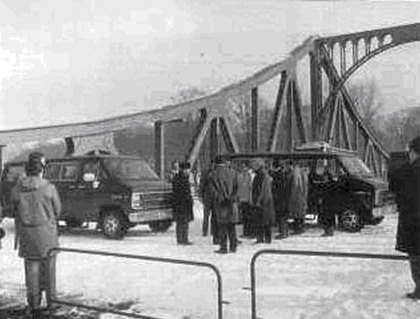
The exchange was carried out on the morning of February 11, 1986 on the Glinic bridge on the border of the Western and Eastern Berlin. On the western side, five prisoners were brought to the bridge in two minibuses that placed across the bridge. From the east side to the border on cars, they brought Scharan and the rest. Anatoly Scheransky was the first to cross the border and found himself at large.
The Glienicker Brücke bridge is not accidentally called a "bridge of spies." On February 10, 1962, the Soviet intelligence officer William Fisher, better known under the name of Rudolf Abel, was exchanged on this bridge on the American pilot Francis Powers, whose reconnaissance aircraft was shot down over the Urals on May 1, 1960.
In 1964, on the same bridge, the Soviet spy Konon Molodi, who was arrested in 1960 and received 25 years in prison, was exchanged for the British intelligence officer Greville Winn, who was a liaison of Colonel GRU, Oleg Penkovsky, cooperating with Western intelligence. They were arrested in October 1962, and next year Penkovsky was sentenced to death, and wine - to eight years in prison.
However, not all exchanges took place according to such a “spy” scheme. In some cases, the defendants in the exchange were simply released by mutual agreement. So, on October 5, 1986, on the eve of the meeting of the heads of the USSR and the USA Mikhail Gorbachev and Ronald Reagan in Reykjavik, who was in exile in Yakutia, Dissime Yuri Orlov was released in the United States. Thus, he was exchanged for the UN Soviet employee, Gennady Zakharov, who did not have diplomatic immunity arrested in this country and was accused of espionage.
There are not many cases of exchange, although perhaps they are not all widely known. All of them belong to the period of the Cold War, which is understandable: it was in these times that in our country there were so many political prisoners, and intelligence of the East and West conducted intensive activity against each other.
What does the resumption of exchange practice mean? In my opinion, this quite definitely indicates that the “Cold War” in a latent form continues, despite all attempts to portray new Russian-American relations in the form of “rebooting” or some other pretty abstraction. All components are evident: political prisoners in Russia and Russian intelligence in the United States. Of course, all this is a bit like a farce, to imitate the time when the superpower opposed each other seriously. Apparently, many are still strong nostalgia for those times.
Why farce? Judge for yourself. Russian spies that have pierced in the USA are an example of amateurism and wretchedness. The ten -year hunt for them of the FBI agents to match the seriousness of the Russian spies themselves. Political prisoner Igor Sutyan was not a political opponent of the regime and went to prison quite by accident-simply because the FSB needed to demonstrate its success at least in something. There is neither political guilt nor spying on Sutyan. He is a random victim of Chekist ambitions and conscious frauds. For work with open sources, he received 15 years in prison - a completely dramatic result of the FSB of Fars.
At the trial, Sutyan did not admit his guilt. A large public campaign was carried out in his defense, Amnesty International recognized him as a prisoner of conscience. Three years ago, Sutyan filed a petition for pardon, and a few days ago he repented in writing into a crime imperfect. It became the cost of freedom. According to his relatives, he explained his repentance by the fact that he refused to write him, the exchange would not take place and he very sorry for the Russian spies arrested in the USA, who would have had to be in prison, like him. A strange, it seems to me, an argument and a very weak position, especially considering that people who defended him all these years were sincerely convinced of his innocence. It is unlikely that they will now change their opinion on this subject, but henceforth, they will probably be more careful in such matters. At least with Russian political prisoners.
Everyone sets the price for his freedom himself. The choice of “sitting or not to sit” the political prisoners are almost always. At the same time, you can be guided by a variety of reasons. When, in 1987, at the beginning of perestroika, more than two hundred Soviet political prisoners were freed, submitting a petition for pardon (there was such a shameful page in our history), the recognized authority of the democratic movement Tatyana Velikanova refused to write a petition because, in her opinion, this would “be ugly”. Here is such a aesthetic criterion in human rights activity.
Igor Sutyagin is difficult to congratulate on liberation, but we can be glad that he is free. True, it is completely incomprehensible why he needs to leave Russia. In this voluntary-compulsory exit, echoes of espionage exchanges of the announced Cold War are heard. But today, if Sutyagin has Russian citizenship (and no one can deprive him of his citizenship), then who will forbid him to come to Russia at least for a while, even forever?
A strange game is played by Russian special services. It seems that they thought out the idea of exchange in a cruel hangover, somehow, without even trying to correlate their plans with applicable law and real life. Perhaps in the same state they also prepared Russian spies to work for the cordon. Well, they are ours, and this explains a lot.