
Translated material
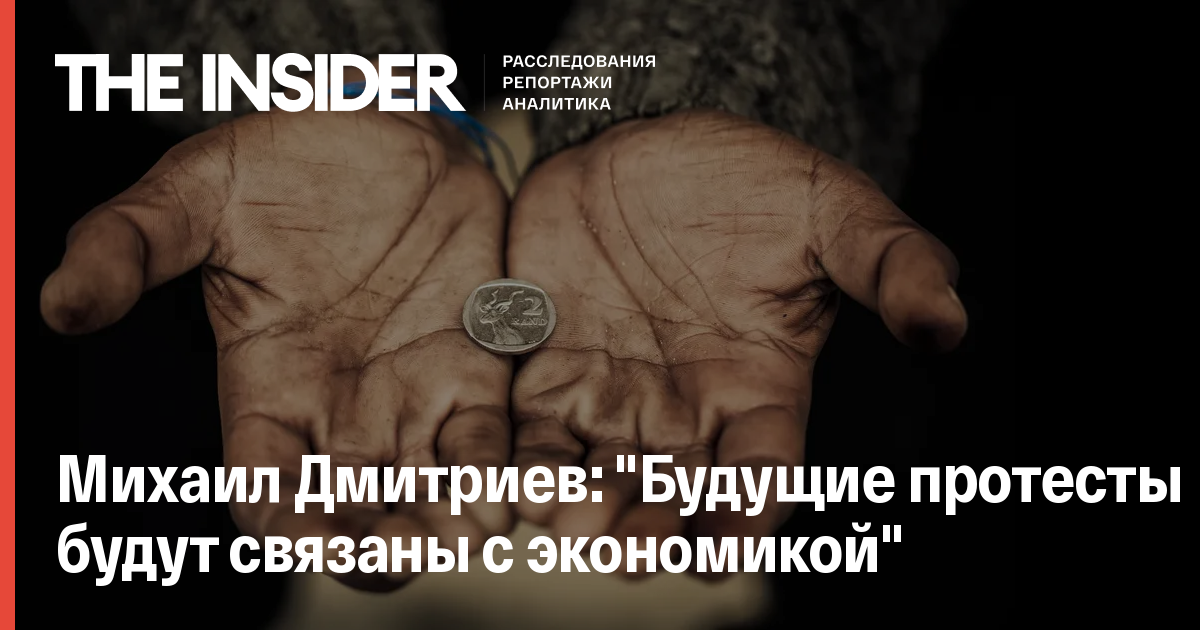
Mikhail Dmitriev: "Future protests will be associated with the economy"
Last week it became known that Mikhail Dmitriev was shifted from the post of head of the Center for Strategic Development. Shortly before that, the expert was attacked at the entrance of his house, that both the police and the expert himself are associated with his professional activities. Mikhail Dmitriev is known as a person who predicted mass protests who broke out in December 2011 and conducting independent studies of public mood today. The Insider talked with Mikhail Dmitriev about how stable the support of the authorities, whether a new wave of protests is possible and how it can be caused.
- Mikhail Egonovich, after the start of Ukrainian events, we see how many hundred -cops appear in the media that show the unprecedented consolidation of Russian society and a sharp increase in the support of the authorities. How much can such surveys be trusted and how solid is the methodology of their conduct?
- In the spring, we planned to conduct a larger study than the preliminary December, which revealed the potential of rather serious movements in public moods. But we refused to conduct it precisely because we expected a strong distraction of the focus of public attention to a foreign policy. Since we did not conduct such studies in March or in April, we have no our own data, according to which we could draw conclusions, but I and Sergey Belanovsky - we believe that the results that are published, for example, FOM - they are very interpreting. That is, they really reflect how the public opinion may hypothetically change, taking into account the events. We are somewhat surprised by the scale and sharpness of these shifts. If we built forecasts, we would hardly have suggested such an amazing homogeneity of public consciousness, especially the middle class in Moscow. Nevertheless, in general, such a homogenization of public opinion does not surprise us, it is typical of such situations.
- At the same time, after Ukrainian events, a feeling of sharply growing gap between the supporters and opponents of the authorities arises, is that so?
- It is between a relatively small group of the modernized part of the intellectual elite and the bulk of the population. In my opinion, the main part of the middle class is now not much different from the bulk of the population in their views on foreign policy events and the roles of power in them. The real position is occupied by only part of the most enlightened intellectual elite, quite a few and currently not possessing levers of social influence.
- How resistant is this growth of public support for the authorities?
- The very speed of changes in public mood shows how these moods can change in the opposite direction. What happened, in no way can indicate the stabilization of mass consciousness, social priorities, attitude to power and perception of the role of foreign policy events. This is really a very fast shift, which simply indicates that the mass consciousness is bred from balance and equally quickly it can swing in a different direction. As for fundamental factors, they still remain relevant. The fundamental factor that determines the political moods of Russians in the medium term is still economic expectations, as we see as a result of a sufficiently deep analysis of primary panel sociological data for different parameters. The temporary actualization of foreign policy issues will only briefly distract the focus of attention from economic problems. Especially if the development of the situation is accompanied by further inhibition of economic growth.
- Which factor in the economic sphere is the main pain point?
- These are expectations that the population derives on the basis of very diverse assessments of the economic condition - their own and others. Here, inflation, current consumption, and assessments of the general level of financial and economic stability matters. It is difficult to say which factor prevails, but ultimately everything is determined by the long -term trend of income level.
- How important the unemployment factor is, because as we see on the example of countries where non -violent revolutions have recently occurred, there it was quite significant. This is not only a matter of income, but also that some people do not find application in society.
- We had two waves of large mass protests, one on the periphery in 2010, under the influence of purely economic problems, and there the growth of unemployment played a rather important role, although, in my opinion, it is not decisive. And the second wave is the protests in Moscow, which were political in nature, and they were no longer connected with unemployment (which in Moscow did not even exceed 1%during the crisis), or with a real worsening standard of living, because these protests occurred in the conditions of an increase in income. As for the upcoming economic problems, the bursts of unemployment will be narrowly local in nature, and only small cities will affect, in which the enterprises of restructured industries, that is, old engineering, ferrous and non -ferrous metal industry, is possibly woodworking or chemical industry dominate. As for large city centers, the problem is the exact opposite. We see this according to the statistics of the market of February-Marta. There is a sharp deterioration in the expectations of managers in the industrial sector. Against this background, the number of jobs looking for 100 vacancies is reduced. That is, roughly speaking, simultaneously with a decrease in employment and a deterioration in the economic situation, there is a decrease in excess labor in the labor market. At the same time, employment is reduced, and the unemployment rate, nevertheless, has fallen to a historical minimum over the past quarter century - 5.1%. And this is due to the fact that in the coming years (and in relation to this year this is also fair), more than 500 thousand people will leave the labor market annually due to age and demographic shifts. Therefore, even when the employment falls, you should not wait for the growth of unemployment, and this factor is unlikely to play a decisive role in changing the mood of the population.
- If in the future we will still see public unrest, then they will rather be caused by economic or political reasons?
- I think that if political moods change in the negative side, then only under the influence of the economic situation. Moreover, before the start of Ukrainian events, already in December we recorded quite strong negative moves associated with the objective deterioration of the economic situation in many regions. It was just that we had a small sample and it was difficult to draw far -reaching conclusions, and now these shifts are slowed down thanks to foreign policy events. But since the economic situation is only worsening, after a while, most likely, these issues will again affect political moods.
- What segments of society will first react to this?
- This applies to the entire population of Russia, there are practically no segments where economic factors would not play roles. So far, perhaps, the inhabitants of Moscow attach less importance to these factors, but in other regions, including the largest millionaire cities, these motives are key in the formation of political mood trends.
- Does the role of television change in the formation of public opinion? Will it be able to continue to convince the population that everything goes well?
- Now, under the influence of foreign policy events, the level of trust in television apparently increased significantly, and it again restored the dominant role of the channel for obtaining information about priority events for some time. But at the end of last year, both our research and studies of other organizations (for example, a VTsIOM survey of trust in different media) confirmed the trend in weakening of trust in central television channels. For example, according to VTsIOM polls, the balance of trust in central television channels (that is, the difference between positive and negative estimates) was only 1%. And in relation to radio channels, which are much more diverse and less controlled, as well as Internet sites and print media, excess of those who trust the non-dispersal were two-digit, that is, from 12% to 20%. According to our December focus groups, we revealed a similar trend, and it is interesting - the tendency to fall confidence in the central television channels on the periphery, in those relatively small cities that were distinguished by a dysfunctional economic situation, was especially noticeable. In particular, we found an increase in interest in the Rain TV channel, which at that time had an audience of up to 17 million people, and for the first time heard people began to talk about it. Before that, we have not met any references to the rain.
- And how the perception of the Internet is changing, because still the penetration coefficient in Russia is already very significant.
- In my opinion, this is a difficult process. Rather, people want to find sources that more neutrally and objectively present information. On the central television channels in December, we received a lot of statements that this information is unreliable, people ceased to believe them. But it was in December, now the situation has changed. But the balance of confidence in the Internet is a more complicated issue, for example, to news Internet sites, the balance of trust is not bad, although not maximum, but to social networks, blogs and forums the balance is negative, minus 12-minus 20%. That is, on the Internet there are different segments that cause a different attitude.
- Many have the impression that the warlike rhetoric of recent months as a whole increases the level of aggression in society, which affects, for example, to the growth of xenophobia.
- We, in autumn research, interethnic problems clearly had a tendency to strengthen, but the measurements themselves were not large-scale enough to draw any conclusions. But from recent studies, the rating of ethnic tension of the regions, which was published a week ago, and there, in the four of the most problematic regions in combined statistical indicators (there the rating was measured not sociologically, but by the number of open clashes between representatives of different ethnic groups), Tatarstan entered, which in the early 2000s was difficult to imagine. Tatarstan was traditionally quite calm and tolerant territory. Changing the situation there is a very disturbing signal.
- That is, there is still the possibility that aggressive foreign policy rhetoric can splash into the growth of xenophobia within the country?
- Yes, such risks are possible, although so far I would not make far -reaching conclusions.
- Returning to polls. Here you quote the FOM and VTsIOM, but how much can you trust their methodology, can their surveys distort their real picture, and not so much reflect as directing public opinion?
- In our focus groups, we try not to ask leading questions, this is the main essence of our methodology- to minimally direct the opinion of people, allowing them to express what follows from their own ideas and sensations. FOM and VTsIOM are mainly engaged in quantitative surveys, there the structure of the profiles with pre-formulated questions and options for answers by will-nilly reflects the ideas of sociologists about the problems, and not just the ideas of the respondents themselves.
- Do you, as an expert, do not feel some pressure from the authorities to an independent expert community?
- We live in new social reality, it just needs to be admitted. The possibilities for discussions (including expert discussions) narrowed, they are not in demand by power, and I think that the expert community has already realized these restrictions.
- Is it about restriction or still pressure? We see what is happening in the same CSR, for example ...
- Call it as you like, but the real opportunities for such discussions are significantly already than a few months ago. Our example with the CSR, in my opinion, is just one of the events that is in the general trend, it is no different from many other events that occurred in this direction.