
Translated material
In the footsteps of the Inquisition
In society
 In the footsteps of the Inquisition
July 13, 2010 Alexander Podrabinek
Typically, a sentence is considered an apotheosis of the trial. "How much will they give?" - The public is worried, and everyone understands that we are talking about crime and punishment. And if, for example, the shadow of the offender is recorded in accomplices of a crime committed thus, a criminal group and by prior conspiracy, then everyone will be more interested in the resources of the prosecution, and not a court decision.
Approximately the same situation was in the process in the case of Yuri Samodurov and Andrei Erofeev, who on Monday July 12 in the Tagan court of Moscow was sentenced. No, of course, the defendants themselves were very worried about the result - they will be imprisoned or fined. But the audience tried to understand - for what? What are they accused of? What are they to blame for?
Yuri Samodurov and Andrei Erofeev were accused under Article 282 of the Criminal Code of the Russian Federation of inciting religious enmity in connection with the organization of the exhibition “Forbidden Art-2006”. In the exposition of this exhibition, held in 2007 at the Museum. Sakharov (which was then led by Yuri Samodurov), the works of modern Russian artists were presented. A year earlier they were offered to various Moscow exhibition halls, but were not allowed to show art councils or directors. Andrei Erofeev, Head of the Department of the latest Tretyakov Gallery Tretyakov Gallery, caught up to arrange an exhibition illustrating the degree of censorship in the cultural life of the country.
The degree of censorship found out, but the degree of idiocy of the Russian femid was not provided. One could not lament about the cave consciousness of obscurants from the "people's cathedral", "folk protection" and other pseudo -Christian Orthodox organizations that encouraged the authorities for reprisal with their alien understanding by culture. One could not even regret the depressing intellectual and general cultural level of investigators, prosecutors and experts who participated in this matter. But it is difficult to come to terms with the meaninglessness of the court, designed to put an end to any criminal case.
All evidence of the prosecution was accepted by the court for faith. All evidence of protection is marked. The verdict says so: the court does not take into account the arguments of the defense. Holy simplicity! As ordered, he thinks. What he thinks, then he says.
I will not dwell in detail on the analysis of the exhibition work itself, the “Hedgehog” has already written about this. It is much more interesting to describe how the accusations witnesses learned about the exhibition from radio programs or from acquaintances, came to watch the exposition, and then, offended to the core to see, were in a hurry to write statements to the police. By the way, almost all of them are written as a carbon copy. A normal judge in a normal court of a normal country would suspect the falsification of evidence. But then in the conditions of normality. Everything went into business with us. In a criminal case. And in the verdict.
Most of the witnesses were not even at the exhibition, they themselves did not see anything, but were offended in absentia-from someone else's words, according to someone's stories. This, too, went into business. The expert Aneev, who decided that the exhibition was not an artistic action and “under the name of art was held a purely ideological event,” did not see the exhibits themselves either. She was satisfied with paper copies. But she sat down her conclusion by many scientific words, such as the “dysphoric ridicule of religious beliefs”, not knowing, apparently that the dysphoria is just accompanied by pain and depression premenstrual disorder, and is very relative to art. But this went into business. Now the Russian court seems to me a universal energy attitude capable of consuming any fuel - raw, inconsolable at all not suitable.
Many people and organizations have embarked for Samodurov and Erofeev. The European cultural parliament said that, pursuing Yuri Samodurov and Andrei Erofeev, the authorities seriously violate Russian and international law. A group of famous Russian artists and artists - Ilya and Emilia Kabakov, Oscar Rabin, Oleg Komar, Vitaliy Komar, Alexander Melamid, Eric Bulatov and others - turned to President Dmitry Medvedev with an open letter, in which they ask to stop the trial and withdraw all the accusations from the organizers of the exhibition. The famous galleryist Marat Gelman announced that he intends to repeat the exhibition “Forbidden Art-2006” in his Moscow gallery if the court finds Andrei Erofeev and Yuri Samodurov guilty of inciting religious growth. According to him, the exhibition will open the day after the sentence, if the verdict is not justified. Even the Minister of Culture of Russia Alexander Avdeev, who said that "the public assessment of the exhibition should be moral and ethical, and not judicial, made up.
Nothing helped. Refusing the prosecution is how to immediately lose his face to the whole state (or what is there in this place?). The state is everything, justice is nothing. However, the verdict was softer than expected. The prosecutor demanded 3 years in prison to each of the defendants. Evaluate: in Tuva this winter, the inspector of the traffic police of Borbaka-ool Bair, who killed a schoolboy and his friend, was sentenced to 1 year and 3 months in prison. And here for organizing the exhibition - 3 years each! Here it would be, justice in Vertical! But not passed. The attention to this process is too great. It is inconvenient all the same. Therefore, the judge was limited to a fine of 200 thousand rubles for Samodurov and 150 thousand for Erofeev.
Probably, the court issued a politically balanced decision. Church obscurantists and zealots of statehood should be satisfied with the very fact of the conviction. The civilized audience should be delighted with the relative softness of the punishment. Justice has nothing to do with it. The court has no place to clarify the truth.
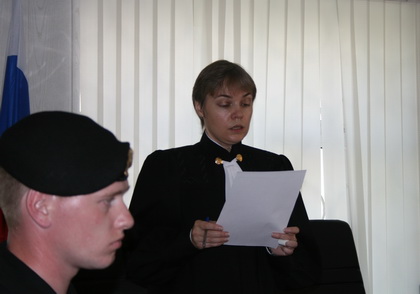
Judge Svetlana Alexandrova, sweating later, in the small stuffy hall of court hearings, cursed by journalists and an interested audience, read her sentence for two and a half hours. In a monotonous voice, she read out dozens of pages, from which it was completely impossible to understand who and what was to blame: the artists who painted these paintings; The organizers of the exhibition or the press, who told readers, listeners and spectators about the exposition at the Sakharov Museum. It was a outlandish document. At every step there were such expressions as “insulting the feelings of the Orthodox believers” and “the suffering of the audience” who saw paintings at the exhibition. The impression of the complete absurdity did not leave me during these two and a half hours. The audience languished, shifting from foot to foot, not risking, however, to leave the hall at all, so as not to lose the place with difficulty and not to miss the most important thing.
Somewhere from the second hour I, like everyone else, lost interest in the meaningless repetition in the verdict of monotonous testimonies of crazy witnesses of the prosecution. I was occupied by a linguistic mystery set by the judge. In the verdict, she pointed out a swearing word of four letters in one of the paintings, but out of modesty she did not utter it out loud. All the remaining time, to the final lines of the sentence, I tried to understand what kind of word it was, but I never guessed. The verdict was a mystery.
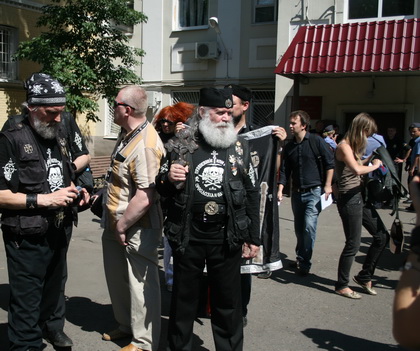
Meanwhile, outside the window were heard the songs of the Gorgnens, praying for the sending of the death of Samodurov and Erofeev. However, a decent crowd of supporters of the defendants stood in front of the court's doors, waiting for the sentence. When the punishment was declared and the defendants left the building, the atmosphere was heated. The obscurantists were depressed by such a mild punishment and did not hide their disappointment. In the courtyard of the trial, fierce discussions flashed, which television men were happy to shoot them with pleasure. However, it did not reach the fight. Maybe because a numerical advantage was clearly among supporters of freedom and cultural diversity.
Samodurov and Erofeev intend to appeal the verdict. It is unlikely that justice will triumph. And certainly, many in the world will further strengthen the opinion of Russia as a barbaric country with inquisition justice and wretched religious life. Which, perhaps, is not quite true, but thanks to the brilliant “Tagan” justice, it becomes a common place.