
Translated material
Remember everything
We continue the cycle of materials “The Terrible Year”. Situation-2020 ” on the deplorable state of the world at the beginning of the third decade of the 21st century.
After a big interview with Konstantin Haaza , the text of Kirill Kobrin about the reconciliated local conflicts - in the crooked places of the colonial delegation.
I first heard the word "Agdam" in 1988. I did not see , namely, I heard - before (and for some time after) I and my friends were emptied by a considerable number of bottles with this word on the label. So I saw him often by that time. "Agdam" was the name of a nauseating alcohol fluid sold in the USSR under the guise of port. In fact, this is a mixture of alcohol with sweet waste from the production of juice or something like that. "Agdam" was (relatively) cheaper - for this we loved him.
Until the age of 24, I did not suspect that “Agdam” was a toponym - just like the other “port”, “Karabakh”. No surprising: there are no settlements called “777” or “steppe fragrant”, and we did not write the other by the poverty of funds, it was not up to Massandra. And suddenly, in the third year of perestroika, a familiar mutter suddenly found a voice in addition to taste, and the voice of an alarming, despite the patented impassivity of the Soviet radio -dialectors. It turned out that in "Agdam" - and indeed in "Karabakh" - shoot, explode, destroy, kill. Prior to this, it was allowed to kill (collectively, not individually) on the territory of the USSR only to the Germans during the war. It is known how this ended for the Germans. Other mass troubles with fatal consequences passed through the department of raging nature (earthquakes, floods, and so on). And at first, in 1986, Chernobyl happened. And this was no longer rebel, but Soviet technique, causing innumerable damage. And then Soviet people rebelled. Two years after Chernobyl, events began in Nagorno -Karabakh. I now decided to test myself and looked at the chronology of the Karabakh conflict. That's right: on September 21, 1988, a special position and a commandant hour were introduced in the NKAO and the AzdSSR district. At the same time, the Presidium of the Supreme Council of the Armenian SSR decided to dissolve the Karabakh committee. Karabakh turned out to be not only toponym, but also the committee: this fact is our counter -cultural company in the mid -eighties, whose participants were in the “committee”, then pretty amused. There was nothing to have fun: even then, in Nagorno -Karabakh, dozens of people died, the Sumgaiti pogrom had already happened, and there was a real war ahead. The Armenians took Agdam in 1993, his Azerbaijani population fled. So it costs empty-a ghost city.
The current Karabakh war began at the very moment when the second wave of the “crown” covered Europe. Alas, unlike myself 24-year-old , now I am following the news, and too carefully. Read the victorious relations of the Azerbaijani side about the capture of some unfortunate residents of the village next to the reports of the next hundred thousand people, or about the next crushing economic dive due to the epidemic, or about the environmental disaster in Kamchatka-unbearably wildly. It is pointless. Stupidly, after all. The world rolls into the abyss, the virus devoured almost as many lives as the Vietnamese war (and will probably kill much more), but here are two states, which have a lot of their problems, it is not clear because of what. Others are in a hurry to help them from different sides, each has their own goals, usually called “geopolitical” (the most mysterious word in the world; tell me the “geopolitical interests” of Finland, Italy, Canada). In the flame they splash by kerosene. Madness worthy of Jonathan Swift. If you tell the guigngnmas or giants from Brobdingneg, they will tear the tummy with contemptuous laughter.
Meanwhile, and now there are no reasons for laughter. And not only because people die and the usual life is ruined. Karabakh-2020 demonstrates the sad truth: almost none of the so-called old conflicts of the Cold War and the collapse of the USSR went out. They are here, they are with us, they are insoluble - or at least seem like that. Afghanistan (in the current stage since 1979 ), Kashmir ( born in 1947 ), China/Taiwan (since 1949) , a little younger than the Lebanese confusion (since the 1980s) , Iraq ( since the 1991 , but it can be considered the Iraq-Iraq war of the 1980 ), the same Nagorno-Karabakh, Transnistria, South Ossetia, Abkhazia. It is not possible to accurately calculate the age of the Yugoslav or Israeli-Palestinian conflict. The first one can start already from the 1804th , and the second-either from the first Zionist Congress and the start of Jewish emigration to Palestine, or from the 1917 Balfur declaration. There are, of course, beginners - Donbass, for example. But there are much more local old-armed wars in the world than fresh ones. However, some of the traditional conflicts were extinguished, although there, of course, sometimes hesitates - we will take, for example, the North Irish problem. Or hastily concocted a surgical solution - as in the case of Ethiopia and Eritrea or two Sudances.
The most cursory look at this list discards our historical imagination for a hundred to one hundred and fifty years ago. Even if this or that conflict began relatively recently - and as a result of criminal external intervention (as in Iraq, for example), then its roots still lie there - in the era of the completion of the construction of colonial empires (and just empires) of modernity, later the crisis of the colonial system, finally, in its collapse after the Second World War and in the transition to the stage of neo -colonialism. Moreover, the following circumstance retrospectively causes surprise: how secondary, as it turned out, the role in most of them played a cold war, a fight of ideologies and the whole attitude of the last century that has an attitude. That's what it seems to me.
In 2007, Christopher Hitchens wrote for the Atlantic magazine a review of Georgina Hauwell’s book “Gertrude Bell: the Queen of the Desert, the molding of the nations” (I apologize for the crooked translation, but to find the Russian equivalent of Shaper in the title “Gertrude Bell: Queen of the Desert, Shaper of Nations ” is almost impossible. Hitchens begins its text with Ecfrasis: the first paragraph is a description of the photograph of March 1921, on which the British Arabist, the colonial official and diplomatic agent Gertrude Bell is captured by a camel in a crowd of men; On her left hand from her - Winston Churchill, on the right - Thomas Edward Lawrence, known as Lawrence of Arabian. If you leave aside the gender side of the matter (Hitchens notes that by 1921 Bell spent much more time on the back of the camel than any of the men around it), then the plot is built in this way.
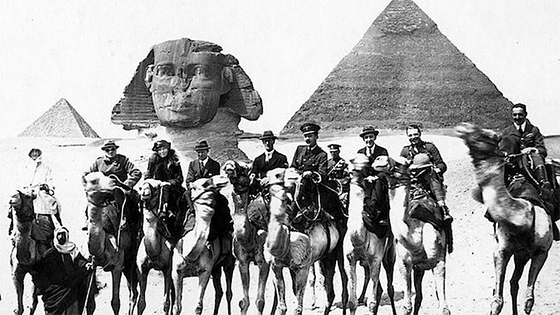 © Gertrude Bell Archive
The political achievements of Gertrude Bell became an unpredictable result of the activity of her neighbors from the photograph. Do not organize Churchill catastrophic for the British landing on the Turkish Peninsula of Gallipoli in 1915, the groom Bell, who served in the landing unit, would have survived-and she, becoming Mrs. Doty-Uilly , would hardly have hit the Middle East in November 1915 as an expert on the local population. And in 1918 , having already become the “eastern secretary” under the colonial official of Percy Cox, she would not take the most active (and key) participation in the creation of a new state under the name Iraq.
If it weren’t for Lawrence of Arabian, who raised Arabic tribes against the Ottoman Empire, the Entente would not promise the rebels that they will be able to create their own states (or at least one state). Gertrude Bell was one of those who believed that promises should be fulfilled. At the same time, she understood: all promises, even half of them, will not be fulfilled. Finally, Bell tried to warn the British administration about the inevitability of conflicts in a new state, if it does not take into account the interests of Shiites and Kurds. Naturally, they did not listen to her, because to preserve their - albeit indirect - the presence of the bet should be made on the strongest, and not on minorities.
Serving all these circumstances in the head, you understand: it does not matter whether the principles of Arab socialism, socialism as such or some other ideological faith, confessed many decades after Saddam Hus. The main thing is that he led the country, under which powerful mines were already laid down during the creation. And they exploded constantly, for the time being, not in question, the existence of Iraq himself, until the US-British aggression of 2003 spread the country into shreds, turning it into an occupied conglomerate of ethnic and religious regions. And the main role in disintegration played, of course, Shiites and Kurds.
At first glance, the keyword here is “accident”. The whim of one British official did not give the Kurds a fairly right and an important role in creating Iraq. The whim of another led the border between India and Pakistan so that after about 20 years, millions of refugees flee from the Eastern Pakistan covered by the war to India, and in Kashmir a half -time stretches. Based on momentary considerations, Soviet officials arbitrarily cut the territories of the Union and Autonomous Republics, and when they do not like the result, they dream of resettleing the peoples living there. The Entente at the Paris Peace Conference of 1919-1920 I would like to punish the Germans, Austrians and Hungarians - and now Boshnyak and Croatat fall under the scepter of the Yugoslav king. There are hundreds of such examples, if not thousands. And a considerable part of them are examples that have today's continuation. But is it worth blaming for all this by chance and whim? Most likely not.
No matter how you divide the conquered territories to the administrative units, no matter how you draw the border between the former colonies, no matter how you reinstall the territory of the former empire, it will still not work well. This is a fact. There will always be dissatisfied, circumvented, waiting for a convenient moment to take revenge and put life in the form they need. The point is not in the personal qualities of Gertrude Bell, Lord Mountbatten, Nikita Khrushchev or Georges Clemanso. Just the idea of the “national state” (either region, or enclave) with the corresponding boundaries contradicts not only the reality of the colonial and post -cylonic world, but also common sense.
Colonial empires (where we relate the Russian with its “outskirts”, which are not quite “colonies”, but still) - against their will, of course, forced the origin and growth of national consciousness in the conquered territories. It would seem that nationalism is the main enemy of the empire, but the need to somehow legally and administratively formalize its possessions to the fact that hundreds of the most diverse principalities of Hindustan under the control of the British were “India”, “Raja”-and so on on a wide variety of continents. Plus, the violent modernization of societies in the territories of colonies, the penetration of the European education system, press, culture, technology, etc. - all this allowed the new national intelligentsia to feel and call themselves “national” and - as intelligentsia - spokesmen for the aspirations of nations.
This is the dialectic of imperialism: Having put the whole world under his power, he thus created the conditions for the liberation movement against himself. The Identity Politics was invented not by the left post -war liberals, but by the colonial administrators and politicians of the preceding era. In the early 1920s, the “molder of nations” laid the foundations of neocolonialism, formed by her and her colleagues: the nation realized themselves as such-and immediately paid attention to numerous injustice in relation to themselves. Conflicts flashed almost everywhere - especially where societies, arranged on completely different grounds, squeezed into the framework of the modern state. So-beloved by right-wing liberals, the phrase Failed state is not about some peoples who have not been dear to a happy life in the bosom of their own statehood: it is about the peoples who have found themselves in the tragic situation in the conditions of a completely unnecessary, alien to them like the state. In these cases, the state either breaks up or acquires the character of the good old despotism from other times, or (most often) transforms into a completely different structure that reflects the real structure of this society, but with the external signs of the modern state. So that people have it. Naturally, at the first serious crisis, these signs disappear - and others shrug. Like, how so, just here there were parliament, elections, and the liberal press, even held the Olympics in Sarayev, and now ...
This is the ongoing drama of colonialism, neocolonialism and postcolonialism. It is ontological to capitalism - without colonial expansion and exploitation of the colonies, no capitalism, no modernity and even no liberalism is impossible. Here - in Sudan and Iraq, in Osha and Congo, in Olster and Bengal and further almost everywhere - the main meaning of how the world of the last two hundred, or even three hundred years actually functioned. This circumstance always tried to obscure, exposing as key points what happened in Paris in 1789 and 1848 , in Manchester in the first half of the century before last, in Petrograd in 1917 , in Berlin in 1933 and so on. But behind the screens of these-of course, extremely important-events were hiding the whole world, much larger than Europe (including Russia) and North America, the world, rapidly reformatted for its use, and then, after 1945 , left without direct colonial control, as an already working car. And this world has rebelled. And he still demonstrates that for him the seizure of the village abandoned by the population is more important than universal climate change or the “crown” epidemic. And to understand this - another - logic is very difficult, because it is ideologically not determined.
The Cold War, although it played a sad role in the growth and conservation of these conflicts, almost did not give rise to them. Moreover, it ended, and the conflicts remained. The main content of the Cold War was not even the “competition of two systems” (at least until some point), but an endless series of small, medium and large wars in the former colonies. In the battle between capitalism and communism, it was not Americans or Soviet, but Angoles and Ethiopians, Chileans and Argentines, Vietnamese and Koreans. They were weapons and weapons of the Cold War: the West and the East used all possible ways to wedge into any of the existing conflicts in the third world, albeit the most insignificant, and to inflate from it a thorough ideological confrontation, ideally, a civil war with a victorious outcome. The rapid collapse of the colonial system did not provide the time and opportunity to residents of most of the world's population to realize their new position and arrange life in the most suitable and convenient way; Two Part -Comers, Moscow and Washington, began to teach the population of the former colonies and semi -colonies to the best arrangement of life - and set each other, of course. A little later, the third - Pekingsky joined them. However, a slightly different story about China, we will leave it for a special conversation.
Both “party committees” cynically exploited quite reasonable and noble sentiments: one “party committee” - indignation about social and racial inequality, the other - the desire for prosperity and everyday freedom. Naturally, no one of these conflicts was implemented on either side of any of these conflicts; In the worst case, degradation took place - even compared to colonial times. Very few countries, such as India, for example, managed to develop an understanding of their socio-economic and political reality and outline their own horizons of expectations from independence. And often these were states that did not adjoin any of the "party committees".
Nevertheless, with all the abundance of political commissars from the Patrons powers, conflicts that arose as a result of the creation and collapse of the colonial system only pretended to be ideological. Both sides of the Cold War thought that they were using two-thirds of the world as their proxy beads, tools against their main adversary. But it turned out quite the opposite. The sides of endless local conflicts used who Washington, some Moscow, who Beijing to solve their problems. And they, as we see today, won. Afghan Mujahideen, fed by America, had and have nothing to do with American ideology; The United States contained and supported them for the struggle against the Soviet troops, but this plot on September 11, 2001 brought Islamists to New York , then to the already American invasion of Afghanistan, where the US military is in vain to destroy the once closest allies. And again they try to create a modern state there, stuffing into its scope of communities, which are absolutely cold to the idea of such a state.
Here we return to the question of fiction, fake of a modern state, modern political and social structure where life is fundamentally different. Этот маскарад, культурно-политический театр, выставка достижений, устроенная для того, чтобы большой покровитель был доволен, — одна из главных черт послевоенного мира. После распада СССР из таких «больших покровителей» остался один. Конец холодной войны дал шанс на то, чтобы заживить или хотя бы остановить многочисленные локальные войны и конфликты — ведь, казалось, уже некому и незачем плескать керосин в эти костры.
Иными словами, казалось, что теперь уж мир бывших колоний оставят в покое. But it wasn’t there. Оставшись в одиночестве, Запад (в данном случае это только США и отчасти Великобритания, которая во внешнеполитических вопросах превратилась в вассала Америки) бросился по-новому переформатировать мир. Конечно, здесь, прежде всего, интересы экономические, финансовые, борьба за ресурсы и все такое, но сложно не заметить в страсти к пересборке реальности восторга триумфатора. Иначе не объяснить, к примеру, последовательного уничтожения сложившегося на Ближнем и Среднем Востоке порядка вещей, причем под ударом оказались не только бывшие клиенты Москвы, но и те, кто держался от нее подальше — и поближе к Вашингтону. Результаты оказались самыми катастрофическими: трудно назвать хотя бы одну страну региона, выигравшую от череды «арабских весен», гражданских войн и интервенций западных стран. Западная идеология, столкнувшись с Другим, которого она принимала за Другого Себя, оказалась бессильной.
В этот вакуум попыталась просочиться новая сила, возомнившая себя старой суперсилой, — Россия. С учетом ограниченных возможностей этой небогатой, страдающей от собственных болезней страны просочиться она пыталась далеко не везде, выборочно, там, где оставались следы (реальные или воображаемые, неважно) былого советского присутствия. Кое-где это получалось на какое-то время. Причиной успеха была как раз идеология, точнее — ее полное отсутствие. Идеологическим указаниям «вашингтонского парткома» Москва противопоставила не свои собственные идейные указания, а полное их зияние, обыкновенный ползучий прагматизм, даже цинизм. Собственно, в тех же краях так действует Китай, но у него для такого прагматизма есть ресурсы, которых у России нет. Потому и успехи Москвы либо мимолетны, либо ненадежны.
Наконец, случился 2016 год, и та самая Америка, которая победила в холодной войне и собиралась править миром долго, а то и всегда, вдруг стала по своей воле сворачивать свое присутствие. Не всё, конечно, и не везде; более того, указания безумного Трампа часто саботировались соответствующими органами исполнительной власти. Но главное, что об этом было прямо и открыто заявлено: «вашингтонского парткома» больше нет. Есть «вашингтонская корпорация», трест, который инвестирует туда, где это экономически и финансово выгодно. И точка.
Внезапно немалая часть мира опять оказалась как бы предоставленной самой себе — и многие бросилась доигрывать недоигранные войны. Или играть в их доигрывание. В ситуации, где каждый за себя и нет никаких арбитров (а главный арбитр настолько выжил из ума, что не признает даже тех арбитров, которых сам же кропотливо создавал многие десятилетия), почти все дозволено. Что касается остальных игроков, то у них либо нет никакого желания, либо нет сил влезать во все локальные распри земного шара (Россия хотела бы, но, увы, у нее самой и Кавказ, и идиотская вялотекущая война с Украиной). Ситуация в мире, где опять, как сто лет назад, в определенных местах льется кровь, так и напрашивается на определения вроде «дежавю», «день сурка» или даже голливудского блокбастера «Вспомнить всё». Ровно 100 лет назад в том же Карабахе бушевала война с погромами, этническими чистками и прочими прелестями. Советская власть пришла и ушла, а война осталась.
В мире, который выскочил из разболтавшихся скреп холодной войны и американской гегемонии, дозволено действительно почти все, что разным группам людей кажется насущным, нужным, важным. Тем более что всегда найдется тот, кто продаст оружие или обменяет его на нефть, наркотики, возможности инвестиций и пр. Только покровители сегодня значительно незаметнее и меньше, чем еще недавно, и их гораздо больше — иногда это транснациональные корпорации, или религиозные движения, или наркокартели, а порой и самый простой придворный повар из какой-нибудь далекой страны. Никаких идеологических объяснений, никакой политической логики.
Бóльшая часть мира становится все более и более непредсказуемой, хаотичной, опасной — прежде всего, для населения тех краев. Не имея никакой возможности устроить жизнь на родине согласно хотя бы минимальному здравому смыслу, эти люди бегут туда, где могут просто физически и психологически выжить. По дороге десятки тысяч из них гибнут, тех, кто добрался до заветных мест, сажают в лагеря, а тамошние власти и население демонизируют их, сваливая на несчастных беглецов собственные беды и грехи. Будто бы все забыли, как когда-то в обратном направлении, с Запада и Севера на Восток и Юг, направлялись сотни тысяч людей, только не просить о милосердии, а завоевывать, обращать в свою веру, грабить, эксплуатировать, убивать. Вот так — при всех нынешних либеральных разговорах о толерантности — завершается история колониализма, на самом деле — история капитализма, паразитирующего на этой трагедии. Наступает другая реальность, в которой условный 1947-й , когда Индия и Пакистан получили независимость, гораздо важнее условного 1991-го , когда кончилась холодная война и рухнул СССР.