
Translated material
Shooters
In the opposition
 Shooters
December 28, 2010 Alexander Podrabinek
Everything someday comes to an end. Even such a hopelessly wretched, scandalous and shameful case as the court case of Khodorkovsky and Lebedev. For 22 months of this trial, so many dirt resulted in Russian justice, journalists and politicians so rinsed it, professionals criticized him so reasonably that one might think that the Russian authorities were pleasing to the country's public humiliation and its state institutions.
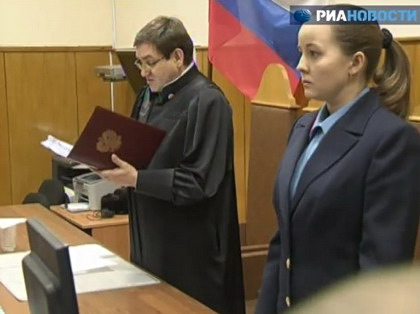
On December 27, the final stage of the court came - reading the sentence began. If someone thinks that the sentence is an apotheosis of the trial, he is deeply mistaken. At least in Russia and in political matters, to which this process undoubtedly belongs, the verdict is only the end of the play based on the play, the content of which is known in advance only by the playwright and the puppets controlled by it in the judicial mantles. The verdict has a little relation to the entire trial as the case file - to real life. After all, it is important not what was really, but what is written about this in the materials of the prosecution. Paper fiction becomes stronger than reality, and in the clashes of fiction and truth, freedom dies and human life carries.
Everyone who somehow contacted this matter feel his absurdity. Judge Viktor Danilkin, who, along with the judicial mantle and the post of chairman of the district court, hung the obligation to condemn Khodorkovsky and Lebedev, at times came to a state of incredible irritation, listening to the stupid and hysterical maxims of the prosecutor Lachtin.
Prosecutor Lakhtin, who is obliged to maintain the prosecution on duty, perhaps in fact a shallow person, but in this process he had no chance to show the mind and talent, as the executioner’s cutting head of the executioner had no chance to show his genuine philanthropy. Such a position. Hence the arrogant stupidity and hysteria during court hearings.
The lawyers of the defendants, competent professionals who understand both the formal and informal aspects of the case, sometimes declared the perfect absurdity of the case, but, related to lawyer ethics and a contract with clients, worked according to the established rules, completely realizing which farce they take part.
Finally, the defendants themselves struggled to defend themselves in court, at the same time that their arguments were completely not interested in their arguments. When Danilkin began to read the verdict on Monday, they sat in his glass cabinet, doing their own business - one read a book, the other dismantled his papers. Probably, it was easy for them that now nothing definitely depends on them.
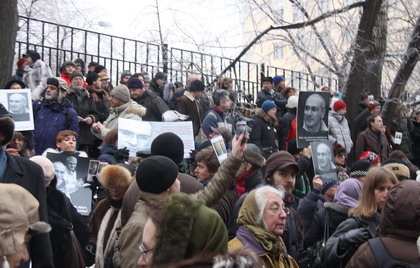
Who remained outside the rules and conventions is the street. Hundreds of people came to the court building on Monday to remind the judges of such an exotic concept as justice. At first, people stood silently on both sides of the narrow street and on the hillock opposite the court building. Political activists called everyone to the “Expecting Justice” campaign, and everyone stood, expecting this justice from the Hamovnic Court. But do you wait for justice in Russia? Do we not know that the humble expectation of justice is an empty and hopeless matter? Therefore, when someone shouted “Freedom!”, Hundreds of people picked up this word and chanted without ceasing. Soon, the abstract demand of freedom was replaced by more specific slogans: “Freedom to political prisoners!”, “Russia without Putin!”, “One, two, three, Putin go away!”. Immediately, some unit suggested screaming "three, two, once, Putin ...", and the wit fell silent. The audience, having fun, did not scandal this speech, replacing it with "Putin - skis - Magadan."
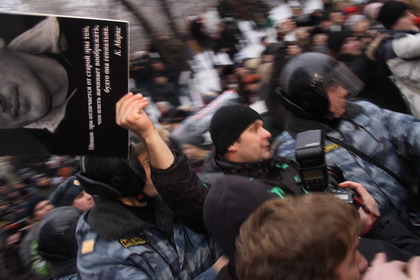
The police rushed to detain those who held in their hands posters or portraits of the defendants. Soon, a detachment of riot police arrived at the help of the police. The detainees were dragged into a police bus to the outraged cries of citizens "shame!" The police were all the same, they were not afraid of shame. For the first time, it was for the first time that it has not yet been heard on any protest action. “Shooters! Shooters! ”, Someone shouted to the policemen who dragged the elderly woman into a police bus. And in response, the whole street thundered to the riot police: “Na-srani! Na-Srani! ”
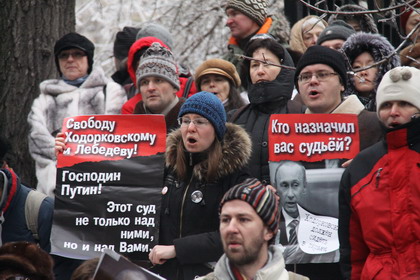
Some foreign correspondents, probably not so long ago working in Russia, could not understand why the police reacted so inadequately to a peaceful civil protest. The German television journalist approached all police officers, from sergeants to colonel, and everyone asked to explain why they were delaying people. The policemen were shy and turned away, as if they were asked about something intimate and indecent, and the most competent spoke “without comment” and sent to the press service of the Central Internal Affairs Directorate.
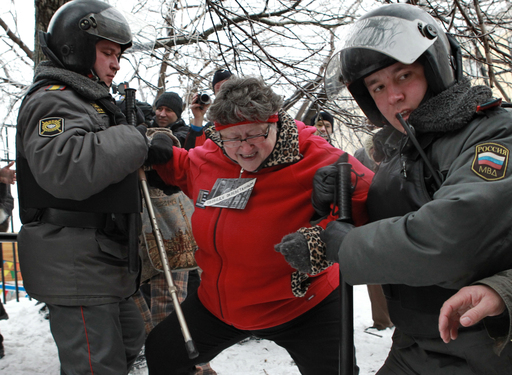

By noon, the most active, about 20 people were detained. One nondescript policeman, as you can see, who did not have time to distinguish himself in the field of detentions, began to climb a snowy hillock and reached a tree, on which New Year's pictures and Christmas toys were hung. Under the universal laughter, he raked these trophies into a heap and carried it to a police bus, which is why the surrounding shouted “Santa Claus - our main enemy!” And "Freedom to Santa Claus!" The police farce on the street was a farce in the courtroom.
Fars became the lifestyle of state -owned Russia. If the story knew how to speak, she would probably tell on the example of the building of the Hamovnik court, what the way from dignity and enlightenment to a miserable judicial farce has passed Russia over the past hundred years. In the building of the Khamovniki court before the 1917 revolution, there was a private female gymnasium A.S. Alferova, one of the best in Moscow. In this gymnasium, among others, Marina Tsvetaeva studied. Perhaps the 14-year-old future poetess ran through those rooms, in one of which they now read the verdict of Khodorkovsky and Lebedev. In a strange way, times and fate are intertwined. The director of the gymnasium Alexander Samsonovna Alferova and her husband Alexander Danilovich, a literature teacher at the same gymnasium, accused the Bolsheviks of belonging to the cadet conspiracy and shot.
The story may have unexpected turns, but there are no surprises from the Hamovnican court. The verdict will undoubtedly be indictable, and will be given to the defendants, probably ten to twelve years old, and in the cassation they will drop a year or two. Judge Danilkin will try to manage before the New Year.
All this does not mean that Khodorkovsky and Lebedev will definitely serve their entire term. President Medvedev can have mercy on them after the 2012 elections. They can be exchanged for some Buta or sell to the West for new investments, a profitable agreement or just a good attitude. Anything can happen to them. The law has nothing to do with it, but there is nothing to be surprised. We live in Russia.