
Translated material
Colta.ru
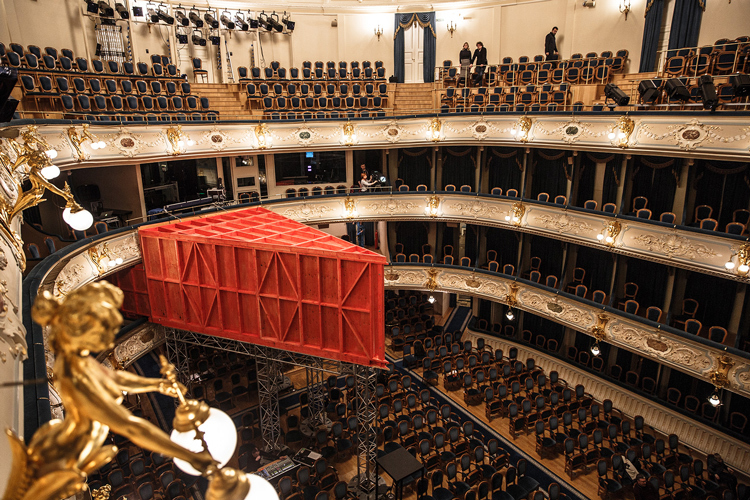
In Marvel comics there is such a character - Venom, a solo film with Tom Hardy was recently shot about him. This is an alien-symbiot, a lump of intelligent mucus, which flows into the body of the carrier, like a hand in a glove doll, and becomes his second “I”. In the same way, the installation created for the centenary of the BDT works. The “plywood theater” is a building, as if growing into another building, a crazy alter of the ego of a dramatic house on Fontanka, his Mr. Hyde, his Hulk, his Tyler Dryden.
He has the primary signs of the theater-begins with a hanger, continues with a kind of foyer, and ends with a chamber hall for 23 places and tiny stages-and the opposite of the “main personality” in everything else. Instead of gold and marble - plywood. Instead of statues, carpets and stucco moldings - pure geometry. Instead of wide front stairs - cramped passages.
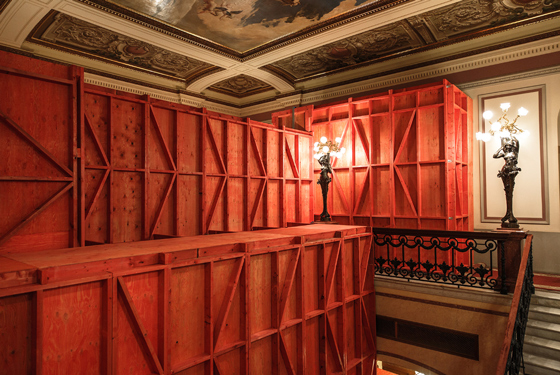
The BDT architecture is dictated by pragmatics, and the “plywood theater” is defiantly impractical: the scene is deliberately designed so that a person can be seen only when he stands at one specific point. The site is located directly above the sinter: outside it looks like a huge red beak sticking out of the box. Analogies can be very different - from sexual to art history.
* * *
The idea belongs to the Khudruk BDT Andrei Mighty and Theater Artist Alexander Shishkin, known in Art Mir as Shishkin-Hokusai. The third author is the architect Andrei Voronov from the Arhataka bureau, who was invited to work on the installation at the insistence of the artist. Industrial material in combination with the architectural archetype is his favorite topic: Voronov has already built a straw temple , an ecological chapel from tires and a triumphal arch from containers , meeting visitors at the St. Petersburg Street Art Museum. So the theater from plywood is a completely logical project in its portfolio.
And Shishkina-Khokusaya is completely favorite material. Plywood figures are its proprietary technique: here is a fragment of the installation of “practitioners of growing up”, here is the Flemish School for the Russian pavilion in Venice. In essence, we have a classic sculpture on the contrary. Firstly, the artist refuses the volume, and secondly, plywood is the exact opposite of the stone: it costs inexpensively, does not last long and is needed for draft, temporary decisions.
 © Sergey Misenko
In a pair of projects, Shishkin-Khokusai literally copied the statues from the summer garden and from the roof of the winter palace . It turned out an Erzatz-sculpture, something like a false facade, a ghost of an old culture. By the way, the first such work - “Summer Garden in Fire” - the artist conceived as an answer to the restoration of the Summer Garden, when the originals of Italian masters were replaced by a remake.
The installation on the BDT is also a game with a classic heritage, however, its goal is already different. Still, plywood is a universal thing: it is suitable not only to say goodbye to the lost monuments, but also to argue with the monuments to the survivors. After all, the “plywood theater” is nothing more than an alternative to the “theater with columns”. In other words, an alternative to the BDT that everyone knows.
* * *
“Alternative attempt” was the name of the exhibition-manifesto of the “anniversary year group” in the Taganka Theater. The alternative, which was offered by the artist Ksenia Peretrukhina and her like -minded people, was in a new, egalitarian, approach to the half -century history of the theater. We know quite a lot about large artists, the authors of the project thought; It is time to give a voice to ordinary witnesses and figure out what the Taganka meant to them.
When planning the hundredths of the BDT season, Andrei Mogeliy probably looked back at the experience of the “Jubilee Group”: after all, on Fontanka a round date was also met as an intellectual and creative challenge, and not just as a solemn reason. When they hear the BDT, the first thing is George Tovstonogov with his troupe. For the first decades of the life of the theater, founded by Blok, Gorky and Maria Andreeva almost immediately after the revolution, only specialists know for the most part. The mighty team used the centenary to fix it.
Visitors to the Plywood Theater see the BDT for the first time - even if they went here all their lives.
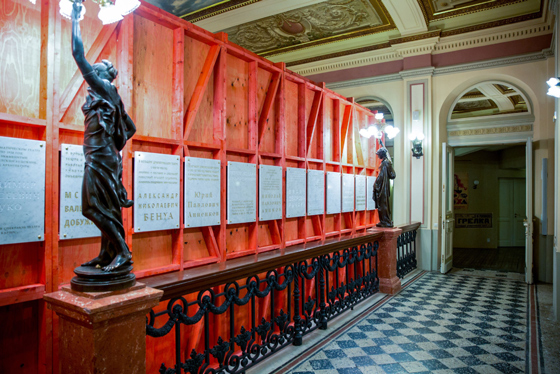
The Plywood Theater is a monument to the era when the Soviet theater could still afford to be avant -garde. Red and black - this color of constructivists, cheap material refers to the ideology of proletarian art, and a “buratino nose” protruding from the box - to the Suprematic poster Elya Lisitsky. The outer wall, which looks at the gallery, is decorated with memorial boards of artists who worked in the BDT in different years: among them there are avant-garde artists-for example, Kuzma Petrov-Vodkin and Nathan Altman.
In general, a dialogue with history is a through plot of the anniversary year of the BDT. If you try to describe it in one word, it will be “unzipping”. Archive is the space of the Austerlitz play : the director and artist Evgeny Safonov recreates the genuine interiors of the Terezinsky ghetto storage on the stage. Roman V.G. Zebalda (by the way, Safonova is the first to put his prose in Russia) - about a man who miraculously escaped this ghetto in early childhood: he was transported to Britain, arranged in a foster family and gave a new name. Many years later, he tries to restore the history of his origin step by step.
The "glory" of Konstantin Bogomolov returns us to the era when Soviet theaters became an instrument of agitation. The performance is based on the poetic play by Viktor Gusev about the heroic pilot, which was first played in 1936, and not somewhere, but in the BDT. The director, in fact, offers a test for resistance to propaganda: “Glory” is quite capable of touches, but the next time they try to manipulate you, you will not unconditionally trust emotions.
 © Sergey Misenko
* * *
An important reservation: although the creators of the Plywood Theater were inspired by left -handed art, they did not try to play “proletarian architecture”. The installation is not at all like a plywood shed from a construction site: between them the same abyss as between training from the market and the collection of Goshi Rubchinsky .
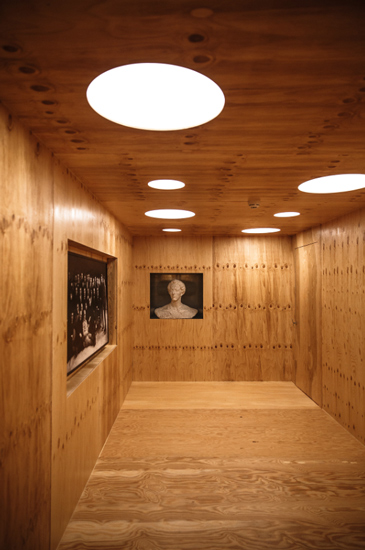
Perfectionism and generosity of the authors are striking: look, how neatly cut holes for lamps are cut, how the light itself is correctly selected, with what love the signs are made. It is a pity that it was impossible to do without plastic smoke detectors and green signs “output”: in the BDT building saturated with details, this is all almost imperceptibly, but the empty space of the “plywood theater” is a completely different matter.
 © Stas Levshin
* * *
"How to return to a beautiful theater?" - The viewer smiles at the guard, who was staged, obviously, so that no one scribbles a word of three letters on a faner. Probably, you can look at the “plywood theater” as at construction forests, behind which the palace is not visible. But it is possible as a frame of precious stone.
Yes, Voronov and Shishkin-Khokusai turn to aesthetics, which the Petersburgers are associated with the BDT, probably, last-but what they definitely did not want to drown out the architecture of the old theater. On the contrary, when you look at their work outside, a gross bow of the structure emphasizes the wealth of painted ceilings and stucco cornices. And when you get inside - you see the details of the historical interior as if through the lens of the photographer, intentionally to show you a familiar place from an unusual angle.
The artists cut out the eyes like door, windows and doors in a faner: from there you can see the monument to Gorky, the busts of the block and Tovstonogov, columns and balustrades. The upper platform of the “plywood theater” was built around a luxurious chandelier, which you look not from the bottom up, as usual, but at the distance of an outstretched arm (resembles the work of the Tatsu Nishi for “Manifesto 10” in the Winter Palace). In a word, visitors to the Plywood Theater see the BDT for the first time - even if they went here all their lives.
Subscribe to the COLTA.RU channel in Yandex.Zen to miss nothing