
Translated material
Bags with the sun
The city of Gulben and its districts are landscaped, trying not to lose sight of either big or small
The city of Gulben and its districts are landscaped, trying not to lose sight of either big or small
Ah, these small cities! The space for life, which can be measured with your steps and build with your own hands. Small cities, in which everyone knows everyone, is heard by the names of all famous fellow countrymen, on the account every attraction and causes pride in every well -groomed place. Latvian Gulben, the capital of the same name, 185 km from Riga, is one of these towns. He is not even a hundred years old as a city, but the names of the great are heard here and for every piece of urban land there is its own plan of improvement.
There are more than 9 thousand inhabitants in Gulben, in the entire area - about 28 thousand. Gulben received the status of the city in 1928, but back in 1224, the name was first mentioned in the annals when mentioning the Talava land section. So the place is forced and that has seen a lot.
The current inhabitants of Gulben live in 1152 houses on 66 streets, this carefully informs the presentation booklet. But having drove around the town several times, you will never think that there are so many streets in it: it seems that there are only a few of them.
Long echo of each other
| | | --- | | 
In the 19th century, Baron Rudolf von Wolf acquired 10 castles on local lands for his sons, Vetskulben went to Henry von Volfa. The estate of Vetskulben is a monument of not only architecture and the park landscape, but - first of all - a monument to the great love of Heinrich von Volf for his wife Marisse, for whom the second park of the estate was landscaped - with ponds, alleys, arbors, hills and flower beds. Two parks - one name of Father Rudolf, the second name of the spouse - were connected by a wooden carved air bridge. Henry gave Marisse and a new house - a red castle in a neo -Gothic style.
Leaving early in the morning on an equestrian walk, the baron left his wife a note in which place of the park he would wait for her after waking up. On one of the hills of the park there was a luxurious flowerbed in the form of the title letter of the name of Marissa.
Mariss, who died after a long trip, remained the only love of Henry von Volf, the park became her tomb, and seven blue candles burned at the head of her place of rest. More Henry von Wolf did not get married.
The absence of direct heirs predetermined the fate of the estate - it was dilapidated. There is evidence that in the Nala 1920s, after a walk in Vetskulben Park, the guests of the town later wrote that they were looking for Vetsgulben, but did not find.
Actually, Vetskulben was the reason for our visit to Gulben - the estate has gained a new owner and now comes to life, acquiring a new face.
The mayor of Gulben Nikolai Stepanov says that all attempts to rent an estate and thus inhale his life were unsuccessful: no one wanted to invest in rented property. The debates in the local Duma ended in high colors: the deputies refused to put up the estate for sale for a long time, they say, there are no money now, then we will, we will restore it, we’ll put in order, etc. The time has passed, the money did not appear, the estate was dilapidated. It just disappeared from the face of the earth.
| | | --- | | 
The estate significantly quickly turns into a hotel complex, the first phase of which was opened in the former equestrian arena in the beginning of 2008, once the largest lavage of Latvia. Already now, 70 guests can live simultaneously and relax here in rooms in two levels. Photos of the open -air walls, made a year ago, are impressive with their contrast with the current hall, suitable for both balls and meetings.
The right of ownership is not an idle issue. Next to Gulben, in the estate of Rumen, there is another castle of ten, which once belonged to the Wolf family. A fantastic castle in the style of eclecticism, built in 1820 and rebuilt in 1835, was burned and restored in the style of historicism in 1908 during the 1905 revolution. In the 1930s, the Castle lived in the castle, world famous by his only novel, the cheetah, Giuseppe Tomazi Di Lamepeduza, who married Baroness Alexander von Wolf. The local authorities did not dare to put up the castle for sale, limited themselves to rent. Now for several years in a row the tenant and local authorities have not come out of the courts, clarifying and contesting each other. The original castle, in the dialing interiors of which there is an interesting museum in the limited areas, and the surrounding building of the centuries -old park, despite judicial disputes, in good condition, still waiting in the wings.
A competent owner is not just a person who has a knowledgeable business. After all, it is important to understand not only what you want to create, it is important to understand where you are doing this. The sense of the historical and cultural environment is necessary in order to understand how to return the park in modern conditions, to recreate the atmosphere, to update something tactfully, because the trees, like people, are mortal, and far from all silent witnesses of the short happiness of Henry and Marissa von Wolf, you can touch your hand.
Therefore, work in the estate of Vetskulben is not only restoration, but also renovation in nature. The concept of park space is significantly changed. Instead of broken bricks that sprinkled paths in the 19th century, a small granite paving stones. Not all the restored paths of the park went Henry and Mariss, new ones appear. A system of modern irrigation and lighting has been developed for the park. At the same time, the park remains open to visiting everyone - no fence, no gate. The park is still on rent, it will become property later, but without the restoration of the park, the new owners of the estate do not see the opportunity to give the whole complex a complete look. They realize that the estate will be the property of everyone - both inhabitants and guests of the city. By the way they drive us along a huge construction site, it is clear that such openness is completely satisfied with, the park is not for the hosts, a park for people.
Some issues are resolved harshly: most likely, an ugly two -story gray brick building, attached in Soviet times to the Red Castle of Marissa, will be completely demolished - its “smoothing” is impossible.
All work is carried out as a project, a significant part of the costs for which (about half) is compensated from the European Union. This is one of the secrets of the quick revival of Vetskulben - large -scale work is not the subject of care of exclusively new owners. The European Union on a competitive basis chooses the best initiatives and helps them get on their feet. So the quality of life is aligned, so monuments of history and culture resurrect from almost non -existence.
A careful study of historical facts leads the owners to new ideas: it is known, for example, that the estate was guested by Ferdinand von Zeppelin. So jokes are jokes, but it is possible that in the near future in Vetskulben it will be possible to climb the sky on a airship. Imagine how many people will come here just for this?
It is no accident that the Gulbensky Museum of History and Art with more than 50 thousand exhibits, founded only in 1982, is located on the territory of the estate, in the building of the former greenhouse. One hundred years of the history of the town in objects of cult and life, genuine things and archival photos - a completely professional exposition, growing day by day. The restoration of the estate gave the museum a second wind and increased the flow of visitors.
It is symbolic that in front of the Wolf estate is facing the monument to the fallen for freedom in 1992. He appeared here in 1929 at the donations of the inhabitants and was dedicated to all those killed during the 1905 revolution, fallen soldiers of the First World War, the victims of the Revolutionary Tribunal of the Red Government of the Knight and the heroes of the struggle for the freedom of the Gulbensky district. Such a significant symbol was completely intolerant for the Soviet regime, and it destroyed it. Now he is recreated. We can say that the restoration of the monument to the fighters for freedom became the harbinger of the revival of the estate of Vetskulben. Freedom gives breathing.
Governor in the load
| | | --- | | 
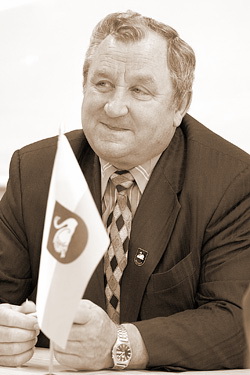
He says that he would never have joined the party in modern Latvia, but political life outside the parties is impossible, and Nikolai Stepanov is elected a deputy of the local Duma for the third time from the conservative people's party of Latvia. All elections are held only on party lists. The winning party or block form the local authorities. There are only 11 deputies in the Gulbens Duma, the People’s Party received 6 seats, but in fact there are 10 deputies in the orbit of the mayor, and this enables Nikolai Stepanov to pursue his policy. City residents are conservative, and they are not looking for good from good.
The troublesome Nikolai Stepanov is careful not so much by the money of the local budget, whose own funds are calculated by 15 million lats [ 1 ], but the opportunity to get the funds of the national budget of Latvia and the means of Euro Funds for the development of the city. The word “project” in the mayor’s speech is as familiar as the word “money”. “I’ll always have time to spend my own and find what, first I need to get everything that is possible on top.”
It seems that Nikolai Stepanov succeeds well.
Judging by Vetskulben, the same design people are attracted to it. And in a small town, in the future of which they once believed little (“place in the swamp”), life changes in front of his eyes.
The mayor personally conducts a tour of the native city, noting the achievements of each organization: gymnasiums, library, stadium. He shows examples of successful and unsuccessful investments, gives a commentary on each construction site, shows a landscaped park, places for future residential development.
The Olympic center built in 2003 - the decoration of the whole republic - takes simultaneously with international school competitions and even school lessons. The city fountain, in which, as the former paratrooper Yurgis Abel confirmed (it was a surprise for guests, of course, to find out that the current successful entrepreneur served in Ferghana in Soviet times), local landing veterans were swimming peacefully. City street hours, a gift of local entrepreneurs to the city. The modern Catholic Church of the Holy Sacrament, built at the end of the twentieth century with the Austrian two -hundred (!) Organ. The Evangelical Lutheran Church, erected on the site of the 13th century knightly castle. Altar painting, organ and bell of this temple died during the Second World War. The fraternal cemetery of Soviet soldiers on the outskirts of the Park Park with granite figures of three mourning mothers. The Swan (Youth) Park, the sculpture of the swan in which has become a symbol of the city, whose name (Gulbene) is translated into Russian as “Swan”. The silver floating swan on the Black Shield became the coat of arms of Gulben in 1938, 10 years after giving the town of the city status.
Nikolai Stepanov freely speaks both Russian and Latvian, moreover, in Russian - with a funny intonation accent that disappears when the mayor does not speak publicly, but speaks with guests from Russia.
For the third year now, Nikolai Stepanov has been working as the governor of one of the four historical lands of Latvia - Vidzem, which includes the Gulbensky district. The power system in Latvia is arranged in such a way that only one of the heads of local self-government can become the governor of the land by decision of the local authorities themselves. For Nikolai Stepanov, the position of Governor Vidzem is the top of a political career. The provincial center is located in Cesis. The governor’s office consists of 21 employees. No power blocks. Everything is very economical, if not modestly. Little Latvia does not have enough managers, the law is allowed to combine state and municipal posts, and Nikolai Stepanov regularly travels to the CES for the performance of governor's duties. In fact, these are responsibilities for inter -municipal regulation and building relations of the entire land with the national level of power. Nikolai Stepanov does not speak, but, of course, he would hardly have been entrusted with led land consisting of several areas, without obvious successes in his hometown. And if they had not seen in him rare qualities of asceticism and justice for an official.
Stepanov himself lives 12 km from Gulben in his private possession and believes that the city is a place for work, and you need to live in nature. Meanwhile, on some streets of Gulben, apple trees grow along the roadway. Ripe fruits fall to the ground, no one selects them - here almost everyone has their own garden. On the Latvian cards of the 1930s, Gulben was called the "city of flowering gardens." Gardens continue to bloom.
The road of life
| | | --- | | 
The Gulben station appeared in 1903 2 km from the Vetskulben estate - in order not to disturb the rest of the estate with a noisy technical innovation. A narrow-blade of gulbene-alksna 33 km long, part and the currently existing road of Stukmani-a valve with a length of 210 km, is the only one in the Baltic regularly acting narrow-gauge railway. Until now, four times a day, at 6.00, 10.00, 13.25 and 18.00 from Gulben in Aloxna, a train is departing for the whole Europe, famous for the whole of Europe. Several wagons of the 1960-1980s of the twentieth century drag diesel locomotives and a unique steam train of the beginning of the century with a wood-like car behind the driver. Glass to this miracle come from everywhere. The steam locomotive was given the name "Marissa" in honor of the wife of Baron Henry von Volf. “Marissu” on holidays is decorated with fresh flowers and balloons. Soon another steam locomotive, German production of 1947, will be added to the steam squadron.
Once a year, a narrow gauge celebrates her birthday. On this day, you can’t get into the wagons, the places are booking right from Riga. The holiday unfolds at all stations, from Gulben to Aloxna. This is a wonderful mixture of the carnival and the festival is seething all day from 10 a.m. to midnight. At the station in Gulben, right between the building of the railway station and the first way (what other way a real steam locomotive can arrive!) A station buffet with an amazing menu and amazing shufflers can come. I admit - I bought this business. Where did they find such cool delicious aunts in the current catering?! - I thought in shock, watching how the legendary Soviet sandwiches with herring and lard appeared on the counter of the corresponding age, juices and vodka, perfumes "Riga flowers" and pickles of home salting. Makeup makeup, but the authenticity of the types was impressive. It turned out - the local theater. Go crazy.
Each following station is an ongoing concert, food and craft fairs, a feast for the whole world. An active life came with a railway here a century ago. And her birthday is celebrated as their personal, as the day of the beginning of a new era, as a connection of times. This is an amazing holiday-it is simultaneously professional and amateur, because it is completely natural, not lowered “from above”, not voluntarily accurate.
You know that, it is, a narrow -gauge road can provide services except ordinary transport? So, maybe! You can order: a special flight during which you enjoy (it is written in the sentence) with the adventure with the Soviet border guards, robbers, their antics and amazing kitchen (!), A trip for newlyweds with gypsies, a trip to a hand-shaped hand, an overnight stay in the Gulbensky depot or a sulon-breeder, inspection of the rolling stock ...
Special travels are offered to everyone for the holidays: Christmas, Easter, St. Martin's Day and Valentine's Day.
XX and XXI centuries, several historical eras at once are ironically adjacent to each other and are connected by a narrow gauge length of exactly 33 kilometers, which celebrated its 105th year of life in 2008.
... In the square in front of the entrance to the building of the Gulben railway station there is a monument to the victims of the repression of 1941 and 1949, when the residents of these places were undergoing deportation to Siberia. The whole valun stone, on which the cutter of the sculptor outlines the outlines of the bodies-mother, father and child, who weaved in a farewell hug and part forever. Nothing else. And I want to cry.
Mountain light
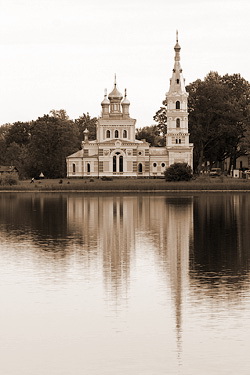
On the outskirts of the town of Ramerien, looking into the waters of the lake, there is a luxurious Orthodox Church of St. Prince Alexander Nevsky. Laid down in 1902, she ascended over the district five domes of the temple and the bell tower 2 years later, the consecration took place on June 6, 1904. Two main crosses of the temple (on a large dome and on the bell tower) are inlaid by mountain crystal, in the crystals of which a rainbow plays on a sunny day.
After the Second World War, the parish was liquidated by the Soviet authorities, a warehouse was arranged in the church, but this made it possible to maintain the building as a heated one, it did not collapse.
In 1995, the local headman asked the only then in the village of the Russian Orthodox family, spouses Irina and Alexander Sazonov with a request: restore the temple. We want the temple to open again. And two people moved by faith have taken up the job. Вся большая округа, от Риги до Санкт-Петербурга и Пскова (настоятель храма Александра Невского отец Олег Тэор), помогала возрождению храма. Выбитые кристаллы восстановили в Санкт-Петербурге. Пожертвования приходили буквально со всего мира. Расширился приход. Стоит храм над водой, смотрится в озеро, плывет над водой колокольный звон. Стоит село, есть в нем праведники.
* * *
Житель города Гулбене, утверждает официальный буклет, это замкнутый, сдержанный человек, со своими убеждениями и своей жизненной мудростью. По преданию, жители Гулбене умели носить солнечный свет в мешках.
Свидетельствую – не разучились.
Lev Schlosberg,
Гулбене (Латвийская Республика) - Псков.
Поездка в Гулбене была организована Торгово-промышленной палатой Псковской области.
1 1 лат равен примерно 50 рублям.