
Translated material
Dance under the tongue
They sang “Oh, create, sky, rain:” - and rain poured
The appeal to folklore or any other country is considered a kind of delight in our time. Many musical and dance groups use folk motifs in their work or try to weave a certain folk element into the common merciful mood. But they often do this with a complete ignorance or misunderstanding of a true sound, having an idea only about the beaten, known to all and every melody.
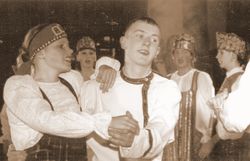
A typical example is the Krako-Vyak dance, the melody of which is known throughout the world, but they dance it in every country in its own way. The Poles have practically ceased to be surprised at the all kinds of interpretations. In this regard, the question arises: is it possible to call folklore groups that sing or dance the “old in a new way” and dress rich, sparkling, as if at a club party, costumes? It's hard to say. Perhaps only a specialist who is well familiar with folk roots can figure it out. According to Galina Berezina - the artistic director of the folklore ensemble "Ghrada" - "Many groups, especially dance, make programs a la folklore, but this is not a reason to call them folk." The team of Ms. Berezina recently returned from Poland, where he took part in the twentieth international folklore festival "Zelen-Gura" and received laureate.
How did the organizers of the Polish festival learn about you?
The fact is that Pskov takes part in the festival movement, and the administration of the region came an invitation, in which the Egrand ensemble was proposed to go to Poland. Our team became the winner of the All -Russian folklore contest "Tradition", which was held in February this year in Veliky Novgorod. It was with this program that we went to Green Guru. Guslyarians and the Vocial Vecherka Vocal Quartet from Lokni also traveled with us, but we all performed under the single name “Ugrand”.
Who financed the trip?
The regional center of folk art paid for the road and all kinds of expenses associated with it, and the Poles - our accommodation, food and everything else on their side. In Poland, there is a festival movement that is engaged in, among other things, the financing of the holidays.
What can be said about the organization of such a large -scale action?
Well done Poles, if only because they arrange such festivals. And, I must say, they really succeed. The media daily, even hourly made reports on the festival. We were interviewed by both the printed press and for television. We brought with us to Russia a lot of cuts from Polish newspapers, which illuminated the holiday.
For this trip, we might say, we saw half the world, because 14 teams from different countries participated in the festival. There were Indians and Scots, Spaniards, or rather Basques (those that live almost on the border between Spain and France), and Portuguese, many Poles. Even our counterparts came from Ukraine. That is, we, like all the inhabitants of Green-Gura, were able to see the culture of different peoples.
How did relations with other teams develop?
All our children became friends. Especially, of course, with Ukrainians. Looking at the guys, the Poles joked: "Look, the Soviet Union unites again!" The atmosphere was very warm and friendly. After all, people who are passionate about their traditions, despite their huge differences, will always find a common language. There was nothing that could cause contradictions between the teams. If you respect your roots, then, of course, you will respect strangers.
Tell us about the performance of teams from other countries. What made the greatest impression on you?
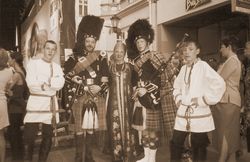
It should be noted that the teams surprisingly conveyed the flavor of each country. The most vivid impression is the Scots. They, it seems to me, is closer to the mentality, because the northern peoples are distinguished by some special calm. Traditional dancing under the bagpipes was performed - a unique and so loud tool that it does not require microphones or amplifiers. Their national skirts were also impressed - wake. Moreover, we were shown how they are created. One skirt takes ten meters of fabric, some of which is used as a cape. The news was for us that they dressed her lying. Pretty curious picture!
The Hindus, of course, shocked their unique culture. They have everything else: other rhythms, plastic, sounds. And nothing to do with the Indian series that show us on television!
The Poles struck with their bright woven costumes, which they change to every dance. One skirt from this costume weighs about ten kilograms, and looks amazing!
The Portuguese brought a real national team. Its peculiarity is that the folklore tradition is still alive in Portugal. They dance in the same way as their mothers and grandmothers danced, and their children and grandchildren will also dance. We have to restore this tradition and professionally teach children folk songs and dances in order to preserve this important part of the cultural heritage.
What is the idea of the festival?
The organizers, first of all, wanted to achieve purity, truth of sound. That is, no electronic music, nothing artificial, everything should be natural. We went without an orchestra, and represented us as follows: "Listen to the oldest of all musical instruments - a human voice." The idea of our program was to show the dancing in the language traditional for Pskov. Dancers performed their parties under the vocal support of girls, under their songs. Thanks to this, we stood out significantly among the rest of the participants.
How were you accepted in Poland?
They took “with a bang” because what we do is an archaic theme. In the jury were ethnographers from Warsaw and Germany, who were amazed at our sound recovery and as experts were able to appreciate it. As for the audience, we did not allow them to relax, because our entire program was built on dissonances. Imagine: Kupala night, a bonfire is burning, universal walking. It is impossible to resist, so as not to set off on dance with us!
On the last festival day, a universal procession was held, which was marked by the holiday of the vine. The fact is that GURA GURA is the northernmost city where wine was produced (now it is no longer produced). Each procession participating in this procession had to give the holiday some dance, dance or something else. A huge number of people gathered, and not only the inhabitants of Green-Gura, but also visitors, and it was clear how everyone was happy. Happy smiles did not leave their faces! It is not surprising, because they presented such a rare gift - the half -planes passed before them along the street!
How many performances did you have in Poland?
The program was very tense. We were given only one day to relax, to see the city. And so almost every day there were two concerts. We traveled all the surrounding cities: Gubin, Sulekhuv, Nova-Sma and others. We performed in various clubs, for example, Rosa de Lucien, where lovers of modern music gather, and Harlem. The last of them is jazz. Clubs such as Harlem, only two hundred around the world and only twenty of them are in Europe, the rest in America. It should be noted that they took us very well, despite the specifics of these places.
Have you received any invitations after the festival?
Undoubtedly. They want to see us at the festival in Bialystok (Poland), in Ukraine, in Portugal. We immediately received an invitation from the Scots to go to Edinburgh for the next year. True, we also invited them, because we cannot miss the 1100th anniversary of the beloved city and are going to prepare a new program.
And what, the Scots will come to us next year?
Who knows, because a person suggests, but God has. We will work on it.
How long has the "ograd" exist?
The team as a creative association has existed since 2000 on the basis of the regional center of folk art. All our guys are graduates of the studios of the house of orphanage. Our program was born a year ago as a result of the interaction of folklore and choreographic studios, the leaders of which are Tatyana Parshenkova and Irina Belotelova.
Where do you draw the material from?
The material is exclusively Pskov, no All -Russian sources. This is our distinguishing feature. We work with our northwestern tradition and use the materials of the expeditions of the St. Petersburg Conservatory.
What is the age of participants in the team, and how do they relate to their occupation?
Only young guys work in Ugrand, who, like everyone else, go to discos and listen to modern music. But they know the Russians, or rather, Pskov traditions, because they are studying them from eight to nine years. "Ugranda" for them is work, hobby, as you want. But, if you take it wider, then most likely this is a way of life. We actually strive for this: so that every child in our city is proud that he is Pskovich.
You sing ritual songs. Did it happen that the forces of nature responded to your call, as in ancient times?
Believe it, you want - no, but a very interesting case occurred on the final gala concert in Poland. All teams were given seven minutes to imagine themselves. Our girls came out and sang the Kupala song “Girls-priorities came out:”. At that moment, it began to crash. And when they moved to the second “oh, create, sky, rain:” - a ritual song -speaker, then a real rain poured. Is there any other evidence of the magical power of conspiracy and Russian folklore tradition!
Anastasia Postnikova.