
Translated material
Middle Ages close -up
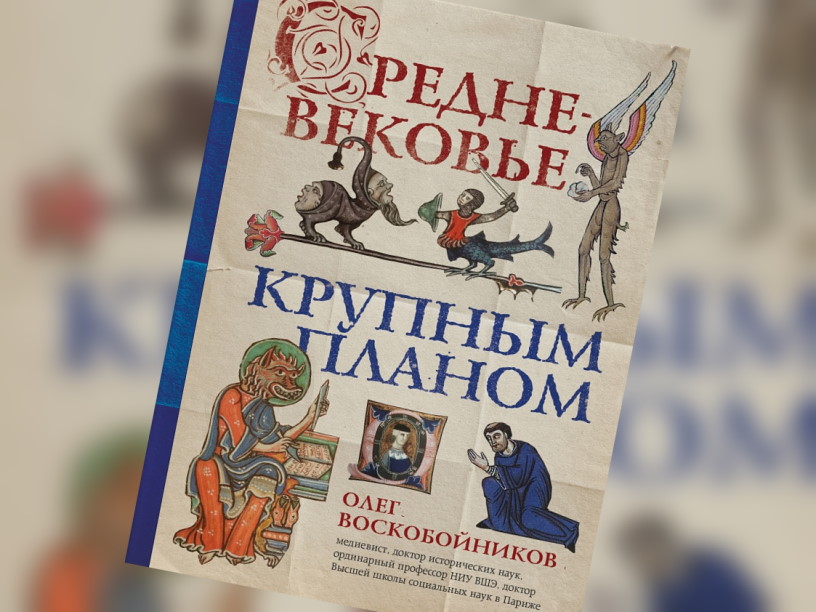
 We continue to acquaint readers with books included in the long list of the Enlightener Prize 2020. On September 17, eight books will be known that will continue the struggle for the prize.
The Bombbor publishing house represents the book of historian Oleg Voskobobinikov “The Middle Ages Close -up” .
The book of Professor Voskobobinikov will tell how people who lived many centuries ago differed from us, and what they looked like, where inspiration was made from, how they loved, how they built the hierarchy of power, how they fought and what caused conflicts, how and why some events turned out to be the prerequisites for changes, while others did not change the course of history at all.
We offer to read a fragment of the chapter dedicated to the medieval war.
Civilization, born of a great resettlement of peoples, was a civilization of war, aggression and cruelty. The militancy of the barbarians became the parable of the Romans of the Romans of the era of decline, because their own militancy by that time had long become history. We take a look at least fluently at the new onomastics-the names inherited by modern Europe are not from the Romans and the Greeks, but from the Germans: Badri (Bald-Rik, Brave and Mighty), Richard/Richard (Rik-Hard, powerful and brave), William/Gilm (Wile-Shelm, Volya and helmet). Gerard/Gerhard (Ger-Hard, Strong spear), Mathyldis (Machthildis, powerful in war), Clotild (Chlote-Hildis, Glorious Battle), Louis/Lewis (Chlodo-Wed, glorious battle), Herbert (Chari-Bercht, brilliant in the war). Latin quickly filled with barbaric military vocabulary, which again is not surprising. It is enough to recall that English. War, fr. Guerrere, Ital. And Span. Guerra - all go back to the Frankish word Werra - “straight”, “brawl” - that replaced the good Latin word Bellum since the 10th century.
Nevertheless, the war was and, unfortunately, remains the traditional way to resolve conflicts at all levels. Therefore, in order to see medieval specifics, you need to make several preliminary reservations. We already know that uncertainty in tomorrow, a sense of danger and instability in general for centuries have remained the norm of life in the Middle Ages. This explains why the use of strength and weapons was considered acceptable both for pacification and restoration of order abroad of the Christian world, and inside-among their own, with something that are not consonant. On the other hand, if you look closely at the history of conflicts and battles, the following can be stated. If in the X-XI centuries the lords and their squads are measured by force without any visible control, then in the future this chaos is first opposed by the Church, then the feudal world itself and, finally, the king. The paradox is that the vast majority of the medieval population, at least formally, is unarmed, the war as a social function belongs exclusively by nobility, weapons and military art - not only an obligation, but also an expensive obligation. People are divided into armed few soldiers - Milites, and numerous unarmed, therefore defenseless, peasants - Rustici. Those few who are available in status decide everything except relations with heaven, which, however, also affect the most directly, because the clergy was mostly replenished at the expense of the same feudal nobility. The place in the military hierarchy coincided with the social and political hierarchy, and the volume of duties and honors related to the war was directly proportional to the size of the feud. All feudal structures, whether it is county, city, bishopric or a significant monastery, were obliged to their overlord with the so -called “help”, lat. Auxilium: to put on the call a certain number of armed cities and infantrymen. The right to such a call was called a bank. The same term, to which the modern word “banal” dates back, denoted a number of other feudal privileges, because the German verb Bannan, related to our “BAY”, was understood as an order, the failure of which threatened Kara.
As it is easy to notice, even in general terms, such a system is not much similar to both Roman legions and professional armies of the New Age. However, the end of the Middle Ages, especially the last stage of the Hundred Years War and the Italian Wars, is marked by the emergence of regular armies. And this means that over the past centuries, society again, as in antiquity, has learned to control military force through politics, law and morality. From the privilege of the nobility, the war turned into a lever in the service of the interests of the state. To some extent, this is the allocation of war in a special sphere of politics, its relative rationalization, can also be considered the end of the “warlike” Middle Ages.
However, you should not think that the binding of war to the state, both at the level of ethics and at the level of law, has become absolute, at least under the old manner, until the 19th century. The revival of military science, treatises, academy, strategy and tactics - all this applies to a new time. Therefore, the temptation is great to see in the medieval features of the fighting and in the ideas about the war of a millennial failure between Roman antiquity with its stable system and regular armies of the New Age. Developed military science and technology suggest huge material resources and centralized power with exorbitant ambitions. Both after the fall of Rome was preserved only in Byzantium. The West, however, in theoretically, for a long time, recognized its imperfection in relation to the heritage of the ancients. Over the centuries, they copied in Latin, and then translated into new languages a treatise “On Military Art”, written in the IV - V centuries. But nothing more. The same admiration is also evidenced by the fact that in the real heroes they did not number their kings, although they expected feats from them, but Alexander and Caesar. The first Carolings - Karl Martell, Pipin, Karl the Great - most likely, were not the great military leaders in the sense in which we are among them the same Alexander of the Macedonian, Rokossovsky or Napoleon. But the knights of the round table and even the first crusaders are unlikely to call strategists, although the Crusades assumed “logistics” very difficult for their time.
Crusades and reconquist contributed to myth -making. It is no coincidence that at the same time the greatest epic poems of the Middle Ages are recorded: “Song of Roland” in France and England, “Song of my Side” behind the Pyrenees, “Song of Nibelungs” in German lands. The latter, although dedicated to the era of Goths and Hunnov, speaks in the language of the warlike chivalry of the XII - XIII centuries. Other songs about deeds (in French-“gestures”) and knightly novels glorified the courage of the heroes of really existing, long-standing and new, or in literary characters brought ideals and conflicts that are understandable to the same chivalry. The sovereigns were still in them on the second and third roles, their behavior remained ambivalent. But the heroic canon was gradually formed, which could be equal to. At the beginning of the XIV century, Jacques de Longgion expressed a specific historical consciousness of chivalry with his ideas about honor in the image of “nine fearless”, fr. Les Neuf Preux. It included three Old Testament military leaders (Jesus Navin, King David and Judas McCave), three ancient pagans (Hector, Alexander and Caesar) and three, so to speak, “their own” - Arthur, Karl the Great and Gottfried of the Boulest. This pantheon has become the subject of literary and artistic imagination: in the company of personifications of sciences, prophets, electors and fathers of the Church, we will see the whole “magnificent nine” on a beautiful fountain in Nuremberg (1385–1396). Medieval connoisseurs of antiquities, who loved symmetry in all, soon added to the husbands-wives who had nothing to do with them, but no less heroic, as it seemed to the mythographers-storrons. It was great for the temptation and alive to join the ancients, redeeming in the rays of their glory: it was an honorable one among the ancestors of the hero of the reconcusse or the Crusade. It is enough to recall how the crusader of the Kachchagvid, the ancestor of Dante, one of the most magnificent characters of his “paradise”, from his beautiful far away, like “a father, baking about a child,” predicts him a bitter fate of the exile (paradise, XVII, 34–99). At the beginning of the 15th century, the poet Estash Deschan Narest the tenth “fearless” of his compatriot and contemporary of the knnberries of Bertrand Du Geklen. The same role was not too successfully experienced after rehabilitation, Jeanne d'Arc burned for witchcraft. All eighteen walked before Henry VI during his entry into Paris in 1431. Burgundy dukes, with great zeal gathered Christian relics, also carefully kept the relics of knightly, heroic ones, and one of the ceremonial swords wore a unicorn (that is, Nargal) in a scabbard.
All these are really products of imagination, not science, myth -making, not history. But if you take the work of reading thousands of pages of medieval chronicles, letters, the same epic or knightly novel, the picture will become more complicated. Almost all chronicles until the 13th century were written by monks, but in them we will find evidence of routine work on the organization of military operations, from the delivery of fodder and financing to the manufacture of siege tools. Behind these written evidence is a hard -to -actual oral tradition. In part, she retained the military customs of the Romans, in part, on the contrary, the Germans, who, in general, could not contrast the relics and training of the legions. We can study the wars of the New Age even on cards, nothing of the kind came from the Middle Ages: most likely, it never occurred to anyone to conjure to portulans or pilgrimage Itinerias, planning an attack. At least until the 15th century. However, this does not mean that the knights did not know how to conduct reconnaissance and generally comprehend what is called the theater of military operations today. Once today in some area that the industrial boom of the XIX-XX centuries bypassed, we often discover the real system of defensive structures that amaze with its complexity, even if the Western Middle Ages did not know the Great Chinese wall, which was stretching for hundreds of miles of Roman luxury. The langobards who won and mastered the Apennine peninsula locked the Alps with the Claus system, Clausae, which can simply be translated as “garrisons”. And although they did not save the Langobards from the Franks, it was the castles that became the basis of the military organization of medieval Europe.
And to build and contain a continuous borderline network of fortifications could only a large state. Therefore, the long fortifications of the Middle Ages are few: in the VIII century, King Mersia Off erected a shaft against the Britons Wales, partially preserved to our days, a little later, Karl the Great spent the “Saxon line” against the encourages. But such undertakings did not become a rule. In the Middle Ages, the very concept of the border, so familiar to both us and the Romans, has blurred. This does not mean that they did not think about the "lines" at all. Line areas began to be called in the German manner of stamps. They assigned a buffer role, and based on it they were controlled. Castles of different sizes were often lined up along the paths along which the troops could pass: no conqueror even needed a small detachment of the enemy in the rear, and he was forced to settle about each such castle if he was ready to resist and did not give up without a fight.
In the late Middle Ages, a narrow valley of the Aosta River, leading from the Padan plain to Montblan and passes, was covered with a network of small castles, strong nuts, some of which stood below, others huddled on the rocks. Such eagle nests began to be called rocks. And in many other lands, stone castles from the 10th century began to form a landscape both in strategically important areas and in whole historical areas. The Count of Shampani was believed to afford to spend the night in a new castle every day: a luxury, unlikely to even a king in the 12th century. Castilia completely received its name from the word “castle”, and the process of feudalization itself in some countries of the West, especially in France and Italy, is called insight, in Italian-Incastellamento.
If we could not see that the story has preserved, but the system of castles, say, Tuscany or Scotland at the time of heyday, the century in the fourteenth, we would have been convinced that without any cards and treatises, medieval barons, columns and dukes learned to control the vertical and horizontal space, on the plain and in the mountains, on land and, on the land and, on the land and, on the land, No less surprising, on the water. Without afraid of an anachronism, we will call this phenomenon a kind of instinct of “operational space” developed by generations. Moving today by car or bus from the castle to the castle along someone laid by the tourist route, we will not immediately guess that roads and foot paths were laid out of strategic reasons. Behind the ruins, restored, visited or abandoned, there is human life: carts, communications, the defense of the surrounding lands, the salvation of local residents from natural and man -made disasters. Any castle was supposed to accommodate the surrounding peasantry in a year of disasters, sometimes for a long time. The performance of such functions caused technological progress, which we have already partially interpreted. He also touched military thought, even if it began to fix it only in the XIV - XV centuries.
Previously, in the heading slow reading, the following books were presented, which included in a long list of an enlightener of 2020.
- Egorov Vitaly. People on the moon: the main answers. -M.: Alpina Non-Fikshn, 2020.
- Kukushkin Nikolay. Cotton with one palm. How inanimate nature gave rise to the human mind. -M.: Alpina Non-Fikshn, 2020.
- Loseva Polina. Counterclockwise. What is aging and how to deal with it. -M.: Alpina Non-Fikshn, 2020.
- Nikiforovich Grigory. From orgasm to immortality. Notes of the drag designer. - Minsk: Discourse, 2019
- Sokolov Alexander. Strange monkey. Where did the wool go and why people are of different colors. -M.: Alpina non-fiction
- Popov Sergey. All formulas of the world. -M.: Alpina Non-Fikshn, 2019.
- Chuprinin Sergey. Thaw: Events. March 1953 - August 1968. - M.: New Literary Review, 2020.
- Yablokov Ilya. Russian conspiracy culture. -M.: Alpina Non-Fikshn, 2020.