
Translated material
Exhibition: everyone lies calendars
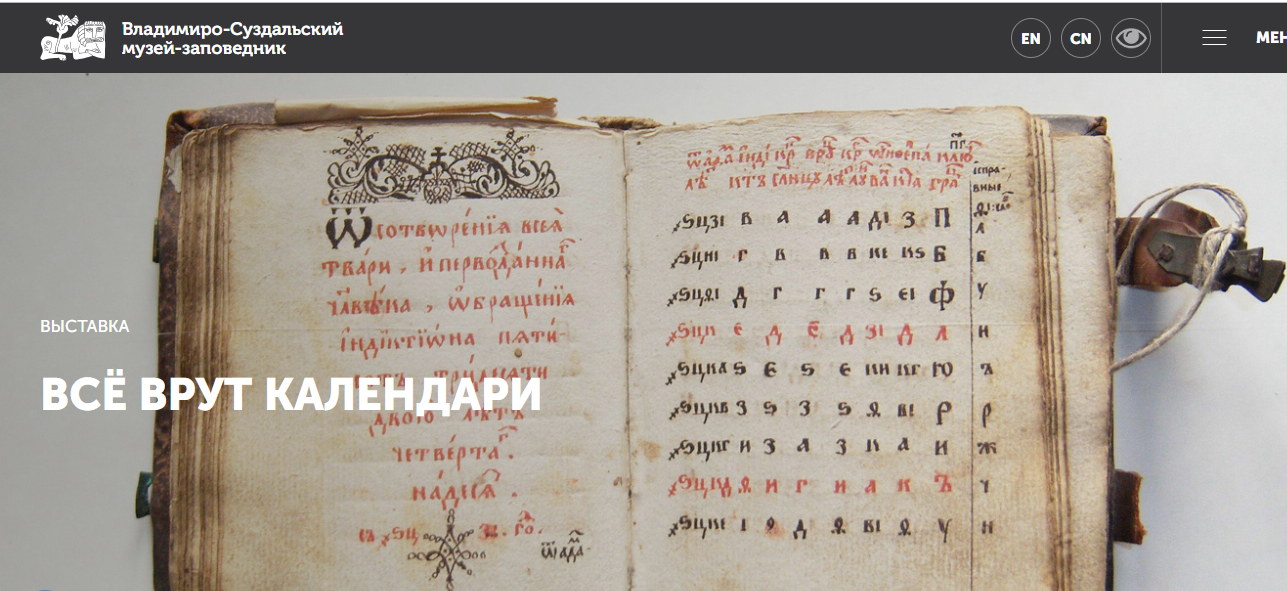
At the exhibition, you can see some types of calendars of the XVIII - first half of the XX centuries, demonstrating various approaches to calculations of time. The objects are presented from three museum collections: “The Book of Star Printing”, “Manuscript Book”, “Documents”.
The calendar appears when people have a need to determine the time and its measurement.
Throughout the centuries -old history, various calendar systems have repeatedly replaced each other, the methods for calculating the dates of certain sign events have been transformed.
As in other Christian countries, from the end of the 10th century in Rus', a Julian calendar was used in Russia, based on observations of the visible movement of the sun in the sky.
For many centuries, the beginning of the New Year was considered March 1. Over time, relying on church traditions, the new date was scheduled for the first of September. Peter I introduced the innovations in the use of Julian chronology: September was replaced by January, but the number remained unchanged.
The decree of Peter I on the reform of the calendar consisted not only in the transfer of the date of the beginning of the year, but also in the conduct of the new chronology: not from the creation of the world, but from the Nativity of Christ. With this approach, the difference in these calculations was 5508 years-the inhabitants of Russia went to bed in 7208, and woke up in 1700!
A hundred years ago, the RSFSR also carried out a reform of the calendar system - the transition from Julian to the Gregorian calendar. These calendars have significant differences from each other. The difference between them is the calculation of leap years. Over time, it increases: if in the XVI century the difference was 10 days, then in the XX and XXI centuries already 13.
In the RSFSR, the transition to the Gregorian calendar was based on the decree of the Council of People's Commissars of the RSFSR “On the introduction of the West European calendar in the Russian Republic of January 24 (February 6), 1918.
The decree began with the words: “In order to establish in Russia the same time with the calculation of time in Russia, the Council of People's Commissars decides to introduce, after January of the month of this year, a new calendar into civilian everyday life.”
Since the difference between the old and new calendars was 13 days, it was prescribed by this decree that the first day after January 31 was considered not February 1, but on February 14, etc. In addition, next to the number in the new style, it was necessary to write a date for the old in brackets.
The proposals for such a calendar reform were made back in the middle of the 19th century, but it was possible to implement these transformations only after the October Revolution of 1917.
The exhibition is located at: st. Bolshaya Moskovskaya St., 64 (Historical Museum).