
Translated material
Against the wind | Colta.ru
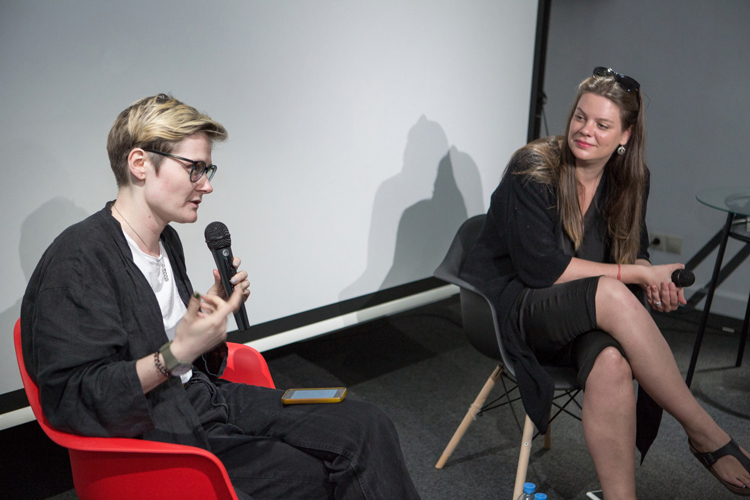
On June 14, in the Moscow Center of Voznesensky met for a conversation on the topic "What is a woman in poetry?" Two noticeable figures in today's Russian poetic life are Vera Polozkov and Oksana Vasyakina. This meeting caused a fairly noticeable resonance: the year of literature promptly published a report on it, partial decoding appeared on Gorky and MK (when comparing these three publications, it turns out, however, that the operational report greatly distorts what was said, and the response of the response received from the organizers of the meeting and only cut, they are naturally silent). This resonance is not surprising: one after another, one after another brings examples of the improper insecurity of women in Russia, and since there are no politicians (and, in particular, female policy) in a civilized form in the country, the field of art and culture remains a priority for a responsible statement on socially significant issues. It is precisely such a statement that is the poetry of Oksana Vasyakina, and the Lyceum Prize, which was awarded to her on the eve of the meeting, is definitely read as a recognition that uncompromising, not sparing either herself or other a story about the life of a woman in post -Soviet Russia, a story in which gender problems are closely intertwined with social and class (not without reason Vasyakin constantly, including in this conversation, including in this conversation. He emphasizes his origin from the driver of the driver in the city of Ust-Ilimsk)-this is precisely the fact that in today's Russian poetry it is so necessary. Well, Vera Polozkova was and remains one of the leaders of reader popularity among the current Russian poets. Well, at least, among those who withstand some level, so to speak, professional decency, because the most recently the horizontal culture of social networks begins to endure a wave of popular recognition of completely meaningless characters, who can only rhyme “blood” with “love”, and I must say, girls with a pop appearance (one of these girls of Poluzkov at the end Conversations recommend that everyone as an “interesting satirical poet”: it “is so cool exposing what is happening in its midst, so tough in fact and so observant” - even I became interested in such an advertisement and got acquainted with the fresh masterpiece of an “interesting satirical poet” under the name “Poems about a person who loses the iPhone”: “He is no longer a lucky one, / Any trifle for him, / and a blogger, and a blogger, and a blogger, and a blogger, and a blogger, and a blogger, and a blogger, and a blogger, and a blogger. Having lost his device, / it retires instantly! ” - stiffness and observation are actually rolling over).
Thus, the conversation of Polozkova and Vasyakina deserves to talk about her seriously. But it turned out to me so, I have my own reason to respond to it. So these notes will, of course, partly subjective. On the other hand, in matters of gender identity, it is quite difficult to attract objectivity, since no one is free from it (identity). At the same time, the very topic of discrimination of women, the inability to realize the most elementary human rights for them, up to the right to life is so painful and indistinguishable that everyone who enters into a conversation about it is as if they are free to take into account the nuances and make reservations. It may, maybe, right if some other struggle was sometimes disguised as a struggle for women's rights, the justice of which is not so obvious.
The general idea in the conversation of the two poets can be predicted by name. A woman in poetry (today's Russian, we are talking only about her) is uncomfortable, and a man is to blame for this. These are they, men (and Tatyana Tolstaya who joined them with Avdotya Smirnova, appearing in a conversation as the vicar of the Patriarchate-female representatives who support the existing order of things), do not let the gifted women to the forefront of the literary process. This “criticism of the uncles” forces gifted young women “just go out the window because it is impossible to endure” (Vera Polozkova). This objective gaze of men considers young poets exclusively from the point of view of the exterior, “as a material that is present somewhere as an attribute of a successful party” (Oksana Vasyakina, who recalls in a conversation, as a certain “eminent critic” unnamed from delicacy, said to her: “Oksana, this is now young and beautiful, and when you will be old and the same stupid, terrible and terrible and terrible and terrible and terrible and terrible and terrible and terrible and terrible and terrible and terrible and terrible and terrible and terrible and terrible and terrible and terrible and the same. Fat, we will find other beautiful girls ”). It is common for men to have “some kind of decaying soul, when you want 40 and you want the collapse that is happening with your soul to touch the whole world and all slowly broke up with you, no one has ever replaced you, did not come and did not disturb your eyes, which differs from how you imagine it” (V.P.). And in order to resist this oppression, this gender inequality, you need experience that comes out over the years of maturity, we need feminism gaining public opinion, and most importantly, you need personal success: when “the circulation of my books is approaching 150 thousand copies” (V.P.), when you are awarded a million rubles (O.V.), then these goats, these goats, these goats. “The genuine knights of the spirit who write books in 2019 do not shave, do not wash, thump” and are printed by a circulation of 500 copies (V.P.), you are no longer terrible.
The winners are not judged, this is true. But is the victory is precisely measured with circulations and money?
Among other men who played a role in her life, Polozkova also mentions his former “mentor”, who “goes crazy, becomes a missile dog and turns into a cheerful shark of a regime that devours all his former friends.” His name is not named from delicacy, but I can hardly be mistaken when I saw Eduard Boyakov in this person, who listed in detail his merits in Poluzkova’s life in the final breakdown of relations with her. (Here we can note in brackets that sometimes, apparently, there is still benefit from men-until their souls will take possession of the decay of the 40th anniversary.) Well, Boyakov’s fascination was shared a decade ago, in the era of the Practice Theater, quite a few intellectuals and esthetes. However, I had a chance to talk with him only once, when the idea of a kind of poetic concerts was born in Practice - and Boyakov invited me to think about the composition of the authors that would be involved in this. It was required to find poets capable of keeping the attention of a full hall, poets emitting charisma, poets, reciting poetry with the same brilliance with which the best actors do it. In a word, winning poets. I thought about this proposal - and refused. It seemed to me-however, I am sure of this-that the victorious poets would not have suited either the Mandelstam or Vsevolod Nekrasov. And the most important figures in modern Russian poetry, from Mikhail Eremin to Polina Andrukovich, are also not suitable for such a setting. No, poetry, even the most difficult, is not the consolation of an unwashed and unshaven elite, but a universal property. Yes, it can and should be promoted, look for funds (including theatrical ones) in order to convey it to a wider audience. But this is a task, not a criterion. External, quantitative, measurable and monetized success parameters are good for the world of cheerful sharks, and you should not be surprised that when changing the circumstances of these sharks, the diet instantly changes. The poetess Polozkov, as a glove, was suitable for the cultural project of director Boyakov - we will not be surprised that the cultural ideology of Boyakov now speaks with us the lips of Polozkova. Not only Boyakov, however: I and Alexander Ivanov, also at some point in a cult figure and aesthetes of the figure, once heard a monologue that no Vsevolod Nekrasov could not compare with Evgeny Yevtushenko, because Evtushenko read millions, and only then he was not surprised, as others, why was the AD Marginem Publishing House instead Prokhanov. And what at the same time certainly arise in a polemic and do not give funny sharks of peace of peace of renegading-minoritarias, swarming in their kitchens with some kind of incomprehensible and unnecessary literature, not a focus: the cat knows whose meat eaten and tremble.
Therefore, the poetess Polozkov in this story is understandable and not very interesting: its main motive in the conversation that has happened is restification. “ N ON/FICTION does not invite me, I do not appear at the Krasnoyarsk fair” - it seems that all these annual resentment were applied annually by the professional community should not be listed so long, if Polozkova herself considered her victory as genuine and undoubted. What says in an interview with Polozkova Vasyakin seems to be almost no different - but it is important, as always, who says it.
The success of Oksana Vasyakina in Lyceum was a perfect surprise precisely within the framework of the prize itself, in the previous two years awarded in a poetic nomination of uninteresting provincial epigones without his own person. But just inside the literary community, Vasyakina's position is completely strong. In recent years, it has been perceived as one of the most striking (along with Galina Romb) representatives of the new generation of feminist poetry. Simultaneously with the “Lyceum”, the “AST” publishing house “Wind of Fury” was published in which, along with the poem that was previously released by the author in the form of a samizdat project for a personal newsletter, only women Pisareva (the format, rather, for “living classics”), and this book has already appearedan enthusiastic review of the country's leading criticism of the country Leo Oborin. Vasyakina's voice is really unique - the readers of the Kolita could well make an idea about this according to the poem “What I know about violence” (the eloquent editorial insert speaks of the outstanding place of the author in today's poetic landscape: “Colta.ru does not publish poems, however ...”). In short, for a resentification, Vasyakina's foundations seem to be not. And there is a resentment itself.
Here the most problematic place in my reasoning begins, because I was not lucky to personify this resentment. Decoding on the Gorky website says this:
OV: I am just a very gambling person. When I was 21 years old, I read Lena Fanailova’s poems and thought: “This is yes.” And then I sent a selection of Dmitry Kuzmin, and he wrote: oh, this is a Fanailovskaya crap that you write there. What he is beautiful is that he reads all the collections. In spam, he also reads collections. And he answers all the collections. How he answers is rudeness, as a rule.
VP: He says: "You are shit, never do it anymore."
OV: For example. This is a quote. And I had a big dream to meet Lena Fanailova. A year ago, I met Lena Fanailova, and now I have a book with the preface of Lena Fanailova.
The initial desire to somehow respond to this fragment arose for me for a purely altruistic reason. The fact is that I really read everything that comes to me (to the poetry magazine) by gravity, but I answer far from everything: it is simply “physically impossible”, as the character of Kira Muratova said, if you start to correspond with these poor people (starting with the unfortunate legion, sending a letter to the editorial office “How to send you poetry?”) Classes. And the need to publicly refute this partly even flattering fiction for me is due to the fact that otherwise one of the poor people will certainly decide that only he, unlike all the others, did not receive an answer from me-so it is not far from suicide.
But once, having begun to answer, it is difficult to stop. I am not sure that it is beautiful precisely because I read all the collections that come to me. But then I keep all the correspondence with the authors. So, this is what the answer received from me Oksana Vasyakina on January 24, 2013 (she is not 21, but 23 years old, but this is not so important):
Oksana, I rather like the texts (especially the “Lucida” as the least straightforward: where the socio-psychological motive is inevitably, I have to look back at the too strong background in the person of Fanailova, from which it is difficult to rebuild). But right now there is nothing “paper” on the conveyor (the fresh “air” has just come out), and indeed I prefer not to rush. Write in two or three months-let's see that you will have a new one during this time and where it will all be.
Three months later, indeed, Oksana Vasyakina sent me a new selection and received the following answer from me on May 10, 2013:
Oksana, theoretically, I would even have printed 3-4 texts from this selection (I still like Lucida, only the word “walls” in the second line is superfluous, in my opinion; perhaps, “Relashnships” and “Svetlana”; other Indian texts seem to me too rarefied, and the “table game” was invented great, but there are, in my opinion, there and there. Sloping). At the same time, I do not see much sense in reprinting entirely from the “halftones” (the most “prestige” of paper publications is an illusory piece, and readers are largely the same), and a couple of May texts in your LiveJournal seems to me somewhere else. So I postponed the indicated three poems to myself, and when the next portion is typing - send me first, and then to other places :)
You can imagine that the young author dreams of in response to his first selection to receive an enthusiastic “new Pushkin appeared” from the magazine, and release the first three-volume collected works to his 25th anniversary. But if these dreams are taken out of brackets, then, it seems, there should not be special grounds for considering my answers with examples of editorial rudeness, Oksana Vasyakina should not have. Moreover, in the next, 2014, its first paper publication appeared in my journal Air, and in 2016 the first book was published in my Argo Risk publishing house-but she did not want to publicly mention this in 2019. Why?
Probably because this would violate the logic of the narrative: Elena Fanailova as a guiding landmark against Dmitry Kuzmin as a hostile obstacle, sisterhood against the conspiracy of patriarchy adherents. In the “Wind of Rage” Vasyakina says: “I think that I am one of these women / one of those who fight against all men for all women” - but we, of course, are trying to separate the subject of this statement from the living person from the old philological habit, with whom we find ourselves on the same stage or in one hall: did Mayakovsky really love to watch the children die? However, there are poetic statements, the hybrid nature of which counteracts such a separation: in the poetic function of the language, expressive and conical leadership is disputed here, poetry as a study directly goes into poetry as an action, the author seeks to minimize the gap among themselves and the subject of writing - and is ready for the sake of this to sacrifice and in the letter, in the ability to comply with the impassable requirements of the artistic Balance), and in their own life (neglecting the norms of decency and ethical conventions).
“Against all men” is also against those thanks to whom you are where you are, against those thanks to whom your voice is so audible and significant. The idea of gratitude seems to be natural for a person, but it is easy to imagine how insignificant it looks in the face of a great revolutionary task, the importance of which is incomparably higher than personal loyalty to specific persons. And in this sense, Vasyakina has a direct predecessor: Kirill Medvedev. In the famous “Kommunik” 2003, he, as we recall , summarizes six (like Vasyakina) years of his professional activity, during which a rather wide circle of people and institutions supported and podzled a new bright phenomenon in Russian poetry - and finds on this occasion (for these people and institutions? If not, for whom?) The following warm words of gratitude: “irresponsible infantile games and supposedly Independent intellectual statements ”,“ cruel and primitive struggle for cultural influence ”,“ disgusting speculations of critics and journalists ”, etc. But this, of course, is necessary for a great goal: but, says Medvedev in 2003, "in my country there will be more honest, uncompromising and truly contemporary art." Have there become more such art over the past one and a half decades? I don’t know how to measure it, but it is quite possible. Did this happen thanks to Medvedev? Perhaps, but doubtful. But what is definitely - although Medvedev has been engaged quite a bit since then, preferring, for example, to run for municipal deputies from the Communist Party, today he is one of the most famous and recognized poets of Russia today. A request for poetry, which can and wants to act directly, is large everywhere now - and many are ready to see the desired effect not in the properties of a poetic text, but in the author's declarations.
Vasyakina has a huge advantage over Medvedev: her great goal from the very beginning lies outside the literature. When you read reports about the case of the Khachaturian sisters or the less famous, but in some more amazing Larisa Koshel case , I really want to put all possible forces on the altar of the fight against the existing state of affairs. Well, what are these forces in the undemocratic state? You can spend a literary evening . This is much more than nothing, but incompetibly less than necessary and want. What can be done with frustration about this? The most natural and easiest way to overcome it is to return - with all the accumulated fury - to the professional environment. The search for the enemy is nearby, where closer and visible.
This is not to say that a literary environment without sin. Poets according to their human qualities - no, no better than other fellow citizens. And to start restoring order from the space in which you are now, in its own way correctly and naturally. But in this space you can not destroy, but create, and in this area the path of Oksana Vasyakina is just beginning . “Fight against all men,” and then inviting them to speak with a course of lectures. The struggle for any more or less serious changes is based on the art of searching for compromises and conquering allies, and not on the art of closing enemies-although, I will not argue, this last art is more spectacular and the author himself starts more.
Alexander Bikbov wrote in 2009 about cultural projects born in the 1990s, and their creators: “It will be another ten years, and perhaps they have to accept sincere radical criticism. Well, if so. This will mean that they managed to create those clear semantic and institutional frames, leaning on which new protagonists and cultural intermediaries will take the following independent step. ” Ten years have passed, and for example, I am ready to receive and sign. But if the radical criticism consists in the fact that the senior comrades impolitely respond to letters and do not follow their and their employees with a moral appearance, then, I’m afraid of this, an independent step will not come of it.
Subscribe to the COLTA.RU channel in Yandex.Zen to miss nothing