
Translated material
The dictator became a jester
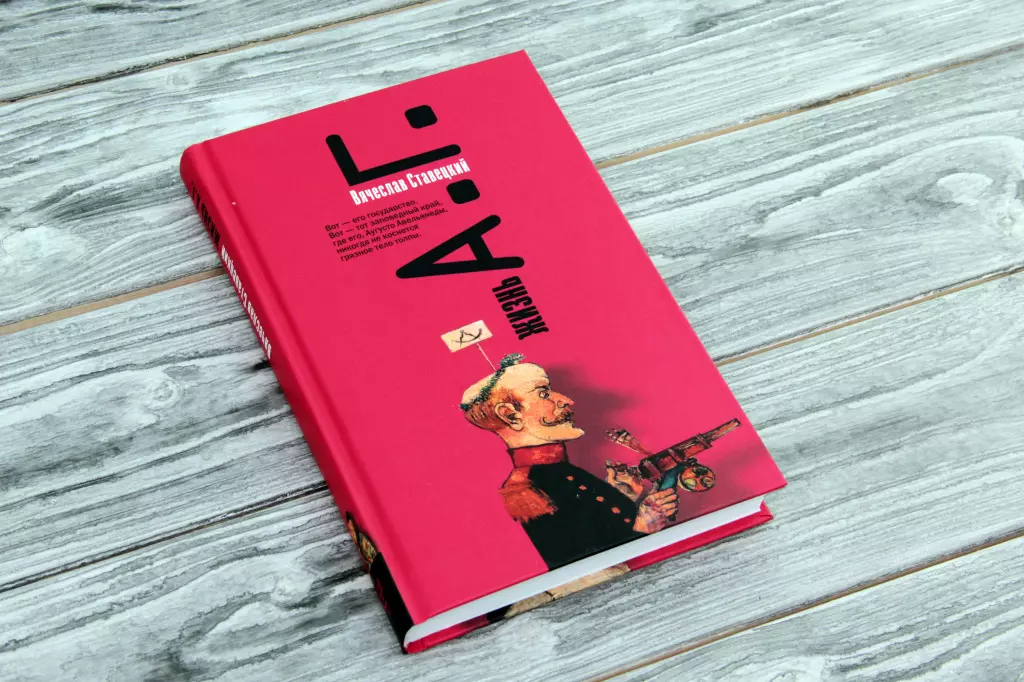
Moody Book: "Life of A.G." Vyacheslav Stavesky
Vasily Vladimirsky continues to monitor the reviews of the most important domestic and translated innovations and once a week presents to your attention a digest in the heading “disputed book”. Today we will talk about the novel by Vyacheslav Stavesky "Life of A.G."Vyacheslav Stavesky. Life A. G. M .: Ast. Elena Shubina, 2019 Elena Shubina
Roman "Life A.G." -The first book of Rostov, Vyacheslav Stavesky, an alternative-historical parable about a fictional dictator of the mid-20th century, concluded by political opponents in a cage and sent to a long tour of their native Spain. The debutant has already managed to attract the attention of professional readers: several of his stories and stories are published in thick literary magazines, visited the short linals of the Debut prizes and the name of V.P. Astafyev. The criticism quickly reacted to the exit of the novel: the book observers discussed the ambiguity of the image of the protagonist of the “life of A.G.”, remembered which of the real historical characters also drove around the country and showed the people, and argued whether Stavesky’s post -modern games or the author were appropriate to say all, without smart. Nevertheless, the general puzzled intonation of reviews says one thing: "Life of A.G." It is hardly squeezed into the usual framework - tools that are usually used to evaluate the advantages and disadvantages of modern Russian prose, work here it doesn’t matter, with a creak. Gorky wrote about Stavesk in two reviews - here and here .
Vladislav Tolstov in the review “Russians: new names and new novels of domestic authors” (“Baikalinform”) draws attention to the alternative-historical component of the novel:
“As a child, my brother and I loved to play“ buttons ”. The political map of the world was spread on the floor, then they took a bunch of various buttons, these were ships, army and divisions. And they imagined that the army invades Peru, and the fleet is suitable there, and there the tanks went ... Well, buttons are plus imagination, and you can play for hours. The novel by Vyacheslav Stavesky is also similar to the game “buttons” because he takes a real geography, takes a certain historical period (the war of the Francists and Republicans in Spain in 1936–1938), and then the game “In buttons” begins, or rather, on top of the famous plot, Stavesky writes his own plot. A certain archaeologist from Rostov writes his own version of the history of Spain of the 20th century, but writes, it turns out, his own fantasies on the topics of real historical plots and characters. In the center of the novel is the fate of the overtaken Spanish dictator Augusto Hofredo Abelianeda, known in his country under the initials of A.G. The ruler once located at the very top turned into a fair curiosity in the hands of a new government. There he has some incredible Spanish tanks, there the Republicans are not republicans, some rebels and generals appear who begin to live their own lives, and in general it is like such exercises in alternative history, sometimes quite interesting. The narrative turned out in its own way strange, but bewitching, and the question “Why do I need to read it” is better to postpone for later. ”
Vera Kotenko in the review of the “dictator tour” (“reading”) draws attention to the fact that A.G. It looks little like a merciless tyrant, as we usually imagine such a character:
“In this torture, the dictator suddenly discovers himself - dreaming not about the seizure of the world, but simply having confused the goal in his diary. He wanted to build a rocket, but turned out to be a tank, simply because scientists at one time did not promise him any quick results in conquering space. It is clear that politics and power are incompatible with art. <...> It would seem that this energy is in a peaceful direction, and how far science, technique and all spheres of the beautiful would have stepped, but now all these facts are perceived as a random curiosity associated with a serious historical figure, as a rule, pretty cruel. In A. G., the beast is not visible - with all the descriptions of his strange regime, Stavesky retains too much humanism in the hero, which is obviously superfluous to any dictator. <...>
He himself loves each of his hero - the dictator, in the end, is also a man. And, despite the maximum as possible from the Russian reality, the setting, it is nevertheless a very native plot, so simple and understandable - when I wanted as better, but it turned out as always. ”
Lidia Maslova in the review “extending to the executioner are: the tragifars of the political clown” (“Izvestia”) confirms the observation of the colleague and responds to the deposed A.G. With obvious sympathy:
“Despite many humorous observations of an imaginary political fauna <...>, for an ironic Stavesky politician there is no more than one of the varieties of a circus show, which gradually turns both rulers and subjects into trained animals. You can only remain a person alone, and therefore forced isolation, which deprives the hero of various opportunities and amenities, as if cutting him out of life, turns out to be useful for the soul and, as a result, life -giving. This is one of the favorite topics of Stavesky <...> - in the "Life of A.G." The writer transforms her into an equally doomed gladiatorial duel of the lone king with a crowd of distraught pawns. "
Egor Mikhailov in a review “Dictator in a cage: why it is worth reading the novel“ Life of A.G. ” (“ Poster-Daily ”) notes the dexterity with which Stavesky avoids parallels between the main character and real dictators of the 20th century:
“The most elegant trick, which manages to crank up in the“ Life of A.G., ”is to write a story about a dictator that will not be an apology or a denunciation. For some reason, it turns out that, say a good or bad word about Stalin-and then people will come who are ready to prove that you are wrong with foam at the mouth. That Stalin is even Mussolini in 2019 you can’t shout calmly. In order to protect literature from ideology, Stavesky diligently shakes off the connections of his invented world with the real one: Hitler remains unnamed, Mussolini also (however, his last name goes to thick pugs), Stalin and Beria visit the plot only in the form of the same transport ships. A.G. Franco takes the place, borrowing the name from Pinochet. The result is amazing: being in fact a Russian novel in the genre of alternative history, “Life of A.G.” It stands aside from Russian prose and science fiction. <...>
 The most important thing is ideals. A.G., unlike the same Hitler, he does not crave world domination. He dreams of Cortes and Pizarro, about the spirit of old Spain, the conquest of far lands and even other planets. Who is to blame that on the way to ideals you can not do without sacrifice? Therefore, it is probably so easy to imbue with sympathy for Augusto Hofredo Abeliand de la Gardo: this is just Don Quixote, who came to power. But this is a warning: cute and funny don Quixote at the head of state, alas, will certainly turn out to be a dictator. ”
Mikhail Visel in a review of “5 books of the week. The choice of chief editor ” (“ Year of literature ”), on the one hand, recognizes the skill of the Stavesky-stylizer, and on the other, calls the author to abandon this spectacular technique:
“The savage, trying to express his admiration for a quick -bearing deer and a powerful tiger, eats the spleen of one and the heart of another. A completely civilized 33-year-old archaeologist and climber Stavesky, apparently, before becoming a writer, also, as many Russian readers, was read out by the works of Latin American wizards of magical realism-and as his own debut synthesized a kind of oxide by their creations <...>.
It is necessary to give Vyacheslav Stavesky the due: he is very witty and skillfully, as a restorer, the missing curl in the medieval pattern, introduces his dictator into historical realities, creating an alternative-fantastic, but convincing version of the Second World War. Confused, despite the fact that it features a wooden submarine at a funny move and a tank with a gun, which can be taken as a gasoline tank. It should be noted that the author’s game is more than just a game: he reflects on the nature of any authoritarian power, about how a unsteady line between folk love and hatred, between grandiose plans and crazy spotlights. And also introduces a wonderful word “supervised”. Yes, and the book is read easily and quickly - it is written by a smooth synthesized style not so much Latin American as translators of the magazine “Foreign Literature”.
But still I would like to hope that in the next novel Vyacheslav Stavesky, from his heroes, uniforms sewn with gold and helmets with rooster feathers. In other words, he will refuse to stylize. ”
Dissatisfaction with the vague of the author’s Messaja is also expressed by Nikolai Alexandrov in the heading “Books” (“Echo of Moscow”):
“In essence, this is a postmodern tale about the dictator of Abelian, who was sentenced to life -long public reproach and became a jester. And here's what is curious: in a fairy tale, evil, as a rule, is not scary, and plus the dictator itself in the process of narration from the grotesque figure seems to turn into a living person. Another thing is that the postmodern game closes the meanings, that is, introduces uncertainty to the told. ”
And, finally, Galina Yuzefovich in the review of "Life of A.G." About the Spanish dictator and science fiction “four” from Alexander Pelevin (“Medusa” * media, recognized in Russia as a foreign agent and unwanted organization ) indicates the incompatibility of the author’s problem and artistic means used to solve it:
"The problem of" Life A.G. " It consists in the fact that for solving a relatively simple problem, the author for some reason launches the most severe artillery. Baroque splendor of the text (each noun in Stavesky is bent under the cargo of several adjectives at once, the verb necessarily drags a whole bunch of adverbs) is aggravated by knowingly excess surroundings. In fact, in order to tell a quiet story about the transformation of the human soul, the author involves the powerful machinery of alternative history, building a whole world in which the vector of European history of the twentieth century swayed to the left, and the fate of mankind has developed a little different.
In general, to blame Stavesky for the fact that the universe he created is excessively detailed and crowded, it would be strange. It is not the idea itself that the questions are caused by the question, and not even its implementation (although why in today's Russia to write a novel, as if escaping from a regiment of Spanish literature of the twentieth century, is not quite obvious), but rather a dramatic inconsistency of one to another. "Life A.G." Most of all it resembles a chamber monoscope, for the production of which for some reason the whole power of Hollywood was abandoned, and it cannot be said that this union looked harmonious. ”
* * *
Here you can read about the real Franco - a review of the book about how he transferred power to King Juan Carlos.
And here we are talking about Franco's favorite books .