
Translated material
Groping the bottom
News of the book market and electronic book publishing from Vladimir Kharitonov
A lot of interesting and important events that are directly related to book, occurs not only in publishers and bookstores, but in computers and courtrooms, on bank accounts and Internet servers, in the applications and lines of the code. In the new issue of the heading “Books, Money, Eight Bits” Vladimir Kharitonov illuminates the gloomy statistics of the domestic book market over the past year, recently released by the Book Chamber.At the end of the last column, I promised to sink with you over the statistics of books in Russia over the past year. And now the book chamber published it - now there is something to sink about!
“In the natural expression of the market fall, it is not expected,” Oleg Novikov appreciated the results of 2016. With the forecast, the owner of the largest publishing holding in the country and the largest federal book -trade chain did not work out. Judging by the latest data from the Russian Book Chamber, in “natural terms” (that is, in the number of copies issued in the light), the market continues to contract. In 2016, Russian publishers released 446 million 274 thousand books-3% less than last year.

What do some miserable three percent can mean? Just a further decline in production. Before 2014, the industry seemed to grope its bottom, but the production collapsed again and continues to sink further. For eight years, the total release of books has decreased by 1.7 times, about the level of the mid-1990s, however, not everything is so bad. For example, a little - by four percent - the assortment has increased, that is, the number of different names of books published by Russian publishers. He returned to the 2012 pre -crisis level.
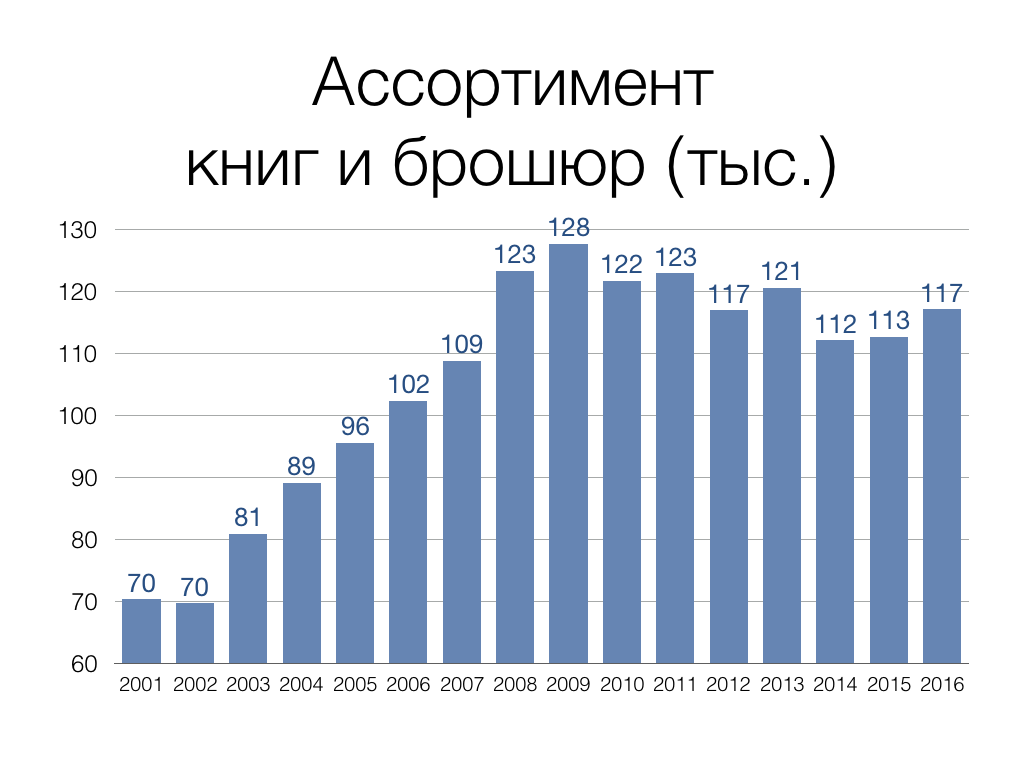
The expansion of the assortment, however, occurred mainly due to reprints of the books of past years (their number increased by 9%). Russian publishers are generally quite conservative, and the ongoing crisis only contributes to an extremely careful attitude to new projects. Agree, if the book found its reader ten, nine and eight years ago, then why not publish it now? The circulation circulation circulations, however, were reduced - on average about 10,700 copies to 7,000. Repeats are no longer so fed by publishers. The circulations of new publications on average grew quite slightly - from 2.9 to 3.2 thousand copies. The worst of all with the average circulation in the whole industry.
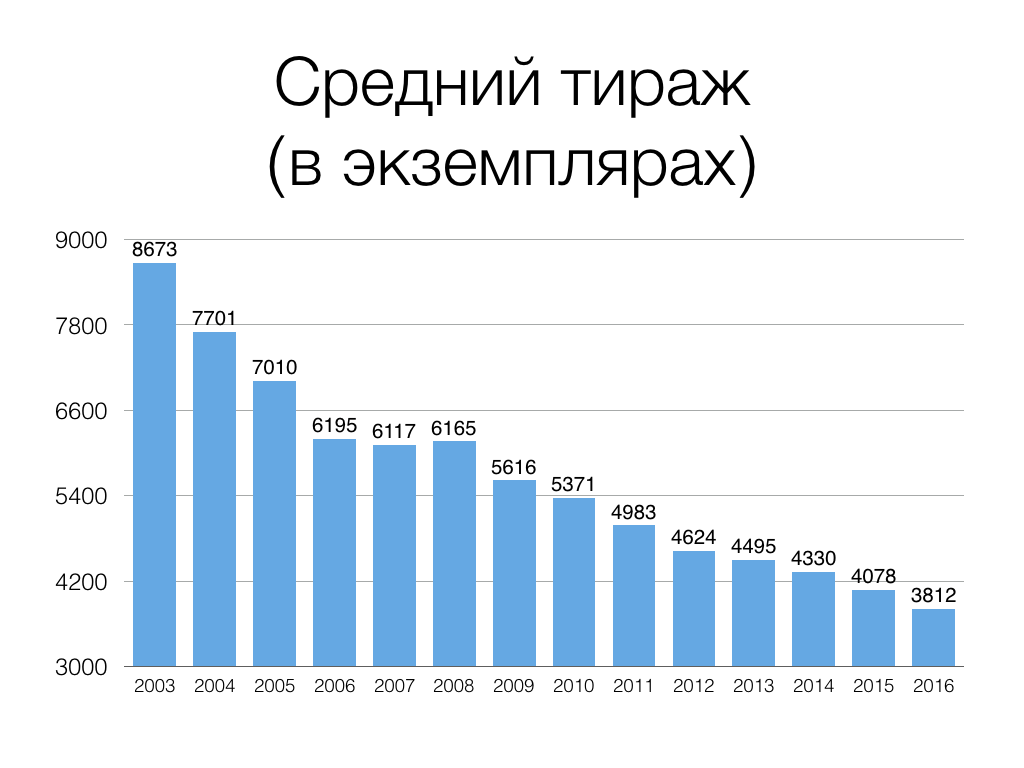
This beautiful schedule clearly shows what a protracted transition from the economy, focused on a mass buyer, to the economy of private or local interest looks. The crisis transition began long before the general release of books began to decline. In 2003, the average circulation reached the maximum, and then began to fall, reducing more than doubled in 13 years. Last year it turned out to be remarkable only in that terms that the average circulation for the first time since the 1920s became less than 4,000 copies. Most books (55%) are published less than a thousand copies, almost half (48%) - less than five hundred. The number of bestsellers was reduced by half: in 2015, more than 100 thousand copies from published 319 books, in the past - 160.
Even with a reduced issue, only large publishers can afford to print large circulations. Of course, there are a lot of the latter in the country - this year the book chamber counted 5800 - but the main production falls on a small number of publishers. The first dozen of the largest publishing houses (education, the EXMO, exam, the ABC-Atticus, Flamingo, Egmont, Mosaic-Synthesis, Rosman, Vako and Central Polygraph) prints 55% of all circulations and approximately ¼ of the total assortment produced in the country. There is no total monopoly on the market, but there is an oligopoly: the largest publishers have divided the market and control a significant share of the production of books in separate categories. Who prints textbooks for schools? Most of mass fiction? Translated bestsellers? They are all on this list.
It turns out that most books published either are needed or cannot find their buyer. The latter is most believed. Because in the very reading country there are very few bookstores. It would be very offensive to compare Russia with France - and the population is half as much, and it is not so difficult to bring a book from Paris to Marseille. But you can compare with Canada - also a very large country with a rare population concentrated in cities. And there are about the same book stores as in Russia. That's just the population of Russia is four times more. We still buy books mainly in real bookstores with living sellers and racks, tired of paper books, and not in online stores, and even more not in electronic books stores. And if there is no bookstore in the vicinity, then the habit of entering it itself dies. Someone reads books on the Internet, and the other finds something to do there and without books.
The mentioned 2003-the year of a large turning point in book publishing-was, by the way, a year when a massive introduction of broadband Internet access began in Russia. The time for reading books suddenly became less. After all, no one has canceled the TV? However, in 2015-2016, the Internet reached television in the competition for the user's attention: the daily city audience of the largest sites has become more than the audience of television channels. Is it already here. Do not be surprised that the number of people who do not read books at all is growing from year to year.
Special reasons that could significantly affect the situation in the book industry are still imperceptible. Talking about reducing the tax burden on publishers and supporting bookstores themselves calmed down themselves - except perhaps closer to the elections, perhaps they will remember this. That is why Oleg Novikov is easily believed in another forecast: "We are monetary to predict growth at 6-7 percent." What does a novice businessman do when they do not buy his product? Right! Raises prices to compensate for the reduction of income. This increase all visitors to the bookstores, I am sure, have already noticed: the average price of the book over the year increased by 25%. How much did the book industry work last year? Did Novikov predict 6-7 percent growth? We most likely never know this. The situation with the statistics of the book market in Russia is amazing. Everything that the book chamber knows is data on the number of printed books, their characteristics, subjects and circulations - it receives from the publishers themselves. All these data employees of the chamber carefully and carefully collect, sort and summarize. But the book chamber knows nothing more. She does not know about the vacation prices of publishers, retail prices and sales volumes - this is not the responsibility of the chamber. As does not include accounting for the release of books printed in small circulations on the print technology on demand. But last year, with the help of the Redero service alone, independent soda authors posted more than ten thousand books in book online stores. For comparison: Eksmo released a little more than eight thousand. The book chamber has no data on the release of e -books. Not for this, she was created 100 years ago!
Nothing is known about the sales of books in Russia at all. Publishers, of course, know how their books are sold, and the booksakers are in the know how things are going on - but only they themselves. Rosstat can mutter something about the average price of the “Book of the Detective-Adventure Genre” and “Textbook, Textbook, didactic material for secondary schools”, but does not keep in accounting for the physical and cash volumes of books. The Federal Agency for Press and Mass Media, which is engaged in the book industry in the government, does not have accurate data, relying on the assessments of the industry experts.
Maybe such an account is kept by industry organizations - for example, the Russian Book Union? Here is an association of American publishers, uniting one and a half thousand large and medium -sized publishers, summarizes the intermediate results of sales monthly. Because all American publishers well understand: such statistics are needed not only to satisfy idle curiosity, but also for doing business. But no. Neither the Russian Book Union, nor the Association of book publishers, nor the Association of Book -Examiners, nor the Alliance of Independent Publishers and Book -Examiners collect such statistics. Or they collect, but they don’t tell anyone. Finally, in Russia there is no independent commercial sales accounting system similar to Nielsen Bookscan, which covers approximately ¾ retail sales in the United States. All that we have is the annual analytical reports of the industry experts and specialists of the Book Industry magazine, very qualified, but based on incomplete sales data and more or less accurate extrapolations. So the Russian book industry descends lower and lower, groping the bottom in the dark.