
Translated material
They wanted to oust Google
But now they are building “sovereign AI”. What remains of Yandex, which the whole world knew about?
Yandex was Russia's technology leader , vying for a share of the international market. But the war put an end to these ambitions, and analysts even began to expect the collapse of the company. However, even after the split and the “ exodus of the Volozh team,” Russian Yandex feels better than ever: there are fewer competitors, and revenues are breaking records. However, Vladimir Putin’s demand for “sovereign AI” is turning former colleagues into ideological rivals. What remains of Yandex and what to expect from the latest project of Arkady Volozh - in the material of Kholod.
This is the final text of a special project called “National Treasure” - a story about the state of the main companies in Russia. In the first part, “Cold” talked about the largest crisis in the history of Gazprom, in the second - about the large-scale problems of Sberbank , in the third - about the upcoming crisis in Rosneft . The fourth material is devoted to the failures of the largest industrial company in Russia - Rostec .
Over 25 years on the Russian market, Yandex has grown from an ordinary search engine into a huge corporation with a wide range of services: from the same search engine to AI technologies. By 2020, Yandex was everywhere: in taxis, in ordering food, on marketplaces, in news and entertainment - it was possible to build an entire everyday life relying only on the services of this company. She always had international ambitions, so she gradually entered foreign markets.
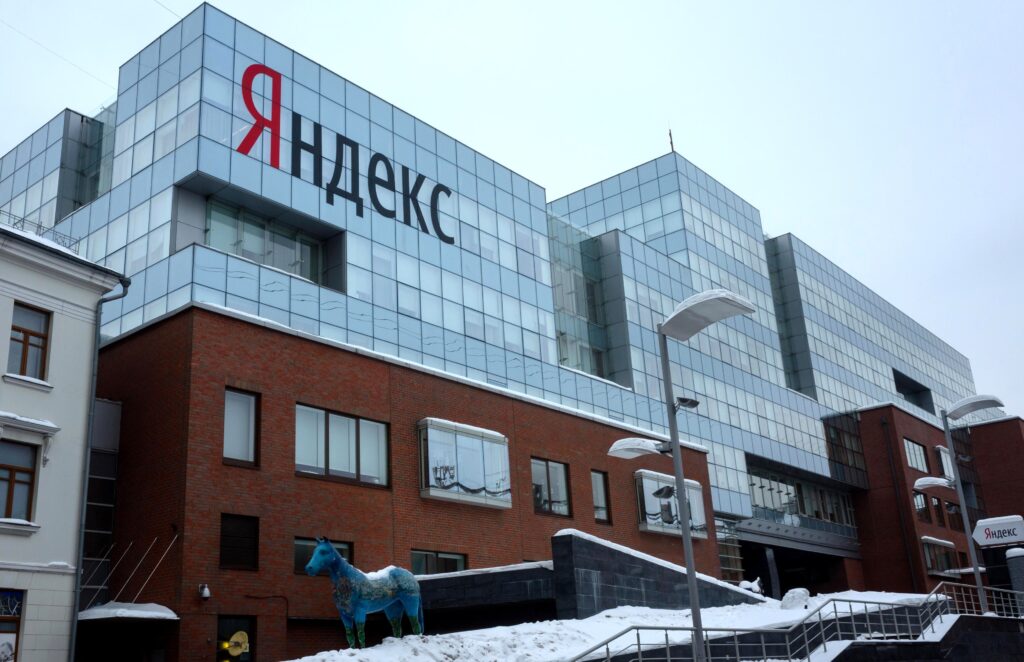
In addition, having a “parent company” abroad makes it easier to manage assets in each specific country when the company enters the local market. It is sometimes easier for contractors to conclude contracts with a European company than with a Russian one, and they are more willing to invest in such projects. As a result: as of 2021, Yandex services were present not only in Russia, but also in another two dozen countries, including the EU (Finland, Estonia, Lithuania, Latvia) and the USA.
Yandex was worth $8 billion after its IPO in 2011. The media have written about Yandex’s international ambitions more than once: the company’s founder, Arkady Volozh, did not hide that he always dreamed of turning Yandex into an international player, and some of the projects were initially aimed specifically at the markets of other countries.
Yandex became one of the first in terms of entering foreign financial markets, especially among Internet and IT companies. Before Yandex, mobile operators MTS and VimpelCom (better known under the Beeline brand) entered the American exchanges from similar fields of activity, and only Mail.ru Group (now VK) from Internet companies in 2010. A year after it, Yandex entered the American NASDAQ market, conducting one of the largest IPOs of 2011.
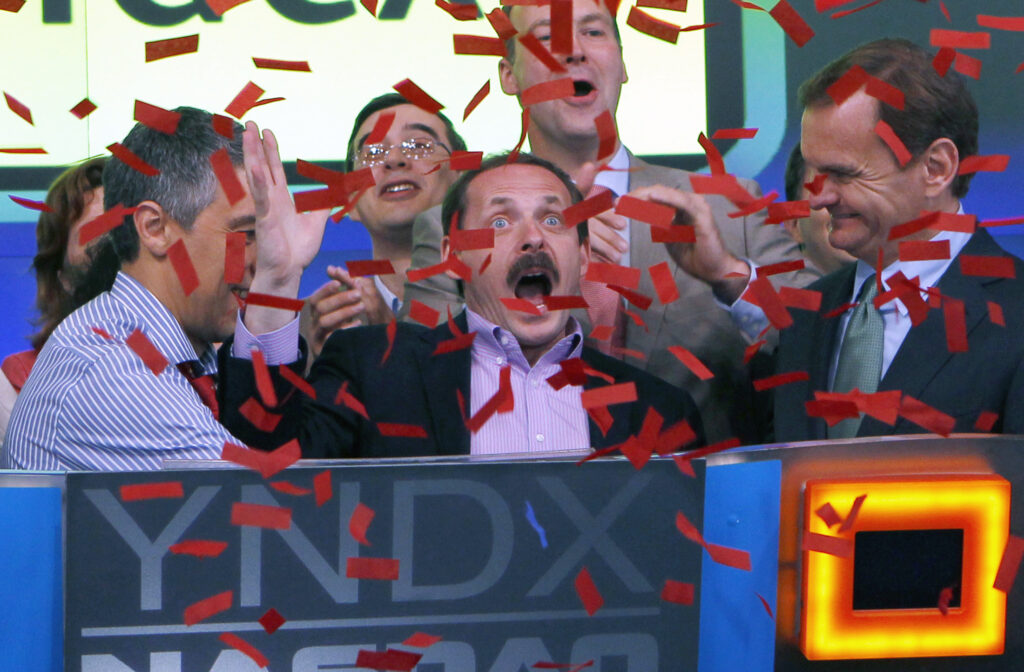
The initial share price was supposed to be in the range of $20–22, but due to high demand, Yandex increased the price to $24–25. As a result, the shares were placed at a price of $25, and the company was valued at eight billion dollars (11.4 billion at current prices ). The IPO raised $1.3 billion, which at that time was the second-largest result for US big tech. Only Google earned more from its IPO—$1.67 billion.
Yandex took 2nd place in terms of IPO success, second only to Google. The success of Yandex launched a wave of foreign IPOs of Russian companies: after it, Qiwi , HeadHunter and Ozon entered the American stock exchange. True, none of them was able to break Yandex’s record; the closest pursuer was TCS Group (Tinkoff Bank) with $1.087 billion raised. In the West, Yandex has become an example that Russia “can produce not only oil and Kalashnikov assault rifles.”
Schism and the liberal “superroof”
The start of Russia's full-scale invasion of Ukraine quickly deprived Yandex of its claims to the Western market, and it turned from a promising company into a toxic Russian asset. Amid the invasion, the company's stock price collapsed, and a few days later the NASDAQ suspended trading. At the same time, trading was stopped on the Moscow Exchange, also due to high volatility. But they resumed at the end of March 2022, but Yandex did not return to NASDAQ in its original form.
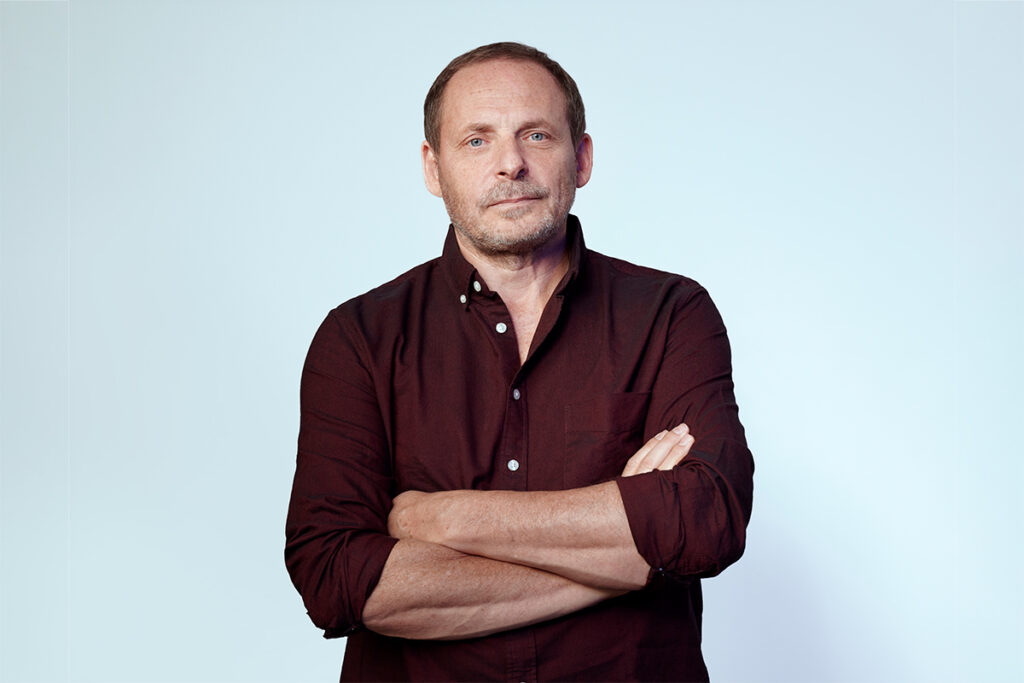
A kind of “split” almost immediately occurred within Yandex: the fact is that at the time of the start of a full-scale war, some top managers and the company’s founder, Arkady Volozh, were abroad. A conflict allegedly arose between those who “left” and those who “remained”: while some, including Volozh himself, lost faith in the future of the company, others believed that Russian Yandex needed to be saved.
And although initially the team included people of similar views, many of whom managed to become friends, it was not possible to find a consensus on many issues: for example, on the day the invasion began, February 24, Vladimir Putin held a meeting with businesses, where Yandex representatives were also invited. The media, citing one of the company’s employees, wrote that top management spent hours arguing whether it was worth going there.
Volozh, who was absent from Russia, allegedly could not make up his mind, but managing director Tigran Khudaverdyan believed that he needed to go. Other colleagues dissuaded him, but in the end Khudaverdyan still went to the meeting. Many still consider this a mistake, and Khudaverdyan himself subsequently came under Western sanctions.
Volozh himself, as the founder of Yandex, was sanctioned in the summer of 2022: the European Union motivated this by the fact that Yandex promotes pro-Kremlin media and deletes content critical of the authorities, and among the company’s shareholders are the sanctioned banks Sber and VTB. After this, Volozh left the position of general director and the board of directors.
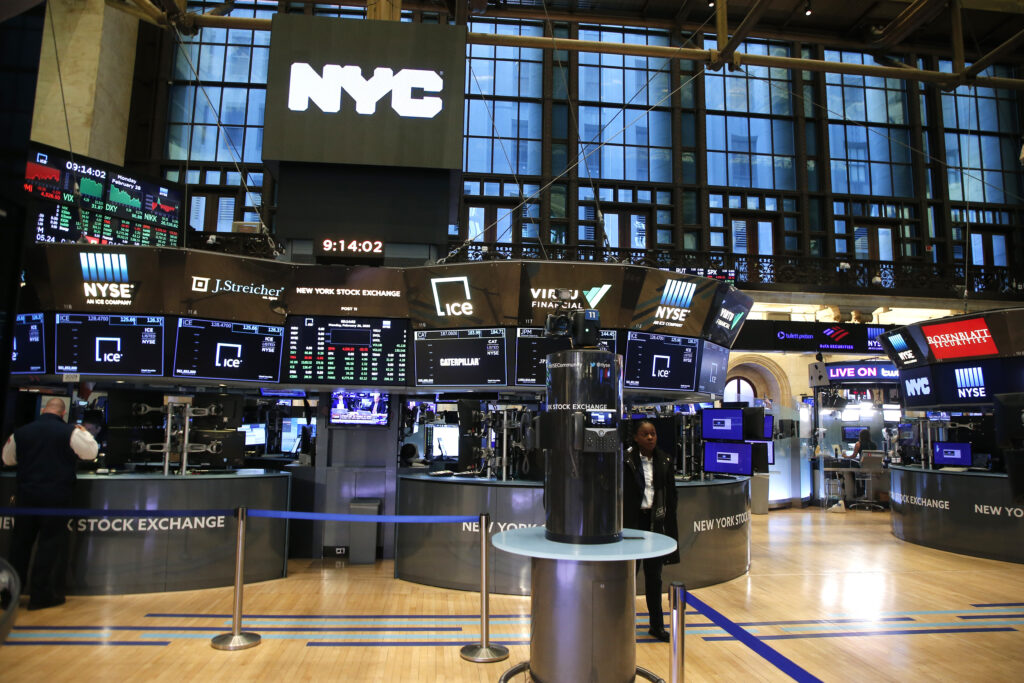
For the West, Yandex has become an example that Russia “can produce not only oil and Kalashnikov assault rifles.” A year after the suspension of stock trading, in March 2023, Yandex received a notification from the New York Stock Exchange about the threat of delisting. This was explained by “geopolitical risks and their potential impact on the company.” Yandex did not agree with this and promised to file an appeal, and also noted that the company is not under any sanctions. At the same time, Yandex immediately stated that there are “no guarantees” that the appeal will be satisfied by the exchange commission.
But Yandex still avoided delisting: during the hearings, the Commission sided with it, and the shares remained on the exchange list, although the decision to suspend trading in them remained in force. Yandex was saved by its announced restructuring, which in essence was simply a division of business into Russian and international. At the same time, other Russian companies whose shares were suspended in 2022 were unable to remain on NASDAQ.
A conflict arose between the “those who left” and the “remainers”: they could not decide whether to go to Putin. OZON, for example, lost the appeal twice, and HeadHunter decided not to challenge the decision after the first lost hearing. QIWI initially received a deferment from delisting because it promised to divide its assets into Russian and international, as Yandex did. But in the end, the company was unable to fulfill the requirements of the exchange in the required time frame, and QIWI shares were removed from the exchange list.
The decision to split Yandex was not made in March 2023 for the New York Stock Exchange - the company’s management announced such an intention at the end of 2022, and information appeared in the media even earlier . The company's message said that the Russian part of the business would be transferred under the management of new management, and the areas of unmanned vehicles, educational services, cloud technologies and data tagging platforms would go to the Dutch legal entity Yandex. In the future, this legal entity will be renamed Nebius, and will be headed by Arkady Volozh.
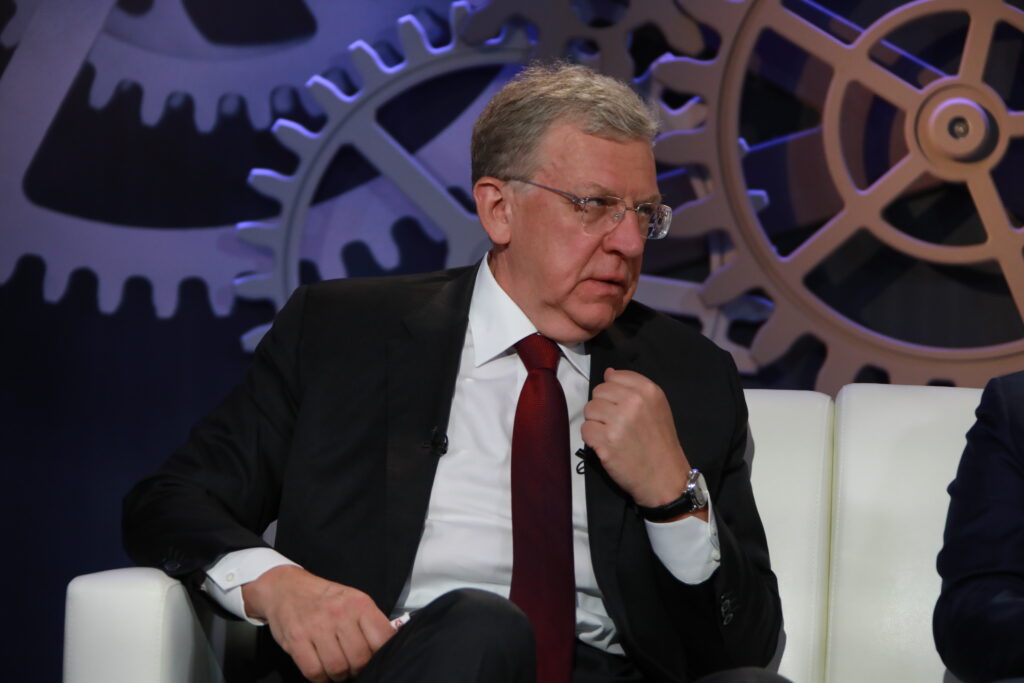
Yandex could go under the control of friends of Vladimir Putin. Yandex did not disclose any other details, but the media reported an unofficial meeting between Putin and the Chairman of the Accounts Chamber, Alexei Kudrin, at which the fate of the company was discussed. According to journalists, Kudrin was offered to leave the Accounts Chamber for a position at Yandex. It was he who had to deal with the restructuring and sale of the main businesses to a Russian investor, for which he was offered a share of 5% of Yandex shares.
The media wrote that Kudrin’s candidacy suited the company’s management, since he enjoys Putin’s trust and at the same time “is liberal enough to understand that Russia needs a private Internet company, free from nationalization.” Other sources called Kudrin the future “superroof” for Yandex — “in a good way.”
“There are very few people who care about keeping Yandex a private company and have influence over the big guy,” sources told the Financial Times.
Yandex management's fears for the future of the company as a private enterprise were justified. For example, the head of VTB, Andrei Kostin, proposed essentially nationalizing Yandex, taking it under temporary external management, and not paying anything to shareholders - this is how he reacted to the too high, in his opinion, price of the business.
Other possible beneficiaries of the deal were also named: the shareholders of the new company could include, for example, the structures of businessman Vladimir Potanin, and the structures of Roman Abramovich and VTB Bank could increase their shares. Abramovich's representative, however, almost immediately denied this information.
Already at the end of November 2022, Kudrin resigned from the post of head of the Accounts Chamber: his dismissal, as required by law, was voted for in the Federation Council, and Federation Council Speaker Valentina Matvienko hinted at his new job, wishing that the upper chamber would now more often get to the top of Yandex.
However, in the end the deal itself took place without mentioning Kudrin. The former head of the Accounts Chamber, it seems, received nothing at all: insiders even reported that he might even return to government service. This was probably due to the fact that Kudrin managed to fall under sanctions before the deal was completed.
As a result, the assets of the Russian company went to a consortium of investors, including top managers of Yandex, the LUKOIL group, as well as private investors Alexander Chachava, Pavel Prass and Alexander Ryazanov. The media suggested that some of the investors in the deal may act in the interests of billionaire and friend of Putin Yuri Kovalchuk or other persons. For example, Prass is a longtime associate of Kovalchuk, Chachava invested in startups together with Vladimir Kiriyenko, the general director of VKontakte and the son of the deputy head of the presidential administration Sergei Kiriyenko.
However, insiders reported that after the initial transaction, in which non-sanctioned persons must participate, the shares can be resold further - to those buyers who really stood behind this transaction. The at least partial truthfulness of this assumption is evidenced by the fact that almost 10% of Yandex shares were later acquired by the already mentioned Vladimir Potanin. His company bought Ryazanov’s company, which owned a stake in Yandex.
What will happen next to Kudrin is not entirely clear. Back in 2022, immediately after leaving the Accounts Chamber, he received the position of corporate development advisor at Yandex, where he remains to this day. The initial share of 5% of shares that he was offered for assistance in restructuring could drop to 2–3 % or even 1.5% during negotiations, while the actual transfer of even this share to Kudrin was not reported.
Characters
The war greatly changed the top management of the main IT company in Russia: out of 11 members of the board of directors, two, Esther Dyson and Ilya Strebulaev, left the company immediately after the invasion began, and a little later Khudaverdyan, who fell under sanctions, joined them. In June, Volozh himself followed them. In 2023, another council member, Alexey Komissarov, came under sanctions and also left the council - he himself stated that he left of his own free will, but sources reported that he was expelled.
As a result, the council was reduced by almost half: it was left with six people. Two months after Komissarov left, Andrei Betin joined the board. And after the split, the entire composition of the Russian Yandex was reassembled , and from the previous composition only Betin and Yakovitsky included. Two (Voloshin and Moldovan) no longer have anything to do with either Yandex or Nebius, and three more (John Boynton, Roger Riinia, Charles Ryan) participated in the division of assets and after its completion joined Volozh.
Ilya Strebulaev never returned to Yandex or Nebius, but Esther Dyson joined the new board of directors of the Dutch company. That is, four of the 11 members of the board of directors changed Yandex to Nebius, and only one remained in the Russian Yandex.
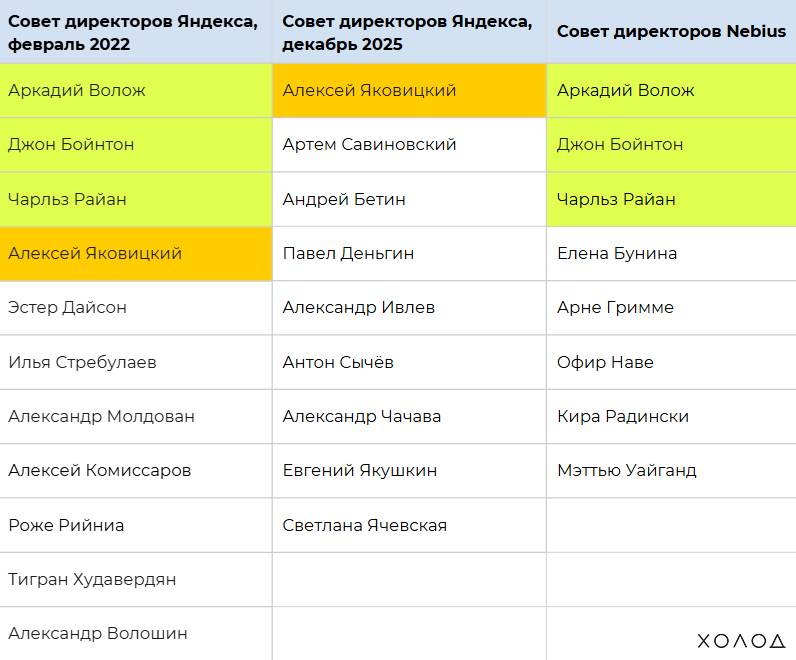
Currently, the Nebius board consists of eight people, and only half of them have no connection with the Russian Yandex. Three were previously on the board of directors of Yandex, and another one worked in a key position - Elena Bunina, who held the position of HR director and general director of a Russian legal entity. She immediately condemned the invasion and said she would not return to the country.
Khudaverdyan, who came under sanctions, was not included in the new councils of either Yandex or Nebius. He did not make unequivocal statements about the war in Ukraine, and did not officially receive a new position, but at the same time he regularly publicly represents Yandex at Russian technology conferences. His attempts to appeal the sanctions failed , and only in 2025 the court partially satisfied Khudaverdyan's demands, recognizing that one specific extension of sanctions in 2024 was groundless, but not all subsequent extensions, so the sanctions remain in force.
The Yandex split put an end to the company's ambitions to become a global technology player: key partners distanced themselves from it, and its capitalization fell more than fourfold during the crisis, from $30 billion to $6.8 billion.
## New " Yandex "
The division of Russia's largest technology company was viewed ambiguously by experts and the employees themselves. According to Bloomberg estimates, about 10% of the 19 thousand Yandex employees left Russia after the invasion - then the publication assumed that they would go to work for the international Yandex, whose projects were called “the most promising” by foreign media. However, analyst Alexey Pavlov did not agree with this assessment, who insisted that the core of Yandex is “everything that is in Russia.”
“If we remove international directions, then from the point of view of the group’s financial indicators, practically nothing will change - maybe they will even improve,” he said.
Sources inside the company said the same thing: one of the main problems of the “division” of the business, in addition to the need for Kremlin approval, was that Yandex simply did not have a profitable business abroad - all attempts at international expansion were financed by what the company earned in Russia.
Russian Yandex, contrary to pessimistic assessments of Western economic media, is doing better than ever from a financial point of view. In 2024, the company recorded historically record revenue, which exceeded a trillion rubles. This is 37% more than a year earlier, and in the nine months of 2025, Yandex recorded revenue growth of another 33% compared to the same period in 2024. In the same 2024, management, based on current performance and positive forecasts, for the first time proposed paying dividends to shareholders in the amount of 80 rubles per share.
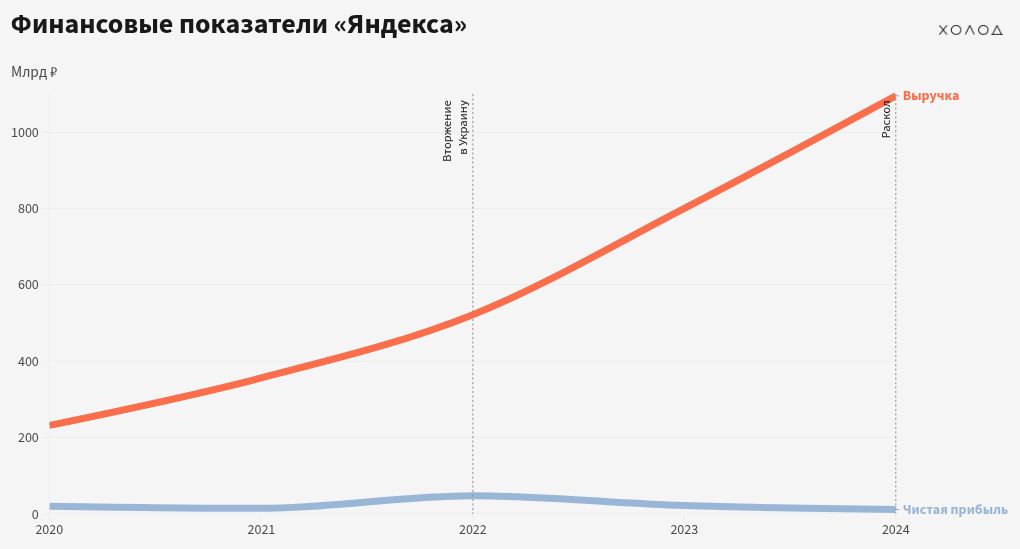
The positive dynamics continued in 2025: revenue is still growing, but at the end of the first quarter the company suffered a loss of 10.8 billion rubles. Analysts explained this primarily by exchange rate differences, as well as an increase in staff and significant investments in the development and development of new services, which have not yet paid for themselves. In the second quarter, Yandex managed to make a profit, which amounted to 16.2 billion rubles.
Contrary to pessimistic Western estimates, Yandex is feeling better than ever. In 2025, the company will set a new record for revenue, since at the end of nine months of 2025 it has already exceeded a trillion rubles, and adjusted profit amounted to 87.9 billion rubles. At the same time, the company maintains positive forecasts, and at the end of 2024, Yandex shareholders were paid dividends in the amount of 160 rubles per share (in two parts).
Immediately after the Russian invasion of Ukraine, experts and analysts wrote about upcoming “hard times” for Yandex and a possible “technological Iron Curtain”; they predicted a shortage of semiconductors, without which high-tech projects would not be able to develop, and a “brain drain” . But in the end, the only real problem Yandex faces is the lack of access to international markets, which leaves the “international class” company cut off from the rest of the world. At the same time, isolation can make Yandex a stronger brand in the domestic market, including due to low competition .
Volozh's latest project
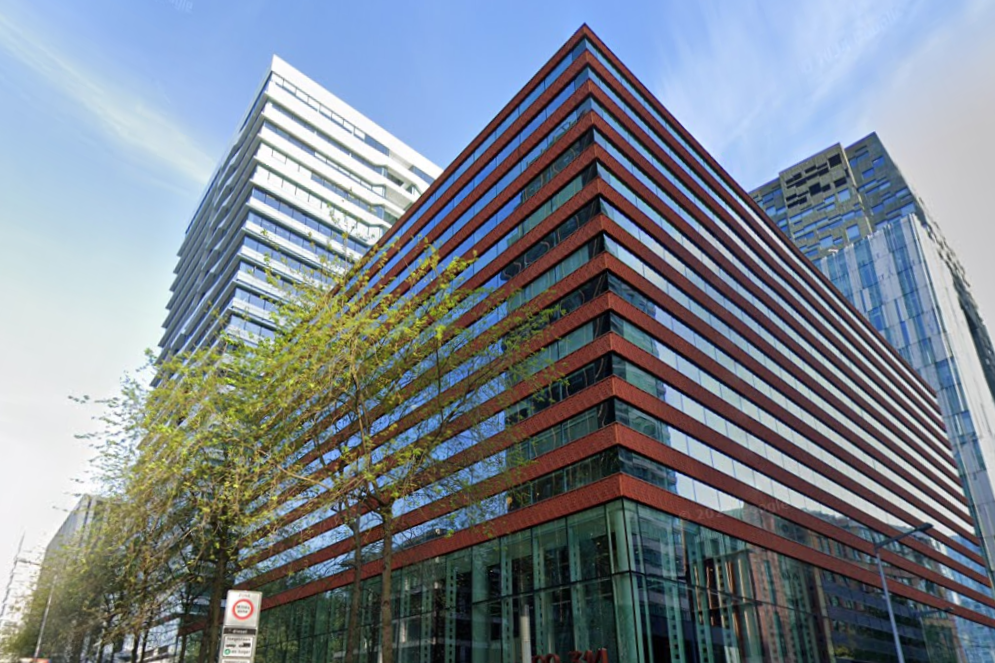
Foreign "Yandex" has turned into several projects under the general name Nebius, with registration in the Netherlands. The main project of the new company is a cloud platform for artificial intelligence, which provides infrastructure to other AI companies. In particular, Nebius has data centers for data processing with thousands of graphics processors at its disposal. Companies that want to implement large-scale AI projects do not need to create servers themselves; they can rent this capacity from Nebius, which essentially made the cloud (like Google Cloud) primarily for AI-related tasks.

Other projects that are part of Nebius are Toloka , which trains neural networks, TripleTen , which trains people in technological professions (in fact, an analogue of Yandex Practicum), and Avride , which develops self-driving cars and delivery robots.
As the media write , Arkady Volozh apparently believed in his foreign projects: through the mediation of Kudrin and Kiriyenko, he wanted to obtain rights to use intellectual property in order to further engage in these areas. In his first full interview since the start of the war in the summer of 2024, he stated that Nebius would become profitable within a year.
Volozh promised to bring Nebius to profit in just a yearVolozh in 2023, even before the finalization of the deal on division of assets, condemned the war in Ukraine and called it “barbaric.” In the public space, he now introduces himself as an Israeli businessman and emphasizes in every possible way that neither he nor his company no longer have any ties with Russia. Thanks to his statements against the war and his exit from the Russian Yandex, he even managed to get the sanctions imposed on him lifted .
For shareholders, a lot has changed: while Yandex was previously valued at $30 billion and was considered the Russian equivalent of Google, Nebius is a young but ambitious European technology company. Even during the division of assets, ex-CEO of Yandex Elena Bunina stated that the future foreign company would be “small, incomparable in size to Yandex.”
“Our goal is to create one of the world's largest artificial intelligence infrastructure companies. This requires access to technological knowledge, GPUs and capital. This is exactly what we have,” Volozh said after returning to the stock exchange.
The foreign “AI-Yandex”, already under a new name and with other projects, resumed trading on the NASDAQ exchange in October 2024, changing the ticker (short symbol of the company on the exchange) YNDX to NBIS. In February 2022, Yandex shares traded at $18.94, and on the first day of trading after returning to the stock exchange under the new name, Nebius closed at $20 per share. Experts estimated the company's value to be closer to five billion dollars, which is significantly less than the pre-war capitalization of Yandex.
Nebius already costs as much as the entire Yandex costs. Nevertheless, the new company began to grow rapidly. Over the past month, its shares traded in the range of $75 to $102, and its capitalization as of December 2025 exceeds $20 billion. This fall, Nebius even overtook Yandex in this indicator, and now they are rated at approximately the same level.
In 2024, the company generated revenue of $117.5 million, an increase of 462% compared to 2023. For 2025, Nebius had even more ambitious plans, with revenue forecast to be between $450 million and $630 million. In the first nine months of the year, the company has already earned $302.1 million, up 437% from the same period in 2024.
At the same time, Nebius operates in a capital-intensive sector, and investments in its development exceed revenues. The company shows losses year after year. Moreover, this year the net adjusted loss only grew : for the nine months of 2025 it amounted to $273.7 million, while in 2024 it was $169.5 million.
This does not really correspond to Volozh’s plans announced in 2024: he stated that Nebius would become profitable within a year. On the other hand, its operating activities are becoming less and less unprofitable. In terms of EBITDA, the loss for the first nine months of 2025 was halved: from $162.4 million last year to $79.9 million.
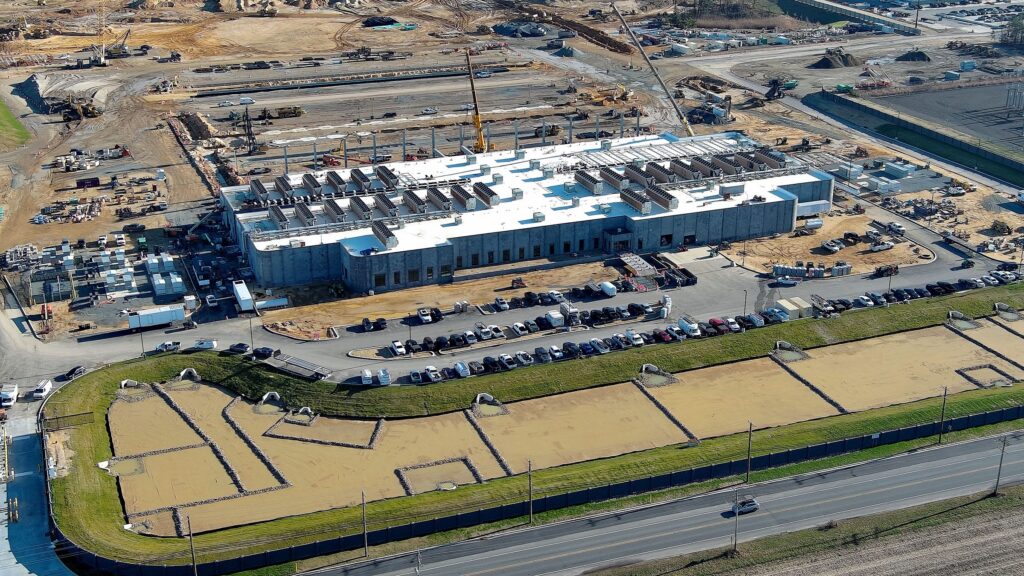
Volozh is optimistic about his business and its results, and attributes losses primarily to aggressive expansion, which requires large expenses. Analysts note that although the company remains unprofitable, it has impressed investors with rapid revenue growth and has “done well in the West.” Nebius managed to attract clients, partners and investors such as Microsoft , Nvidia and Jeff Bezos' investment fund .
Nebius' partners included Microsoft, Nvidia, and the Jeff Bezos Foundation. About a third of Microsoft's capital expenditures came from leasing capacity from cloud companies, and more than half of this amount ($19.4 billion) went to Nebius, and the rest was shared by competing companies. Nebius' advantage is that it is one of the first to gain access to Nvidia processors - as Volozh himself explained, due to close ties dating back to the days of Yandex, which was a key client for it outside of China and the United States.
However, not all analysts expect further success from Nebius: some believe that it is time to sell the shares, and the company will continue to show losses until 2027. There are problems in the AI market in general: experts doubt that the demand for AI will grow, as more and more questions arise about its effectiveness. Analysts see a threat and risk of crisis in the extent to which AI startups and tech giants depend on each other.
Battle for AI
Registering in the Netherlands puts Nebius in an unusual geographical position, as most successful AI projects are located in China or the US, not Europe. Volozh, however, does not see this as a problem and, on the contrary, strives to create an AI company in Europe so that this region can compete in the AI sector. According to the businessman, he chose the Netherlands because he is convinced that it is easier to build a long-lasting business in countries with strong democratic institutions. And the EU, the founder of Nebius believes , has untapped potential in the field of AI.
But it is not only the EU that lags behind America and China. The Russian authorities are also concerned that their own strong AI project has not appeared in the country, and other people’s services are ideologically incorrect. A year ago, advisor to the head of Rosatom, Ruslan Yunusov, complained to Putin that the main AI models were not neutral and were “heavily skewed towards left-liberalism.” Putin agreed with him and said that Russia needs its own, sovereign artificial intelligence. And, according to the president, two companies are working on this: Yandex and Sber.
Moreover, according to Putin’s vision, the BRICS countries should also join in the development of artificial intelligence models. And Russia is ready to help with the creation of models not only in Russian, but also in other languages, because they should be developed “taking into account the cultural and national characteristics of each civilization with its history, identity and traditions.”

Active work on AI technologies is confirmed by Yandex itself. The company said that it is now focusing on three main areas of business: data, information security and AI for business. Now Yandex provides a wide range of services related to artificial intelligence: this includes replacing the usual ChatGPT with the ideologically correct YandexGPT, commercial solutions for business, and the neuro-assistant Alice.
In a sense, the separated companies Yandex and Nebius have now become competitors in the same sector. While Nebius is trying to expand as much as possible and occupy a niche as a provider of AI infrastructure for other companies, Yandex is fulfilling Putin’s instructions to create “sovereign” AI: both companies need developers and technologies for this.
Their interests do not directly intersect, since Volozh in every possible way emphasizes that his company has nothing in common with Russia and, therefore, does not lay claim to the Russian market, and Yandex, in turn, is denied access to the American and European markets. Despite the lack of access to the same technologies that Nebius has, Yandex continues to release AI products: for now it is helped by developments created even before the division of the business.
The key problem is the chips that Nebius buys from Nvidia. Yandex stated that their shortage could significantly slow down the development of AI projects. Russia cannot produce such chips, so it is forced to use parallel imports, which, however, does not allow purchasing technologies in the required volumes.
However, high-tech equipment can be purchased from other countries - for example, from China, which produces analogues of the same Nvidia chips. There are also vague prospects for cooperation with Indonesia in the field of AI - the country’s Minister of Communications and Digital Technologies reported about Yandex’s interest.
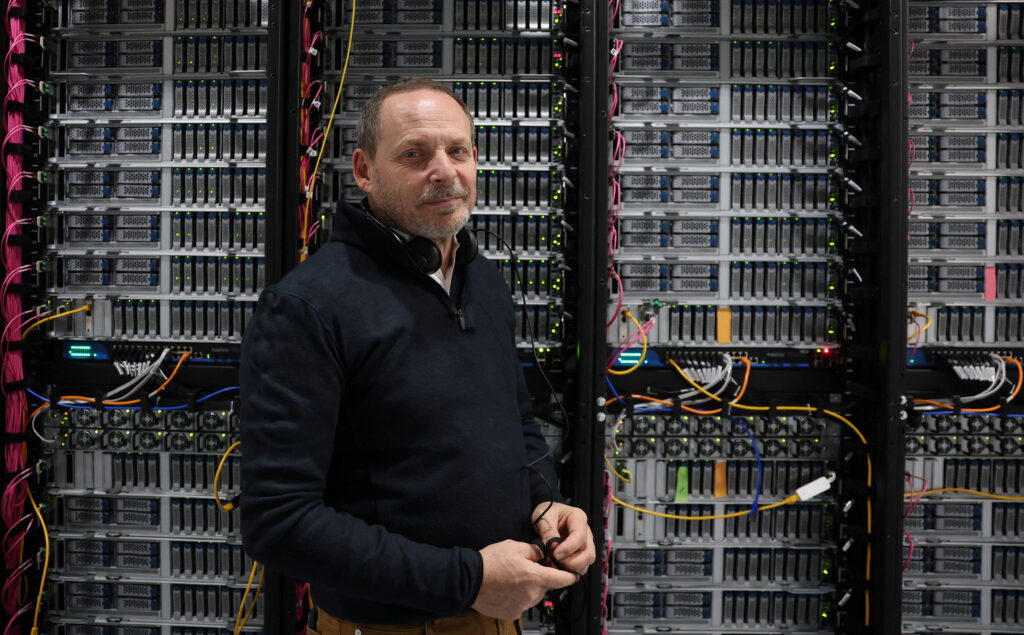
Nebius has no problems with access to technology, but the company's further growth directly depends on what will happen in the AI market. Nebius may never turn a profit, and Arkady Volozh, as he himself admits , will not have a second chance. According to him, the Dutch company is the last big project in his life.
The Russian Yandex is increasingly prioritizing precisely those areas that Volozh took to the foreign company. This may be due to the state’s general policy towards “sovereign artificial intelligence”, but a number of experts see in this the prospects for a multiple growth of capitalization. In 10 years, companies predict a key role in the “smart robotics and automation” market, which is estimated at 28.6 trillion rubles.
However, 91% of the company’s total operating profit for the first 9 months of 2025 still comes from the advertising and search segment, but city services, including taxis and delivery (where Yandex is actively integrating AI), brought in more revenue, but retained only 7.1% of it (40 billion rubles) as a margin. At the same time, the growth rate of advertising revenue is slowing down , and autonomous technologies so far only require large investments and do not pay off.
Author: Artur Shebarshov
Photo: Mark Lennihan/AP/Scanpix