
Translated material
Anton Dolin. Cinema-25: promised scoop
Endless complaints about the squalor of domestic cinema are what we all reconciled with, however, as with the squalor itself. Also, everyone agreed that the main reason for both squalor and complaints is a lack of money. Meanwhile, the artistic and ideological failure of modern Russian cinema is a much more frightening factor than the poor funds. What is the general creative crisis connected with? Probably, partly with the common treasure that we lost - with the Soviet Union - and a sense of involvement in it, a sensation that gave everyone something of their own. Today, the movie is trying to catch this feeling again, but it cannot be returned; In fact, the power of the Soviet power was to a very large extent associated with the power of the most important art, and you can still talk about the traditions of the pre -revolutionary movie as applicable to our times. Hence the conscious mediation of the totalitarian aesthetics of all the most wealthy cinemas of recent years - from "Khrustalev, the car" to "Moscow" . Oddly enough, nostalgia for the scoop as a certain artistic universal is characteristic not only of new Russian cinema; This is proved by three films, the premieres of which in a strange way fit in a week. The Israeli "friends of Yana" , the German "Legends of Rita" , the American "military diver" ... three films, four letters: USSR .
Life
With the Israeli film, the situation is most understandable. In fact, Israel is a bizarre clone of the disappeared USSR, closer to the former empire, and not the current amorphous "Russian Federation". Director Arik Kaplun - an emigrant from Russia, like his heroes; However, unlike them, the cape is a long -standing emigrant, which has fused with Israeli aesthetics and ideology. The line on which the director, standing with one foot on the Earth, skillfully balances, and the other in a non -existent union is valuable and important: the Israeli, which does not have Russian roots of cinema, amazes the modern viewer with ideological lightness (this is an example of Israel at the last two Cannes festivals of Amos Gina), while in "friends Yana "The alloy of exotic material with universal intrigue immediately takes possession of the heart of the observer. The everyday ironic tragicomedy is already compared with the almodovar - festival prizes also contribute to this (the main award in Karlovy Vary). In fact, the nearest analogue is different: Soviet cinema of the postpotherapel period. From the problem - to a person, preferably little, the fate of which, heavy and boring, will certainly come to a happy climax. “Moscow does not believe in tears,” “the irony of fate, or with a slight steam” ... The late Ryazanov comes to mind, his most successful film in recent years, “The Promised Heaven” . History: Several wretched loners gradually find each other, and then their life acquires a certain meaning. An unusual community is woven from several loneliness. Ryazanov had “former” heroes, homeless people, and Kaplun is an emigrant.
Fragile blonde Yana - apartment Moscow butterfly on the burning Palestinian land; Gloomy Armenian Bayanist, in the former is a teacher in a music school, now collecting meager alms on the street; The harsh apartment mistress, the emigrant of the second wave, buried the son of the soldier; The family, shamelessly exposing the paralyzed grandfather-veteran to the street to collect alms. The fate of the heroes of this story taking place in Tel Aviv are mixed, as befits in a good modern film, touching and surprisingly, according to the laws of exclusively professional scenario drama. All of them could become the heroes of a good film Ryazanov. In the end, did Danelia "passport" took off? There are also many analogies with this picture.
 Each of the characters is a carrier of a psychological type from Soviet life. "Soviet" here is not ideologically supported, but justified by everyday behavior. How they pour tea and talk with a silent phone, beat each other's muzzles and put up ads ... The whole indisputable truth of life that everyone who visited in Israel has seen and which the director said so accurately and poeticly. Another funny moment: the only non -Soviet hero of this story is the apartment neighbor, and then the lover of Yana, Eli. He is a clear embodiment of the Western (in the broad sense of the word) type of creative consciousness - removes everything that happens around on the video camera and revises the cassette in his leisure; An obvious reference to the aesthetics of "dogma" and "sex, lies and videos" Stephen Soderberg. So, it was this Eli that he considers to give his hand to his duty and the heart of a completely nondescript, pretty ex-mosquito, a clear bearer of the magical substrate of “Sowl”.
The slogan "everything will succeed", the next manifesto of the happy ending, is clothed in "Friends of Yana" into the pretty forms of small details, of which a good Soviet film is glued and covered with a light smoke of oblivion Soviet life: sex in the gasheses under the rudder of the air anxiety, a screaming child and a disabled person, unloading furniture on their own, morning The dog’s walking ... Love is born or returns from non -being, and the degree of artistic validity of such a plot stroke does not bother anyone - neither the director nor the audience. Since both of them are passionate about pure emotion of immersion in the sweet scoop that they once lost.
Idea
From everyday, sweet and charming component - to ideological. The last film of the classic of the "New German" cinema, the author of the "tin drum" of Folker Schlendorf "Legends of Rita" is dedicated to her. The heroine is a convinced terrorist, attacking banks in the 70s in West Germany on the principle of "robbery loot". After a serious puncture, she has to hide in East Germany, under the wing of a friendly staff. She changes the “legend” for the “legend”, remaining not recognized (officially Eastern Germany is obliged to give out terrorists), sacrificing her personal life. After the fall of the Berlin wall, the final collapse begins: no one needs Rita anymore, and everyone hunts for her - not as a representative of an alien ideology, but as a criminal. Finita la comedia. In the old-fashioned dry, hard and uncompromising film, the audience was impressed by the penalty at the penultimate Berlin festival, and the performers of the main roles were awarded.
 Unlike soft and supple Yana, wearing a scoop in the soul, Rita is an ideologist who is ready to fight for his beliefs. She does not adopt contact with the socialist special services, because she knows that they have a common enemy. She refuses to flee to Beyut and consciously remains in Eastern Germany to find out what is the life for which she is fighting. Schlendorf is spared from illusions: the weaving factory and the contests of amateur song are represented without the slightest humor, it is almost scary to look at them. There is little funny and in Rita’s fate: being the “secret service” delivered from romanticism (she just hides, and does not fulfill a special task), the heroine is forced to refuse from her only girlfriend first, and then from her beloved man. But the most interesting thing is that Rita is not too disappointed with this: she is morally ready, she understands that it should be so. The struggle has long ceased and lost its meaning, but the heroine is consistent, and this is her happiness: to drive nightmare cars, wear nightmare clothes, drink Soviet vodka, relax with pioneers on the Baltic Sea, and receive letters for successes in social labor.
"Rita Legends" - a mixture of "thirtieth love of Marina" by Vladimir Sorokin and "Nikita" Luke Besson; Submitting to his boss, smiling and intelligent gesnik, Rita acquires a kind of happiness. Involuntarily, another text is recalled - “Conversations with Vladimir Putin” with many times discussed quotes about the tragic fall of the Berlin wall. Rita feels the same thing that, apparently, the current Russian president and his wife felt the devastation from the ideology that had lost meaning. Ideology does not have to be supported by facts - it exists on its own, and it can make even a woman happy. In the final, Rita goes to death, lies under the bullets of the border machine gun, and this is not the heroic death of Alexander Matrosov. Rather, this is the last salute of Captain Rudnev on a sinking “Varangian”, the ordered death of Firce’s poor fellow, a keeper of a long -cut cherry garden. Schlendorf managed to show a true story without evaluating it. The West could not understand something here, our viewer will definitely feel.
Aesthetics
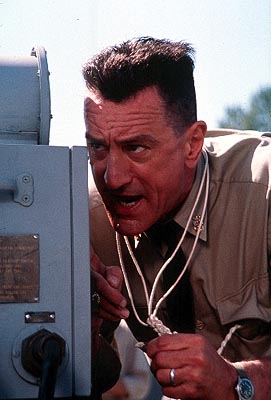 The film, outwardly not having any, even indirect, attitude to the scoop, is completely built on its aesthetics: "military diver" - an ideal example of a long -dead and buried socialist realism. And here you have the proof of how much the stereotypes of the audience’s perception of the audience’s perception in childhood and youth: all the critics unanimously spread the film to the fluff, but ... the hall at the pompous premiere at the Prague Cinema (a giant room filled to capture by beer and chips in their hands) was not just complete; Almost no one has gone to the end of a fairly long film. In the most pathos moments, the hall laughed, but applauded; At the exit after the final, the absolute majority had happy faces. And let someone explain this to the “how good laughed”, and someone praised Robert de Niro, this is not the point. De Niro is a really good actor, and here he plays with all his might, he climbs out of his skin ... But many bad films did not save De Niro. Here he is only a gear in a generally perfectly debugged mechanism. In the end, in all ideological films of the Stalin era, beautiful actors also starred.
In the "military dive" is amazed at what was striking in socialist art and which is completely deprived of the art of modern: the incredible integrity of form with grotesque tension, even the meaninglessness of the content. Well, judge for yourself what kind of story, and even based on real events: a black youth dreams of becoming a military divers-and it becomes, despite the opposition of the instructors-racists (it takes place in the 50s), and then, when it turns into a better diver, as a result of an accident loses its fullness and thus becomes the first and only one-legged divers of the US Navy. Analogies from the Soviet era are constantly arising: from the "circus" and "Maxima" (the story of a nobra boy who fell into the Russian ship) to the "Tale of a Real Man" - as one of the colleagues wrote correctly, the one who will not mention this obvious similarity will shout.
However, Meresyev could still understand - he dreamed of the sky, about the flights, when a person who had a wings has no need to think about his feet. Karl Brashir, the hero of the "military dive" (Cuba Huding Jr., memorable in "where dreams lead" and "better never"), dreams of a quarry of a diver, which in all respects is mysterious. Of course, the diver is the astronaut, on the contrary, and the "riot police" is also recalled in the course of viewing at least once or twice, but the romance of the diver in the interpretation of the authors of the picture is doubtful, and the main part of the action does not occur under water, but even outside the water. A diving thing is a model, an example of the socialist work can be built on any topic. Aesthetics would be observed. And its basis is the preference for duty to feel and heroism as an element. Down with humor! You can’t laugh at the saint.
In the original, the film is called "People of Honor", although it would be more precisely to translate his title as "people who honor." By this, Brashire and his teacher, racist and bastard, and subsequently - the most faithful friend, midshipman Sandy (de Niro) is constantly doing this. After all, as the main character rightly declares in the final of the film, "honor is given in especially solemn occasions." The whole "military diver" is a particularly solemn case, the more valuable it is. This is a unique case of returning the lost scoop to our longing viewer - where is Nikita Mikhalkov and Alexei Balabanov ! The consumer is offered uncertain and confused in his own ambitions, in which it is clearly painted - what is good and what is bad. Here it is, the return of utopia: no matter how simple the recipe is, I want to believe in it.
And one more thing: I sincerely want to become a divers. A real diver.