
Translated material
Anton Dolin. Cinema-39: Songs of our century
To the exit on the screen "Songs from the second floor" Roy Anderson
Emotional shock, covering many spectators during and after watching the film of Roy Anderson "Songs from the second floor" , a film recognized in Sweden with a picture of the year and received several main local "Oscars", is incomparable with the impression that large -scale Hollywood projects or opposing the shocking technologies of some Europeans: here it rolls slowly, with waves, covering the viewer with their heads and Forcing you to feel your community with strange, phantasmagoric and highly conventional heroes and events of the story told. This feeling could be called archaic, now cinema is extremely rarely worried in this way; Probably, the work of the early Godard and the late Bunuel, where the social satire reached a completely cosmic level of generalizations, and the absurdity of what was happening on the stage, filled his hearts, instead of making laughing, looked something like this. And this is explained by the fact that the film Roy Anderson is about the end of the world, the apocalypse ; The feeling of genuine apocalypse, of course, is connected for the majority not with militants with the participation of Bruce Willis and Ben Effleke, but with the paintings of Bosch and Brueghel . With the aesthetics and ideas of which, by the way, Anderson identifies himself quite consciously.
"Songs from the second floor" is the most important manifesto of European cinema. If von Trier and some others try to return the European movie to the expression and the strength of the American or Asian cinema, then Anderson honestly and bitterly recognizes Europe by the estate of the past, but not the future. However, this is exactly what Europe is strong, and it is precisely to her that the first to feel, if not the approaching end of the world, then the specific sensation of "fin de siecle", that is, a change of eras. "Songs" is not the history of the death of mankind and not the history of the death of culture (both topics in the last year are in the first places in the charts of European and American directors); These are sketches about the death of civilization. That is, the phenomenon that originated in Europe - if not geographically, then ideologically. The death of civilization, revealed through one of its highest achievements, through cinema, seems to be at least witty; However, Anderson does not stop there, since the statement of the death of cinema can also be seen behind his creative method. But - about everything in order.
Roy Anderson - perhaps the most significant and at the same time controversial figure of Swedish cinema after Ingmar Bergman . He began to work a quarter of a century ago, then shot two films that became a kind of event; Anderson was called among the most promising beginners. Suddenly, exactly after the triumph at the next Berlin festival, the newcomer announced that he was refusing the director’s work, as he rejects the dictatorship of the producers. It must be admitted that Anderson was consistent: he founded his production company and took up the production of commercials, the vast majority of which were shot by himself. The result was overwhelming - almost all the advertising festivals where the Anderson's video got, he took a particular prize, and most often the main one. Speaking in twenty years of money, the director decided to return to his previous occupation, but he did it gradually: at first he shot two short films, not understood by anyone, but by general recognition - innovative ones, and then launched a film that he dreamed about for many years. He shot it for more than four years, and then, introducing it at the Cannes festival , he received a special jury prize . This film is "Songs from the second floor."
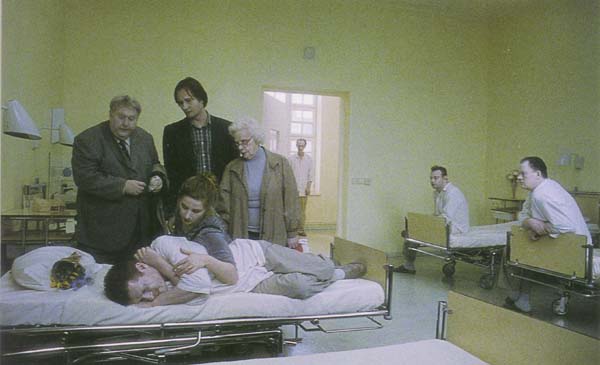
The death of civilization, the death of Europe for Anderson is not a plot, but a situation. Or a number of situations, variations on one topic, as a result of developing in the film. Each "song" is a picture moving and exploiting a certain artistic style. Basically, the pictures go back to the Flemings-paradoxalists, from Bosch to Magritte . Anderson's technical method consists in a stable shooting angle installed "once and for all" in each episode of the camera; The camera does not move, only occasionally swaying slightly. According to the director himself, this method was used by Chaplin to achieve the greatest tension in the frame; However, it is obvious that in modern cinema a similar style is opposed by another powerful Scandinavian wave, "dogmatic", where the camera takes off his shoulder and is not at rest for a minute. It is curious that in Cannes in 2000, another film was shown about the crisis of modern Europe, the "Unknown Code" by Michael Hanek. The harsh Austrian also used a stable camera, but he needed it to the illusion of reporting, as well as to give the viewer the feeling that he was peering behind the heroes. Anderson has everything differently - there was no spontaneity in the film and could not be: each “frame”, that is, an episode, he built for months with the assistants, choosing the color, shape and location of any object, in fact - building a living picture.
The principles of painting were followed by underonson and in working with actors. The only professional artist appears in the film in the bewitching first episode, when one of the heroes comes to ask about the "situation of affairs" from the mysterious oracle. He answers, lying in the solarium, and the viewer sees only his legs. This, according to the author, is the maximum of "authenticity" that is able to introduce a professional comedian into such skillful and artificial construction. Because the artificiality of the construction is redeemed by the generosity of absurd situations, which are, as it were, are born from the personalities of the "actors" of Anderson, not one of which has yet been shot in the cinema. Among them are drivers, unemployed, managers ... The main character, Karl, was met by Anderson when he made purchases in Ikea (Sweden all the same); In real life, he is a typograph, and in the film - the owner of a furniture store, burning it for insurance. The director is interested in the authenticity of his heroes, and, having come up with the initial situation, he develops it in the course of filming, based on the personality of the actor. This seems incredible, but Anderson does not write the script in advance (therefore, shooting lasts years). Having built the scenery of a particular episode, he begins to improvise, writes dialogs on the go, with the help of the character himself. The final mixture of terrible naturalness and parables cannot but impress.
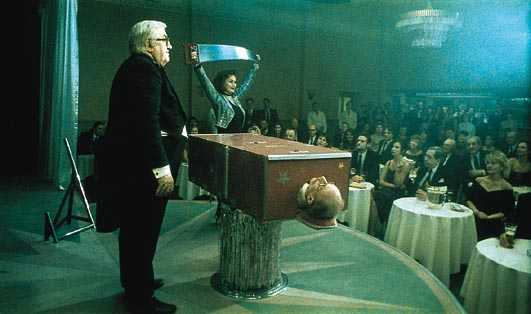
Each episode of "songs" is a semblance of an absurd joke, reminiscent of Harms. For example, a joke about a magician who calls a volunteer from the hall to cut him in half ... and actually saws him. Not on purpose, just an unknown failure occurs in the program. This failure in the program is the basis of each joke. Here a certain office employee is fired for no reason, and he tries to beg his boss, crawls along the carpet in the corridor, grabs him by the legs ... all, of course, in vain. But the foreigner is trying, extremely polite, to ask passers-by on the street how to go to such an address, and they suddenly begin to beat him with their feet. Either the connection of the worlds is torn, and Karl, the through hero, begins to see the ghosts of the Second World War, hanged in Russia by the Nazis and dragging behind him everywhere with slurred requests in an unknown language. One of the central places of action is a crazy house where Karl comes to visit his eldest son, the poet who was considered a psycho when he refused to work in order to write poetry (a parallel with another bright Scandinavian film last year, “Angels of the Universe” by Friedrich Friedricksson). Charles constantly getting out of himself, who is filled up and starts screaming, led by a duma orderlies, and the doctor, to whom the family is trying to address questions about the health of a relative, turns out to be a disguised psychoma. The other madman repeats one phrase: "Jesus Christ was not God. He was just a good guy. For this they crucified him ... " .
There is no special pathos in these words and other symbolic episodes of the film. Just for Anderson, the principle of humiliation remains the key, on which, in his opinion, human civilization stands. It’s a pity for everyone - both humiliated and humiliating, especially since together they form a closed system, a vicious circle. Almost all the heroes of "songs" are old, heavy, clumsy; Most have a white makeup on their faces, like clowns in a circus or actors of the Japanese theater. This is the next indication of theatricality, the conventionality of everything that is happening, and the fundamental attitude towards unprofessionalism; Before us are the actors of the provincial circus who have learned to do even the most trivial tricks. This is how all humanity appears in the film.
Anderson's method reaches the greatest power in group scenes, which are many in the film. The first image of mankind is a giant traffic jam, in which it seems to be stuck the whole city, and from which there is not the slightest hope of getting out. The second is a group of self -flagella, among whom are quite decent townspeople in costumes and diplomats, raving along the central streets as members of the medieval sect (the image goes back to the classic Bergman scene in the Seventh Press ). The third - people who are trying to leave the damned place with all their belongings (where they are going to remain a mystery), fly away ... but who cannot get to the reception of the airport. They drag their grotesque trolleys with luggage, but they can barely move them out of place, and each with the coveted golf clubs fly to the floor. Finally, the final is human sacrifice, with a stream of people, with raised flags, a banquet, church and secular authorities, and a wind orchestra. The joke is gaining momentum, becoming worse and funnier in each next scene, but still not giving soil for empty hopes. A generalized picture of the old world, doomed to inglorious death, is emphasized by an old-fashioned-living green color that predominates here and creating a "soothing nerves" atmosphere of psychiatric hospital, as well as music: pastoral-cycle melodies on the accordion, touching and tender ones, written specifically for the film by a single-phase director-the leader of Benny, the leader of the Abba Benny Anderson.
The only thing that remains in the fog is the meaning of the name. Perhaps we can agree that each of the stories told is a kind of song, but what does the second floor have to do with it? It remains only to assume that songs from the second floor - never sounded a signal from above, from heaven, from where, in theory, the bright side should sit; Those who accept the side of mankind when Armageddon comes. But the last battle was not needed; The end of the world came by itself, but we did not notice. Therefore, we can only listen to the only song, banged by Roem Anderson.