
Translated material
Achillesov Pipe
Talking about the water supply of Pskov has been going on in a circle for more than thirty years
An elderly man with sheets of paper in his hands entered the editorial room: “I brought an article to the newspaper,” he said and introduced himself: “Alexander Vasilievich Nikityuk, the former head of the Pskov city water line.” We read the text and decided to give the floor to our reader. The editors hopes to get a detailed and reasoned response to the criticism of the senior colleague from the current leaders of the Gorvodokanal and is ready to publish it in the nearest issue of the newspaper.
Modern water supply in Pskov was built and put into operation, mainly in the period 1959-71. And designed for performance exceeding about 14 times that existed before.
Despite the increase in capacities, the project was provided only for the 15-year period of development of the city, without taking into account its further expansion, since the existing construction site in many respects did not allow expanding. Therefore, measures were taken to search for additional sources of water supply, which would provide and take into account the prospects of urban construction.
Such a source was found by the Pskov geological and survey party, which, at the request of Gorvodokanal, opened in early 1971 on the shore of the Pskovsko-Chudski Lake, large reserves of groundwater in good quality. The State Committee for reserves approved them for water supply to the city with a fence of 120 thousand cubic meters per day.
By this time, the construction of the water supply ended, the water supply networks were built much more than the project. It remained to build only a second water supply, equivalent to constructed the city with reliable and sufficiently quantity water supply, as well as build a second block of treatment facilities, half a lower power to bring total performance to a design amount, and close the project on that.
At the same time, it was necessary to begin to resolve the issue of designing a water supply on groundwater, and then about its construction.
But in 1971, the leadership of Gorvodokanal, and the new leaders, and the present, had already replaced six people since then, decided that the city with its “water” problems would wait, and began to build the Gorvodokanal base, the administrative building, a residential building and other facilities. And the above, very necessary for the city, the structures are not built to this day.
This led to the fact that, starting from the 80s of the last century, the city began to feel a lack of water supply associated with both the quantity and the quality of the water supply water supplied to consumers.
In the month of April 1998, in the newspaper "Pskov News" under the intriguing heading - "What are we going to drink in 2000?" - It was reported that the World Bank allocates Pskov to solve the problems of water supply of $ 15 million and that the representatives of this bank from the USA and Sweden have already visited Gorvodokanal and made their proposals on this issue.
Acquaintance with the latter showed that their authors self -confidently ignored the situation in the city and decided to improve the situation with far -fetched and low -skilled events, the implementation of which will lead to an unjustified consumption of a loan, the cost of water supply, but will not solve the problem of water supply to the city.
The Pskov Pravda newspaper for June 25, 1998 was printed a large article under the same heading as in the "News of Pskov": "What are we going to drink in 2000?"
However, the foreign authors of the project, apparently, did not read these articles, and no one introduced them to them, therefore, as a result, Swedish specialists from Stockholm summarized these proposals with the addition of their own and sent ready-made materials to Gorvodokanal, under the loud name “Pskov’s water supply project”.
And Gorvodokanal through the Pskov Pravda newspaper for January 27, 2000, notified the Pskov experts about receiving the “project” and asked to get acquainted with him and give his conclusions.
I, as a specialist who worked as the head of the Gorvodokanal for about 13 years, also presented his conclusion, which, in most of the provisions of the new project, made a reasonable, in my opinion, criticism.
My conclusion was not taken into account, they decided to carry out the specified project provided with a dollar loan.
The Pskovites saved from the bonded dollar “help”, which would have to be paid by rubles from our pockets, only the decision of the federal government, which refused foreign loans for such purposes. It was a reasonable step, since such loans with large interest and dictatorial requirements for what exactly can be consumed for themselves to take only profitably working enterprises and only for such projects that can quickly recoup themselves.
Last year, in the newspaper Pskov News, for October 20 and the Pskovskaya Pravda newspaper, small articles were printed for the same content for the same content that the city administration was negotiating with foreign investors from Germany and Denmark, who agree to build water supply facilities in Pskov on groundwater, but with the condition: limit the productivity of up to 80 thousand cubic meters of water. per day.
We understand why foreign investors agreed to build a water supply system on groundwater, designed precisely for such performance, with a permitted fence of groundwater in the amount of 120 thousand cubic meters per day, it will be less necessary to invest in the construction of capital, it will be built faster and begin to give the desired profit.
Is it really possible for the pursuit of profit that you can ignore the interests of the whole city, which would have lost 40 thousand cubic meters per day of good quality cheap water, which differs in constancy of composition and temperature, which are not dependent on the vagaries of nature, and high purity. Another plus is that the construction of complex and expensive treatment facilities is not required, and then their operation using far from cheap water coagulation - all this will greatly simplify the system of watering structures and make water cheap.
But to build a water supply system on underground waters - half the battle, you also need to serve this water in the most rational and cheap way, with reference to existing water supply networks, to the Zapskovya area, the central district of the city and to the Bending, and this will require the revision of the entire scheme of current water supply networks.
Apparently, all this was not included in the calculation of foreign investors, so the signing of the contract for the construction of the water supply on the groundwater did not take place.
And on August 7 of this year, on the regional television and on August 8-9, a message was transferred to the regional radio on the resumption of negotiations with the World Bank, which agrees to allocate Pskov to solve the problem of water supply loan now in the amount of $ 8 million. In this information it was not reported only on what conditions a loan is allocated and for what specific goals it can be used. Although this is very important for the city - the Pskovichi should be sure that everything will not happen again according to the 1998 model, when foreign banking specialists gathered to solve the problem of water supply to the whole city with unqualified methods, without expanding existing tap buildings.
It seems that Gorvodokanal and all the others who are put by position do not know the true reasons for the insufficient water supply of the city and therefore believed the foreign guests instead of ordering and getting the necessary design and estimate documentation for the above facilities and gradually, as far as possible, to begin to build them - due to loans, investments or other sources of funding.
Without such documentation, conversations about improving the water supply of the city are indescribable for both capital owners and construction customers themselves.
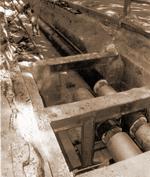
To date, the main object, capable of relatively quickly and in our capabilities to improve the problem of water supply of the city, is the construction of the second water conduit, but only if it is laying on the left bank of the Great River, along Y. Rainis Street - this can be proved by simple calculations.
In general, the problems of the water supply of Pskov should not be solved by officials on the sidelines, but openly, taking into account the opinions of interested citizens. Moreover, these issues are also very important because for their solution in any case we will have to pay us, the Pskovs.
A.V. Nikityuk,
Honored Worker
Housing and communal services of the RSFSR.