
Translated material
Why is Putin boiling?
The war in Chechnya is Putin's personal war
"New York Times" , USA
Michael Wines (Michael Wines),
November 13, 2002
Today, in certain diplomatic circles outside Russia, not to mention the whole pile of political gossip within the country, only one question is being extended that has a concern for the stop of President Vladimir Putin on Monday in Brussels: did he really say this?
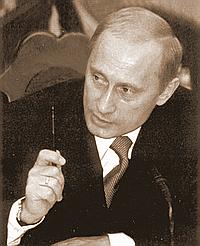
Yes, in fact said. And there are no signs that, despite the shaking and hasty apologies for his Kremlin assistants, he is going to take his words back.
Mr. Putin, whose usually incomprehensible behavior fits into the framework of his former career of the Soviet intelligence officer, on Monday rejected his usual equanimity when discussing the topic, which, it seems, was deeply eaten into his gutto: Chechnya.
This happened at a press conference after a summit in Brussels with the leaders of the European Union (EU), when the reporter of the French newspaper Le Monde asked if the Russian military military was used to death along with Islamic terrorists also innocent civilians. Mr. Putin replied that Islamic radicals want to tear Chechnya from Russia as part of their global plan for the destruction of Americans and their allies.
“So, if you are a Christian,” you are in danger, ”said Mr. Putin. “If you decide to become a Muslim, then this will not save you, because they believe that traditional Islam is also hostile to the goals that they set for themselves.”
Then he said the following: “If you want to completely become an Islamic radical and are ready to go to make a circumcision, then I invite you to Moscow. We have a multi -confessional country, we have specialists on this issue. I would recommend an operation so that after you nothing to grow up at all. ”
In the long pause followed by his words, even the translators did not know how to translate it. The last critically important proposal was never translated for the present diplomats and journalists. It should be paid attention to the fact that it also did not appear on the official web page of the Kremlin, which published in the rest of the full text of the press conference.
Later, the Kremlin assistants explained that Mr. Putin was, firstly, was tired, and secondly, as one of them said, "Chechnya stands across his throat." He has every reason for this: 3 years after the start of the war, in order to destroy the Islamic radicals, which invaded the neighboring Russian republic (Dagestan - approx. Per.), Not only hopes for an ambulance military victory have evaporated, but, as it seems, the atrocities are growing.
Chechnya for Mr. Putin has long been a topic that transforms his behavior. This is the only topic that over and over again turns it from a clearly expressing thoughts and a convincing Europeanized Russian, who is happy to see at any table of global leaders, in something reminiscent of Nikita Khrushchev, another leader with advances for his time, who once tried to prove his innocence with the help of his own shoe.
None other than Mr. Putin in 1999, after the explosions of residential buildings in Moscow, expressed an undisguised threat to the Chechen terrorists, saying that "we will wet them in the toilet." Many then regarded the use of the rude slang as an attempt to imagine himself a "cool guy."
Later, Mr. Putin surprised foreigners from the West with his shoulders with his shock when his own army transferred the Chechen rebels of the journalist Radio Liberty, as believed, in exchange for captured Russian soldiers. Mr. Putin called the journalist who questioned Russian politics in the Caucasus, a traitor.
Mr. Putin once again raised his eyebrows high in mid-2001, when the question of one London journalist about human rights violations in Chechnya by the Russian military instructed an indignant lecture on human rights violations, which, as he suggested, is ignored by foreign media (the media). There were so many similar episodes with President Putin, both public and private, among those who follow him, the effect of Chechnya became an indisputable fact.
Boris Nemtsov, the leader of the Russian Union of Right Forces (ATP), in the news of Mr. Putin's statements in Brussels, said: "This is not news for me."
“He (Putin) is completely absorbed in Chechnya,” says Alexander Rar, one of the leading German foreign policy experts and a friend of Mr. Putin, adding that, apparently, the Russian president is determined to prevent the collapse of Russia. “And since he sees in an agreement with the separatists the path to such a breakdown, he will never make concessions,” Mr. Rar believes.
Whatever the reasons, the contrast between the pale and evil Putin and the statesman in the European style was never as obvious as on Monday in Brussels. European human rights activists and European leaders have always been the most consistent critics of the Russian war in Chechnya and pushed Mr. Putin to put an end to the excesses of his army and began to search for a peaceful solution to the Chechen problem.
Abbreviated translation:
Fedotov Victor, inosmi.ru