
Translated material
In search of gestures
The conductor of the orchestra Alexander Razumov: "I want to work at the highest level"
The conductor of the orchestra Alexander Razumov: "I want to work at the highest level"
Symphony concert is somewhat similar to the sea. The waves of sounds, such different and independent, roll from all sides, nevertheless formed something integral and one - immense, incredibly large. And the most amazing thing is that this element rests at the fingertips of one person.
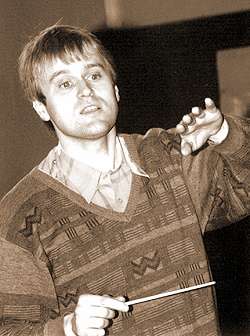
Since October 1, 2003, the Pskov Symphony Orchestra has been led by a new conductor. Alexander Razumov to the question of how it happened, that he became a conductor replies: "case."
The case brought him after the children's music school to the choral conducting of the middle special music school at the Belarusian State Conservatory in Minsk. Then there was a St. Petersburg Conservatory, first choral, then symphonic conducting. The general complexity of the “case” stretched for 21 years.
"One denominator"
The fact that a third -party viewer is striking to the core, for Alexander Razumov - work. The usual thing is to put music in motion with a gesture. “Each musician has his own understanding of the work, his feeling of pulse, meter, rhythm, and I must lead to a single denominator so that everyone is like a single organism,” he says.
The conductor largely depends on how a musical work will sound, and this is a great responsibility: “We work with brilliant works, and it is important to try to reach them as much as possible.” The conductor is the nervous center of the entire orchestra:
When 70 people are sitting, and each has its own character, its own temperament is very important to gather everyone together. In the process of conducting, contact with the performers is established - this is an amazing feeling when you make the slightest movement, and they understand you! But this comes with experience. In our profession we must constantly learn. I'm just entering it.
Alexander, how do you feel it?
Up to the point that I know the features of how everyone plays. A conductor is more psychological than an external profession. I feel some impulses, I know that here someone can rush, go forward, and someone will delay, someone, by virtue of character, will be careless somewhere. The duties of the conductor also include psychological work - to feel, understand people. And the more inconspicuous you do this, without thinking how this happens, just happens and that’s all - this is the skill.
Do you need to know the musicians or can you play with an unfamiliar orchestra?
In Pskov, I constantly work with these people, and by willy, I know them-characters, problems, etc. But even if you come to an unfamiliar orchestra, there are certain rules of the game that are known to everyone. I am a conductor - they are musicians. There are certain points that are clear to us, and already along the way you understand what.
How many times do you need to play so that the conductor and the orchestra become one? At what point does mutual understanding come?
Good question. You see, in different ways. When I come to the orchestra, I already know the work, I know how I want it to be - of course, I am engaged, because the unprepared people cannot go out to people! I know how it will be, but there are technical barriers - everyone has different abilities. We have a fairly long process of winning, no matter what work I take. We still have to work. What we have now is some step.
Can you play the work itself the first time?
From the sheet? It does not rust up for me ... In principle, I am able to figure it out. But it’s just indecent to read from the sheet! Each work needs to be heard before going to the orchestra. If I don’t hear him, I can't take him to the orchestra. Although there are all sorts of moments in the life of the conductor, I also happened to go out not entirely prepared, then you are already understanding in the process ... In any case, I prefer to learn everything to know what I want to hear. In order not to muddy people later, but to set problems and solve them.
Personal imprint
How much your personality brings to music?
My? I think probably yes. My advantages and my disadvantages-I have not yet got rid of some kind of husk, but I am going to this. To sound exactly the composer. I work, and try to follow some hints in the musical text, it is composer, trying to do it efficiently. These issues were discussed by people of the highest order, the same sheet. Naturally, you cannot be completely detached, naturally some moments capture me, and I am fond of, but what is it, what did the composer himself mean? - I don't know. But in any case, this should be done interestingly and professionally.
Are the works played by different conductors greatly differ?
You know, differ. Even if we talk about the great. It seems to be done correctly, and this one is right, and he is great, and this one is great, but still, there is a difference. The personality leaves the imprint, with his sensations.
Are you playing only the classics?
Basically, this season we played for the most part classical music. Plus, we played the songs of the war years, plus we played the Argentine composer Astor Piezzolla. But he is already considered a classic. Previously, Prokofiev was perceived as “avant -garde”, “modern”, and now this is the brightest classic - time is also an interesting thing. But we do not play pop music.
The London Symphony Orchestra made Queen music programs, The Beatles. Would you like to do something like that?
Our director, as far as I heard, is looking for these notes, it is the processing of The Beatles for the London Symphony Orchestra. If we have them, we will make a program with pleasure. I am not against any music, if it is professionally made, if it is interesting, well written. You can perform any music, the question - how to do it. I want to do everything as best as possible.
Alexander, do you have the difference what to play?
In sensations? If I say no, it will look strange. Of course, I have some preferences. But sometimes it happens that I need to do this work, that's exactly what. But I will approach any work from the position that I like it. Because if I do not like it, then I cannot captivate people.
But what if it is necessary, but really does not want to?
You know, it happened. But all the same, I come up so that it needs to be done, and I need to do well. Each person is individual. I may have some of my “cockroaches”, but the thing should not suffer from this, right? If I take it for something, I try to do it in good faith. Due to their abilities and capabilities of the orchestra, but in any case, not through the sleeves.
"Yes, there are not many of us!"
What is what the conductor of the symphony orchestra live now? This is not a very common profession, you do not meet every day ....
Someone told me: “There are many directors in Pskov, only the governor is one and one main conductor!” It lives normally. I do my job, I love him. Yes, there are not many of us! This is the specifics of the profession. Three people studied on symphonic conducting on the course - this is how they are accepted. I think random people are not in our profession. If a person has passed such trials, then there is no longer back.
What do you mean by "tests"?
I mean that you need to know and be able to know a lot to enter the choir, not to mention symphonic conducting - such an immense profession. In fact, I am happy that I am doing this. Of course, not everything comes right away. But at those moments when we succeeded in something-this is incredible happiness! I do not posing, I actually felt it. For this, it’s worth living.
Are you getting tired while working?
I used to spend more physical strength, tried to do more than necessary. Now I can’t say that I have learned, but I come to the fact that I achieve the same return with my smaller physical efforts. This is more neuropsychic activity than physical. Of course, it happens that you are getting tired, but not precisely during rehearsals. I am ready to rehearse 6 hours, if necessary, immunity has already developed, even when learning, this is not a problem for me. When I stand behind the remote control, I do not get tired, fatigue comes later.
You and your emotions are constantly in front of the public. Does it bother you?
I'm not shy. I, I, are not afraid of this word, a very extensive experience of performances, but not as a conductor, although this experience appears. From the age of 14 I sang in choirs, and I constantly sang in good choirs. The latter is the St. Petersburg Chamber Choir, we traveled all over Europe, were in America, in Canada. We sang in all the best halls in the world. I have no fear of the scene. I try to do everything at rehearsals so that no force majeure situations arise at the concert. Usually does not arise.
Do you have a special relationship with tools?
I really love string tools, but also love brave, wooden and copper. I like all the tools if they play well. But the tool itself leaves an imprint on a person. The observations shows that thrombonists are others, than say, valtor, and goboists are not like clarinetists, this is something in character.
Can you guess what a person plays?
You know, approximately yes. The tool conveys something to people. Good musicians get used to the instrument, feel it.
There is no temptation to redo the work a little for a good musician to highlight it?
I don’t specifically set such a task, everyone is equal to me. It is important what value is for the work. If this is necessary according to the episode, then of course. The musician himself feels this - "here is my solo." And here he can show the maximum of his capabilities. And naturally, he receives some freedom. We have musicians of a very decent level, not even by Pskov standards. But the composition is motley.
Public profession
Alexander, do you come up with your gestures?
Of course, I am constantly looking for, in the framework of what I already received. A certain program has already been laid in my head, and on its basis I move on. Technical development - hands - also takes a lot of time, and I am constantly learning. I'm looking for gestures. But the conductor is not enough just to know the music, it still needs to be conveyed, and cause a response to the musicians, and then from the audience. The pianist is easier - you depend on yourself. My tasks - so that everything is clear to people, conveniently and calmly. In the sense that I will always help them, tell them and there will be no problems.
AK is easier to perform - with a full hall and with an empty one?
Honestly, I am happy when the hall is full. Just happy. When an empty hall used to go, a 50-60 man sits-all the same, I will strive to do everything to the maximum. But when the full hall is something that happens, some kind of feeding.
Do you feel your back?
Feel. Sometimes I try to consciously affect the hall.
How - through the back?
No, not through the back - through spectacular, through the feed. You can play the same way, but how will you present it? There are conductors that come to look at. I am a supporter of the fact that they come to listen to music, but still the profession bears an imprint of publicity. If music implies some kind of spectacity-why should I avoid this? I also work on this - to do it brighter, more expressive and more convincing.
Alexander, and the question never occurred to you: how much will it continue?
And this will be all the time!
And are you satisfied?
Certainly! It used to be a panic and such a horror was ... I am sure by 99% - I will leave 1% - that I will do only this. Another thing is at what level and how, but these are my internal questions. I was 28 years old and I got an orchestra - this is very good! Here is my creative laboratory. I can say that during this time I gained tremendous experience.
Is Pskov for you a peak or are you going further in the capitals?
I would say this: I want to work at the highest level. And it will be Pskov, or I do not know what - I will strive for this level.
Talked Svetlana Prokopyeva.