
Translated material
Tactical benefits and strategic evil
Igor Plotnikov: "The search for the enemy can unite, but this is not constructive"
Igor Plotnikov: "The search for the enemy can unite, but this is not constructive"
The competitive market, electoral system, multi -party and much more suddenly put us before the opportunity and the need to actively protect and promote their interests. Along with this, a mysterious and frightening word "PR" appeared.
What is PR, almost no one knows for certain. What does not stop at all to be afraid of, it is to hate it and do it. Largely due to the activity of homegrown “PR specialists”, the attitude to what is literally translated from English as “public relations” has developed, to put it mildly, biased.
Meanwhile, no one will deny that “public relations” in essence is a necessary and useful thing. Again, would the domestic education system teach “bad” and something harmful to society? And the "PR" is taught.
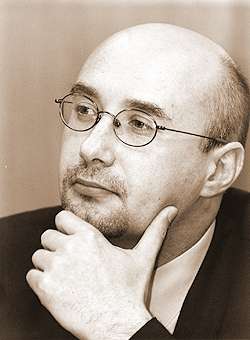
Igor Plotnikov, currently the head of the information and analytical department of Gazprom, at one time graduated from the Military Red Banner Institute of the Ministry of Defense with a degree in Special Propaganda and has great experience of the PR work. In 1997-99 Igor Nikolaevich worked as the head of the press service of the Norilsk Nickel RAO, in 1994-95. He headed the press service of the State Property Committee of the Russian Federation, was an adviser-a spokesman for several deputy prime ministers and chairmen of the Civil Code of the Russian Federation, etc., etc.
We met with Igor Nikolayevich at the seminar “Charity Business Projects. Reflection in the media ”, held at the end of May near St. Petersburg. We talked on a coffee break.
Igor Nikolaevich, tell us what is “PR”?
In my understanding, which, in general, is not very different from the classic one, what is called “PR” is an activity aimed at coordinating different interests. It is quite obvious that in business, politics, social life - in all areas - there are always people or groups of people with opposite or different interests. And in order for your tasks to be solved more efficiently, it is necessary to coordinate these interests at least.
“PR” as “coordination” - it sounds, I must say, unexpectedly. How does it all happen?
Each time, starting the project (and PR is, as a rule, project activities), we formulate goals and objectives, say, corporations. There is a goal - any. Then we draw a picture whose interests this goal contradicts. These are our natural opponents. Someone’s interests are “so and that, that is, some aspects are negative, some are positive, but in general-neutral. And there are groups of people (we call them “target audiences”), whose personal goals coincide with ours. And our task is to activate our supporters with various humanitarian methods, and secondly, those who are neutral to drag to their side, and, thirdly, those who are our enemy, try to neutralize. When we determined this picture, we begin to develop the so -called “key messages”, that is, to whom and what we must say in order to bring information and convince. There are rational or emotional methods of influence, as well as the spheres of our brain: either facts and arguments, or some feelings. Then we determine the forms and methods of working with these target audiences, as well as targeted funds, budget, terms, expected results, stage. And finally, we determine the start time and the informational occasion, which is created. This is what any PR project looks like.
Why did the negative attitude towards PR, as a very aggressive phenomenon focused on someone's narrow interests?
In many ways, this is a reflection of the state of the economy and the policy of our state and our society in the last two decades. They are sharply contradictory. We have a socio-economic formation, and this, of course, is very dynamic. Those processes that have passed in other countries for decades, we (the same stages!) Are forced to pass in a matter of years. Therefore, a very high intensity of campaigns. And like any intense stream, such an effect causes counteraction.
Is there a difference between economic and political PR?
By mechanisms - no. In forms and methods, according to key messages, on target audiences, according to the results, according to the dynamism of campaigns - of course, there are. Therefore, we are divided, specializing in: political technologists are engaged in politics, and corporate PR people are engaged in “corporate PR”. You can also distinguish “social technologists” who are engaged in social processes in the country in the country, “charity PR” is a slightly different category.
And the word "PR" does not interfere?
It interferes, of course. We are looking for and find other definitions: “humanitarian technologies”, “public relations” or “public relations”, “communication management” and so on, and so on. But in fact, this does not change. You can use those words that were before, for example, “agitation” and “propaganda”.
You studied special propaganda when the word "PR" in Russia almost did not hear. It turns out that the phenomenon itself arose by no means today and not yesterday?
I think PR as a form of coordination of the interests of individuals and social groups appeared together with human society. The church has been engaged in its own PR from time immemorial. There is always interstate, inter -class PR. PR was and will always be. Only now it is realized in this form.
What is Black PR? How does it differ from "white"?
The fact is that the PR community assumes certain obligations and principles in relation to those technologies that cannot be used. Which can be effective, but not environmentally friendly. They solve tactical problems, but strategically harm society. These are things like lies, slander, humiliation of human dignity. But in certain situations, some experts use such forms and methods.
More often, probably, this happens in politics?
No, in Russia, during the section of the former state property, in the era of sharp competitive wars - and in corporate PR, too.
Igor Nikolaevich, are there any rules that could keep from the use of “dirty technologies”?
In many ways, of course, it depends on the moral and ethical attitudes of the customer. Because we, as experts, must be able to own all forms of work.
And such technologies can be learned?
Yes, they are taught both educational institutions, and in many ways this is known in practice. There is a developed PR theory and so on.
That is, you can learn to lie, deceive? ..
Well, I think that each person knows how to lie, deceive and substitute to one degree or another! Just when these forms and methods are improved by specialists-this is already somewhere on the verge of the work of special services.
Are there any appropriate special courses?
Undoubtedly. Then, when the enemy is in front of you, these forms and methods, like any military science, have the right to exist, and are applied, and they teach this. But if you consider others not as enemies, but as partners with whom you need to agree, it is better not to use these "combat methods"!
Thus, does the state of "PR" characterize the state of society?
Yes, of course. What I talked about: in many ways, the presence of black technologies is an indicator of a very sharp demarcation of the interests of social groups. But it is necessary not to increase this gap, but on the contrary, to increase connectedness, this is more strategically important for our entire society.
Is PR project possible that would unite the whole society?
Well, you see, we have long been talking about the fact that it is necessary to find a “national idea” - that which would unite us all. Unfortunately, in Russia very often the idea of the enemy, external or internal was used as national. Unfortunately, now such elements are observed in our political and socio-economic life. The search for the enemy can combine, but this is not constructive.
Igor Nikolaevich, you get the impression that a good specialist can do everything: create any attitude, any situation ...
No ... I, despite the fact that I earn my living, would not exaggerate the possibilities of PR technologies. Of course, in many ways we use the situation, and do not create it. In many ways, the result depends on those people who are actually carriers of interests. We can only help express these interests, bring to others, tie people. But if these interests are not, then ...
So people still have free will?
Undoubtedly! Including, hire us or not!
Talked Svetlana Prokopyeva.