
Translated material
Goodbye socialism
Monetarization of benefits for some categories of citizens turns out to be their complete abolition
Monetarization of benefits for some categories of citizens turns out to be their complete abolition
“We had no childhood, we did not have youth. And we don’t have old age either. ” For the first time I heard these words on the bus, from an unfamiliar rural pensioner. Recently, the same phrase sounded from the rostrum of the house of officers at a meeting of labor veterans and workers of the rear of the Pskov region. “There was no childhood, there was no youth, there is no old age,” - a whole generation in Russia lives with this thought.
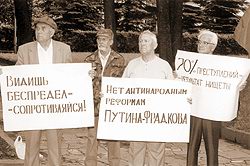
Involuntarily, you begin to demonize history. What did this country do, what and before whom it was guilty that several tens of millions of people were virtually devoid of life - not a physical existence, namely life - worthy and full -fledged?
The words "justice" and "merits" have always occupied a special place in the Russian language. Now, in connection with the upcoming replacement of social benefits, they sounded even more often, even louder, filled with a new, redesigned meaning. The good third of the population of Russia was forced to wonder: how did we deserve it?
Parald opinion
Not a single bill in the foreseeable historical period caused such a violent discussion as adopted on July 2, 2004. In the first reading, federal law with a long and obscure name. It sounds like this: “On amendments to the legislative acts of the Russian Federation and recognition of regulatory legal acts in connection with the adoption of federal laws“ On amendments and additions to the Federal Law “On General Principles of the Organization of Legislative (Representative) and Executive Bodies of the Constitutions of the Russian Federation” and “On the General Principles of the Organization of Local Self -Government in the Russian Federation”.
The law provides for the abolition of several tens and a change in one and a half hundred legislative acts. Without even going into details (try to go into 400 pages! And the deputies were not able to), most of the population opposed this bill, expressing their attitude at numerous rallies, protests, in thousands of letters and appeals to the supreme power. There was not much sense from this - the parliament did not hear the voice of the recent electorate.
Even the official opinions of the constituent entities of the Federation were not taken into account for the consideration of the bill in the first reading. On the website of the Institute "Public Expertise" (http://www.freepress.ru) a summary table of the positions of the regions in relation to the bill was posted (in the same place - the results of the echoing voting). It can be seen from it that on July 2, reviews from 44 executive and 45 legislative bodies of regional authorities were not received. Only in 5 constituent entities of the Federation (out of 89) the legislative and executive bodies in accordance with the project expressed a positive attitude to the project (in 13 - unanimously negative). The project was approved - 23 governors (including our, Pskov) and 7 regional parliaments, did not approve - respectively 16 and 33. The review of the Pskov Regional Assembly was not presented to the State Duma.
Probably, the Pskovs are not highlighted to find out how their deputies voted on such a burning issue. For the first reading bill, all the deputies of the unit voted: both Igor Dines and Kirill Ragozin, as well as assigned to the Pskov region, and the single-mandate Alexei Sigutkin. “Against” were Vladimir Nikitin (Communist Party) and Vasily Shestakov (Blok “Rodina”).
Good intentions ...
But the government is not fools sitting - a sane citizen thinks. It is impossible to suspect the highest persons of the state of malicious intrigues against the people! This means that the bill under consideration must have a bright and wise idea, which, according to the developers, will contribute to the establishment of happiness on the Russian land.
Surely there is such an idea! It is not clear why she has to dig and think out why she was not explained in advance, did not explain to people, did not lay out everything on the shelves to enlist their understanding and support. It is clear that with the current composition of the State Duma, all this is useless, but still ...
The indicated bright idea is loosened by the following strokes. Firstly, the federal center clearly agrees with the regions: “This is ours, this is yours”, no confusion in authority. Great. Secondly, all obligations accepted by the state are provided with money, and obligations not backed up by sources of financing are removed. It's clear.
Thirdly, money as universal value equalizes within one category of all citizens who have the same right to benefit, but various opportunities. Here they bring as an example of beneficiaries living in rural areas: they cannot use the right of free travel or 50% discount on the phone (due to the absence in the village of both transport and phone), but al, albeit small ones, are very useful.
The benefits are “clamped” in cities. According to the observations of one of my friends, a disabled person of the 2nd group, from the benefits provided for this category of benefits, you can actually implement only one-free travel in city buses. It is almost impossible to get a prescription for free medicines, buying medicines with a discount in special pharmacies is more expensive (!) Than without a discount in others, and this discount is only on drugs worth up to 100 rubles. (not the most effective, of course), etc.
Well, in the fourth, as the most far -sighted and large -minded analysts note, the abolition of benefits in kind can change the mentality of Russians. The reformers hope to turn the current system of “social dependency” (when only the lazy system was in a hurry to sign up for “disabled people”, and enterprises and institutions got used to living due to subventions on beneficiaries), dispel the complex “everyone should” me, wake up a sense of responsibility from citizens and teach them to rely only on their own forces. And from here, to civil society, a stone's throw. Very good!
... and regret performance
However, a rather clumsy embodiment was essentially good.
At first, the government complained that the state since the USSR promised the people of free goods for 6.5 trillion rubles (with the resources of all budgets for 2004 at 4.5 trillion, as Minister of Finance Alexei Kudrin said on July 2). Then we were talking about 2.8 trillions laid down by law. It is supposed to compensate them with 171 billion. Some types of benefits are canceled without any compensation.
Well described this situation at a meeting of the State Duma, deputy Oleg Shein: “Look, what an interesting logic. They tell us: here are the laws - 2.8 trillion, we do not pull it, give 170 billion, and everyone will live better. That is, people have the right to receive benefits by almost 3 trillion rubles, these benefits are eliminated, and instead they are introduced as if a certain state help, driven into pensions, not everyone who loses benefits, in the amount of 170 billion, and we are told that 170 billion is better than 3 trillion rubles! ”
Next. The amounts of payments were not very large - from 600 rubles. up to 3.5 thousand. It is clear that, for example, the cost of a flight to Vladivostok, which is possible for some beneficiaries in kind, will not enter here in any way. But even without such extremes, there is not enough money. For example, Deputy Chairman of the Regional Assembly of Deputies Gennady Podzozoev at a meeting of labor veterans on July 27 claimed that he calculated the average cost of benefits in the Pskov region: “This is at least 4,000 rubles. When I announced this in the Federation Council, they told me: well, are you laughing, or what? A pension is one and a half thousand, and you offer 4 thousand for benefits! ”
With such calculations, it would be most logical to give each citizen the right to choose in what form to receive social benefits. Or recount better.
It was planned to add the amount of payments to the average per capita income of a person (amendments were proposed that cancel this). This will formally lead from the poverty line, which means that it will deprive the right to housing subsidies. Finally, an effective mechanism for indexing cash payments is not provided. Most critics of the bill are sure that inflation will “devour” compensation in a matter of months.
In the field
But the case has been done, the first reading the law has passed, which means that now citizens remains to achieve their within the framework of the adopted “as a basis”.
One of the most difficult points of the bill is the transfer of some social obligations to the regional level. In terms of benefits, this applies to payments to labor veterans, rear workers and victims of political repression.
Labor veterans are the largest category of citizens, which already has the right to a relatively small amount of benefits. Now they have a free travel on city and suburban transport and 50% of the phone, radio and television. The bill suggests regions to independently establish and ensure social support measures for them.
In fact, this means for veterans of labor and others like them to cancel benefits without any compensation. Of the 89 constituent entities of the Federation 71 receives subsidies from the federal budget, which means they live with a larger or less budget deficit. Will the regional budgets be able to find funds for labor veterans (for the Pskov region this will amount to about 500 million rubles per year)? The regions honestly answer: no.
As the expert weekly calculated, the volume of expenditure obligations of the regions will increase by 426.4 billion rubles. At the same time, a serious increase in the revenue base is not expected. Even on the contrary, the center continues to rake up to itself more and more financial revenues. So, for example, since 2005, the federal share of income tax has been increasing (from 5 to 8.5%) and hydrocarbon production tax (from 85 to 95%).
There is no need to expect a rapid economic growth in the Pskov region in the near future, especially since the regional administration sees the main source of profit in the federal budget (“We have one donor - Gazprom - does not forget to emphasize Evgeny Eduardovich on occasion). From January 1, 2005, a situation may be developed when tens of thousands of labor veterans of the Pskov region will lose the right to travel on buses for free, they will take twice as much to pay for the phone and so on - and they will not receive a penny of money in return. With a pension of 1.5-2 thousand rubles, this means a serious decrease in the standard of living.
This can be avoided only in one way - to transfer these obligations to the federal level. With this requirement on July 27, the Pskov veterans of labor and only the rear workers gathered in the house of officers and accepted the appropriate appeals to the deputies of the State Duma and the Federation Council, to the President and the Head of the Regional Administration.
Such appeals come to them from all regions. It is expected that this particular issue will become the most problematic in the second reading of the law.
More than benefits
Other, no less important changes that will affect education, healthcare, and labor relations remained almost unnoticed by the “preferential” hype. And they will touch everyone.
For example, the minimum wage is canceled. Yes, yes, the very minimum wage that is guaranteed by the Constitution, for which all generations of revolutionaries fought, on which the entire system of fines and rewards is built, which for trade unions has become the main tool in the struggle for a decent standard of living of workers - now it will remain only for federal employees. And for “your own” it will not be difficult to raise it to a real living wage.
A unified tariff grid for employees of the budget sphere is also canceled (the same bill, against which “budget” trade unions have been different for the whole last year). Now all issues of paying salaries (tariff rates, salaries, additional payments) are transferred to the level of regions. Think only - doctors and teachers, as well as students with their scholarships, like all schools and hospitals, will live at the expense of regional budgets. Where does our scarce budget come from for education and healthcare? Apparently, from where and from the payment to veterans of labor.
The regions now must again pay children's benefits from their own funds. Such an experience in Russia has already been. It ended with many years of litigation and transfer of responsibility for these expenses to the center.
The fulfillment of all these obligations for the region means the complete folding of their own targeted programs. Failure - the collapse of the entire social sphere.
25%of the allowances to rural doctors and teachers are also canceled, their benefits for housing and travel are canceled-the little that kept specialists in the areas. Farewell, sat down!
It is noteworthy that the legislative changes that grind the entire “Socialist” were held without the obligatory coordination with trade unions in such cases. The trilateral conciliation commission - the pride of the FNPR - did not visit the bill. So, goodbye, "social partnership."
To date, more than 1,200 amendments have been included in the State Duma working group. The first revenues were announced on July 2, Andrei Isaev, chairman of the State Duma Committee on Labor and Social Policy. Amendments can withdraw part of serious claims. But again, seeing how they are there, in “United Russia”, they will agree among themselves.
One way or another, in the form in which the bill first came to the Duma, he has the right to life only under one condition - subject to the abolition of the seventh article of the Russian Constitution. Which reads: "The Russian Federation is a social state." All experts agree that with those changes in the legislation that implies the bill under consideration, our state will cease to be “social”.
Svetlana Prokopyeva.