
Translated material
2006 plane crashes - a consequence of errors in the development of civil aviation over the past 15 years
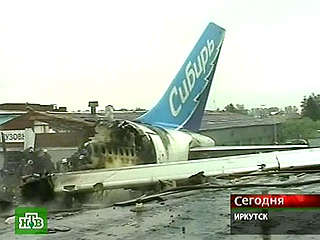
The 2006 plane crash is a consequence of errors in choosing the goals and priorities of civil aviation development over the past 15 years. Such conclusions were voiced by the Minister of Transport of the Russian Federation Igor Levitin during the first meeting of the Interdepartmental Commission for Civil Aviation Flights, ITAR-TASS reports.
“The tragic consequences of the 2006 disasters are a consequence of errors and miscalculations over the past 15 years when choosing the goals and priorities of civil aviation development in the organization of the industry management, regulatory regulation, providing the industry with modern aircraft, maintaining their flight fitness, as well as improving the training programs for personnel and the development of ground infrastructure,” Levitin said.
In this regard, he drew attention to "the need to develop a strategy for managing flight safety and taking decisive and systemic measures to increase it." Within one month, a number of working groups in the main areas will be formed as part of the commission, its meetings are planned to be held at least once a quarter.
The head of the Ministry of Transport recalled that from 2002 to 2006, 65 aviation accidents occurred with civil aircraft of commercial aircraft, including 27 disasters. In addition, the copyright supervision system was completely destroyed, the weather supply system is outdated, and the wear of the runways reaches 80%.
Expert: "Today there is no one to fly, and there is no one to retrain"
On Tuesday, Rossiyskaya Gazeta publishes an interview with Honored pilot of the USSR, president of the Air Transport infrastructure development fund Oleg Smirnov.
"Today there are serious problems with the preparation of flight personnel. And above all, on heavy types of aircraft. After all, the A-310 plane, burned in Irkutsk , is a modern ship. Tu-154M is a magnificent plane in general, and it was installed , as it was installed, without any technical flaws. Finally, the Tu-134 is an obsolete but strong plane, one of the most reliable. I believe that these disasters should not have been, ”said Smirnov.
“Yes, there were concomitant moments, however, if the crews were prepared and turned out according to all the canons of flight-methodical work, there were no reasons for such outcomes. The mentality of any pilot is laid in the school, the institute. But over the past fifteen years, the initial flight training system has degraded. The collapse began not a year or two ago. At one time there was a clear cadre policy. Aviation leaders of all levels clearly knew how many pilots, dispatchers, aircraft and what aircraft are needed for ten years in advance. From the schools they began to scatter, ”the expert said.
He noted that "there is no one to fly today and to retrain nobody." “Arithmetic is simple: only one“ Aeroflot ”will require 234 pilots for the next year, in 2009 - over 300. But all flight schools are producing about 200 per year. But in the industry there are still 189 airlines that also need flight specialists,” Smirnov said.
He said that the pilot instructor receives in the average flight school 2.5 thousand rubles.
"The total park of the aircraft of our educational institutions has about 260 units of equipment. It is idle - 80 percent! Some have developed a resource, some require a major overhaul. According to the ICAO recommendations, a raid of at least 150 hours is needed to receive a commercial pilot. We have not only secondary, but also higher educational institutions produce pilots with 60 hours," noted the 60 hours. Expert.
"In Russia today, a little more than 2.5 thousand aircraft fly. But almost 30% of the total passenger transportation is drawn on themselves about a hundred" foreigners ". And, apparently, by the beginning of 2008 this figure can double. The mass of the crews will go abroad. This is a huge money. Large airlines, such as Aeroflot, Transaero and some others, some others, some others, some others, some others, some others, some others, some others. Of course, the rest is unfortunately, some Russian airlines are headed by dentists, financiers - everyone who did not sit on the cadet and did not absorb the laws of physics, for which the main result of the work is the main result of the work. pilot.
The introduction of new ICAO standards since 2008 by knowledge of English can further aggravate the situation. "If the pilot does not own English at the fourth working level, the road to Europe will be closed to him. Someone calculated that the entire literature of Boeing and Airbus is 100 kilograms. And all in English. Moreover, the designers prohibit translating it into any language of the world, since in this case they take off responsibility for the safety of flights, because each translation cannot be checked. One of the worst planeway in the world It was precisely due to the fact that the pilot had a weak English, then two "Boeing-747" collided during the rise, 560 people were killed.
According to Smirnov, the budget allocates 50 rubles a day to food for the cadets of flight schools. “There is a paradoxical situation: aviation experts are preparing to deal with devices, the cost of which goes off scale for one hundred million dollars. However, they learn to operate it in such beggars. Is it surprising that the guys are not eager to go to pilots. They are not satisfied with the fact that they immediately take them into the army,” the expert said.
He said that earlier in flight schools were military departments. "The graduate, along with a diploma and pilot certificate, received the title of lieutenant of the reserve. The system was eliminated. Today, not having time to reach the threshold of the airline, yesterday's cadet changes the flight uniform to the soldier’s Kiraza. And in two years, he was completely" reset to the security company. Otherwise, professionalism is lost more than once, but so far it is only a few hundred people.
“In general, in a country where eleven time zones, civil aviation ceases to be just aircraft. This is already social transport. And by and large it is high time to give its development the status of a priority national project. The price of the issue is too large,” the pilot concluded.