
Translated material
Obama and Medvedev depict dialogue
Around Russia
 Obama and Medvedev depict dialogue
January 26, 2010 Alexander Podrabinek
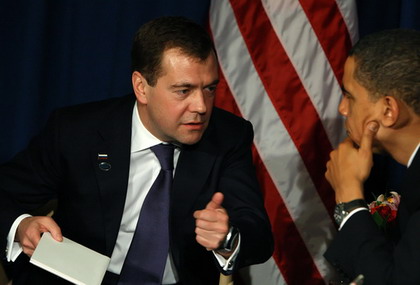
On January 27, in Washington, a meeting of the joint Russian-American working group on civilian society, created based on last year’s negotiations between President Obama and Medvedev, begins. The American part of the group is headed by the special assistant to President Obama on national security issues Michael McFol, the Russian - First Deputy Head of the Presidential Administration of Medvedev Vladislav Surkov. The latter is known in Russia and beyond as an ideologist of “sovereign democracy” and the initiator of the suppression of civil freedoms and human rights. He is also considered the inspirer and organizer of the pro -Kremlin youth movements that conduct their activities, balancing on the verge of the law.
The appointment of Surkov by the Russian co -chair of the group was met by many in Russia and the United States with bewilderment and criticism. In July last year, 23 Russian human rights defender turned to President Medvedev with a request to revise the decision on this appointment of Surkov. In December last year, 71 American congressmen sent a letter to President Obama demanding not to take part in the work of a joint group until the Kremlin replaces its Russian co -chairman. Vladislav Surkov, according to congressmen, compromised himself too much.
The appeals of Russian human rights defenders and American congressmen did not take action. Maybe it would be an exaggeration to say that the appointment of Surkov, the co -chairman of the Group for Civil Society, is just as if Reinhard Heydrich were introduced to the International Commission for Combating Xenophobia or Paul Potu were appointed judge of the International Tribunal for Genocide crimes. Nevertheless, the absurdity of the appointment of Surkov in this case is obvious.
The matter, however, is not only in personalities. At the first meeting in Washington, three topics will be discussed: at the suggestion of the Russian side - corruption and crimes against children, on the suggestion of Americans - negative stereotypes and myths in bilateral relations. Of course, these topics are important, like many others. However, the problems of civil society can be conditionally divided into two categories: problems that come down to violations of human rights, and the problems of the lack of mechanisms for ensuring civil society, its protection.
Any master will confirm that a good tool is needed to obtain a quality product. With the help of scrap and sledgehammer, it is impossible to create a computer or build a space rocket. With the help of authoritarian power mechanisms, it is impossible to create civil society and ensure human rights. It is pointless to discuss the struggle with corruption and the disenfenity position of children, but at the same time forget about fundamental rights that ensure the possibility of surviving civil society; Forget about tools that allow guaranteeing the observance of human rights. These necessary tools are freedom of associations, freedom of speech and media, the right to rallies and processions, the right of citizens to be a source of power in the country. And just these topics are left overboard in the negotiations in Washington. This format of negotiations is quite consistent with the Kremlin position. As it is now obvious, the positions of the American administration too.
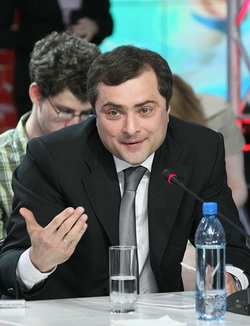 In an interview with the Izvestia newspaper last Saturday, Vladislav Surkov spoke about the preparation of the Washington meeting: “We sought to bypass questions that we can hardly agree on,” Surkov explained. The banal unwillingness to discuss the really acute problems of the marmos gives out a fatal impossibility to agree. As if there are some mysterious natural forces and insurmountable objective circumstances that impede the discussion of important topics. Consent with this position of the American side has long been not surprising, but still very regrettable.
Keeping Obama’s election style, a meeting in Washington should be held under the slogan “We Can Not”. This slogan could become a symbol of mythical “rebooting” of Russian-American relations, which exists exclusively in the imagination of politicians who are looking for popularity. You can discuss the issues pleasant for discussion with rapture, infinitely long and absolutely to no avail.
Everything turns out, as in a joke about a drunk who was looking for a lost wallet under a street lamp. The passerby decided to help him, they were looking for a long time together until the drunk admitted that he had lost his wallet in the neighboring dark lane. "So what are we looking for him here?" - the passerby was surprised. “Because it’s lighter here,” the answer followed.
What will McFoll and Surkov find in negotiations in Washington? The success of this meeting is as possible as the probability of finding a wallet under the lantern, lost in a neighboring lane.
Photos of RIA Novosti