Translated material
The FAS team worked
The court approved claims of the antimonopoly service to oil companies
The Federal Antimonopoly Service has achieved a sensational victory in the High Arbitration Court over one of the largest oil companies. TNK-BP must pay a fine of 1.1 billion rubles for the establishment of monopoline high prices for gasoline in the summer of 2008. Thus, a precedent has been created that can affect the outcome of several other similar cases: the total amount of fines, the payments of which the FAS from oil workers, exceeds 26 billion rubles. What is behind an unexpected victory before the “manual” department - found The New Times
The FAS CASE AGAINST TNK-BP lasted over a year and a half. Considering that in the summer of 2008, the oil company unjustifiably lifted the prices at its gas stations, the antimonopoly service imposed a record of a fine at that time. TNK-BP with a billion did not want to part and challenged a fine in court. At all previous stages of the consideration of the case, the FAS lost: the arbitration of the Tyumen region, the eighth appeal arbitration and the Federal Arbitration Court of the West Siberian District recognized the imposition of a fine illegal.
FAS helped you
However, in April 2010, the College of Judges of the Supreme Arbitration Court (you) transferred the case to the Presidium, deciding that lower courts did not study the FAS arguments properly. In particular, the judges did not take into account that the FAS accused TNK-BP of collective dominance with three other companies (Rosneft, Lukoil, Gazpromneft), whose activities cover the whole country, not individual markets. The total share of four companies in the all -Russian wholesale market of automobile gasoline, according to FAS, was almost 75%.
The rates on the outcome of the case were high: the FAS leadership immediately stated that the Presidium’s decision on the dispute with TNK-BP would be determined for other similar cases. As a result, antitrust won a convincing victory in the Supreme Arbitration Court, which, apparently, was predetermined this time. In any case, eyewitnesses to the court hearings note: the chairman of you Anton Ivanov during the process literally “plugged the mouth” to the representative of the oil company, clearly demonstrating his location to the other side. Now TNK-BP must pay 1.1 billion rubles to the budget within a month. In the oil company itself, comments are refused from comments on this subject.
Independent experts note that the penalty itself will not be a serious financial blow to the company. “The net profit of TNK-BP for the first quarter of the current year amounted to more than 37.5 billion rubles,” counted the analyst of the Metropol IC Alexander Nazarov. “And this year is scheduled for $ 4 billion for this year, so the payment of a fine will not have a noticeable effect on the financial indicators of the company.”
Campaign for billions
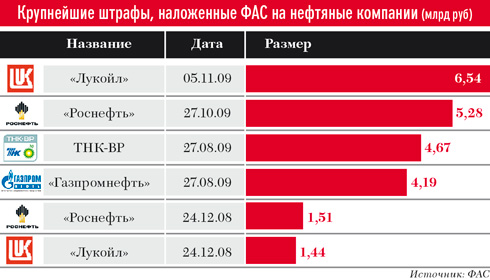
The very fact that you recognized its legality is much more important than the amount of the fine. Now antimonopoly workers are counting on victory, at least in six similar processes, following which they hope to get from the fined Rosneft, Lukoila, Gazpromneft and the same TNK-BP of about 26 billion rubles. Until now, the FAS on similar cases suffered humiliating defeats in the courts
* * The New Times wrote about this in more detail in No. 40 of November 9, 2009 , and everyone was sure that the lobbying weight of omnipotent oil barons on the political scales of modern Russia is much higher than that of a not too powerful antimonopoly service. “The judges of the regional courts did not hide that they were not in a hurry with the issuance of verdicts in similar cases of other companies precisely because they are awaiting the decision of the highest arbitration regarding TNK-BP,” says Alexander Nazarov.
Oil companies, which have recently felt the winners, are now forced to adapt to a new layout of forces. On May 26, Rosneft already asked the Moscow Arbitration Court to transfer its case against the FAS for a month, “price” 5.28 billion rubles: oil industry workers are counting on a settlement agreement with antitrust. It is curious that the oil companies themselves are so far from any comments on this topic. Only in the press service of Lukoil announced their intention, as before, to defend their case in court, whose closest meeting was scheduled for June.
And here
Mr. Lava FAS Igor Artemyev noted that the main task of his department does not “undress” the oil workers with fines, but to force them to reach the exchange so that it is a fair market price for oil products that are formed there. Last year, 2% of domestic oil products were sold on the exchange, in the first quarter of this year - already 8%. The FAS is going to bring this level to at least to 15%: “Otherwise, we will initiate new affairs until the companies begin to trade on the exchange and we will not receive transparent pricing,” Igor Artemyev threatens.
The struggle of the Nanai boys
The question remains open why the wind suddenly changed in the highest courts and blew into the sails of the FAS. Some of the experts surveyed by The New Times believe that it was not without a political decision in favor of antitrusters adopted at the very top. Vadim Novikov, senior researcher at the Academy of National Economy, believes that the court could well take into account the plight of the budget: after all, it is precisely it that multimillion -dollar fines would fall into it. Indirectly, in favor of the “political” version is evidenced by the fact that on the eve of the court Igor Artemyev met with Vladimir Putin. And although they publicly discussed the overestimation of prices with metallurgists, it is possible that it was a question of oil workers there.
At the same time, Vadim Novikov notes that earlier FAS experts did not carefully prepare their evidence base and therefore lost to powerful legal services of oil workers. “Previously, the courts in oil affairs were played largely on formal grounds: there was no calculation of the company’s share or“ competitive ”price. This suggested the haste of preparation by the FAS. They acted on the principle of “we will get involved in battle, and we'll see it,” Novikov explains.
For his part, Nikita Krichevsky, the supervisor of the Institute of National Strategy, believes that “to throw nonsense into the air” regarding the curbing of the monopoly market early: “The decision has so far been made only on TNK-BP. This company in recent years among all the largest oil was the most remote from the authorities. It is enough to recall the deprivation of TNK-BP licenses for the development of various deposits with the subsequent dedication of their Gazprom. Now, if this is followed by such decisions in relation to other companies, then it will be possible to judge that something changes for the better in the oil market. ”
The first Deputy Prime Minister Boris Nemtsov is sure that such decisions will not follow: “The policy of the current government destroyed competition in the oil market, which is divided between four companies, and each of them feels a monopolist. At the same time, the prime minister personally controls two of them - the state “Rosneft” and “Gazpromneft”. And TNK-BP can be pressed slightly: this has nothing to do with the emergence of true competition in the market. ”
As for the judicial victory of the FAS, its significance, according to most experts, should not be overestimated. The antimonopoly service representing the state is fighting in the courts, in fact, with the same state, whose share in the domestic economy last year exceeded 50%. The department Igor Artemyev does not have a chance of success in this struggle of Nanai boys.