
Translated material
Evgeny Onishchenko: Speak louder

Evgeny Onishchenko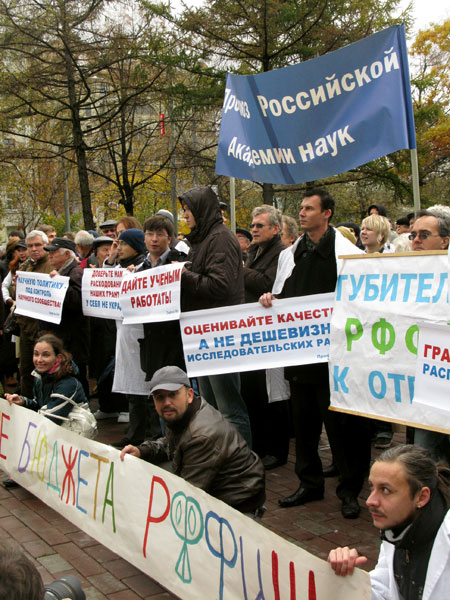





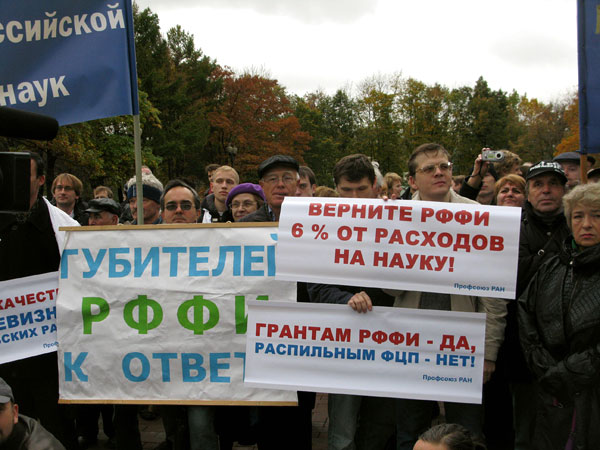






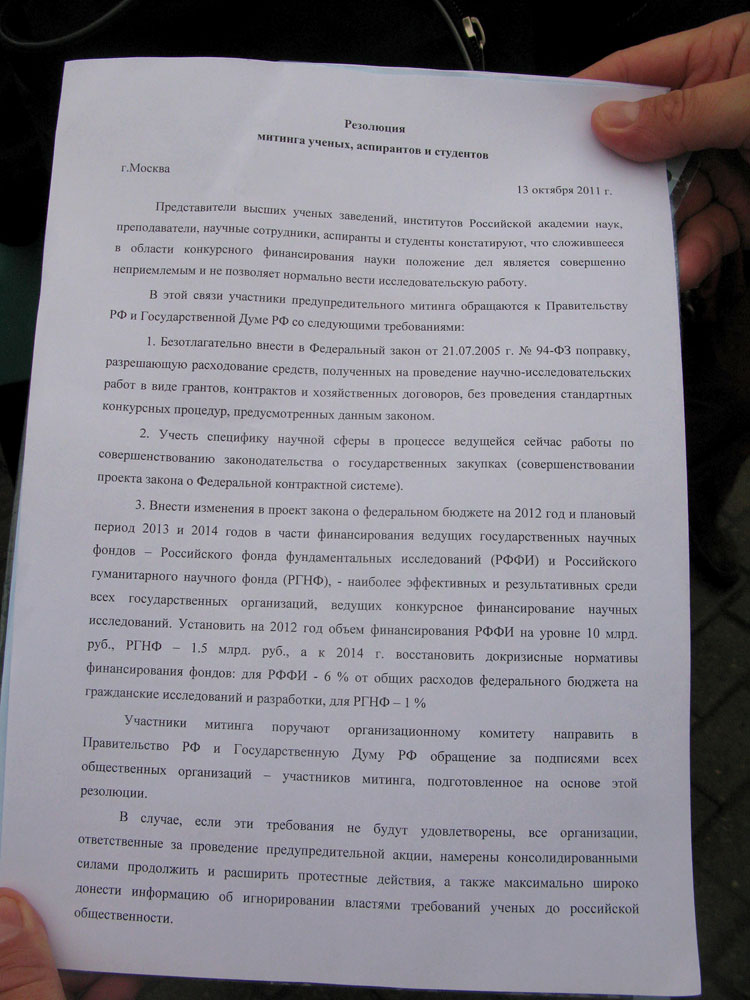
October 13 , 2011 At 11:00 on Pushkinskaya Square, a rally of scientists will be held , the two main requirements of which will be an increase in financing of the leading scientific funds of Russia and amendments to the law on public procurement. The goals of this civil action are told by a researcher at the Physical Institute of the Russian Academy of Sciences Yevgeny Onishchenko .
Despite the fact that the reduction of financing of scientific funds and problems arising from scientists due to the law on public procurement, in recent years they spoke and wrote a lot, there are practically no changes for the better. This is the reason for the decision of scientists to conduct a rally.
This is far from the first protest of scientists, but it is noteworthy that researchers from Russian universities and the Academy of Sciences have united in order to achieve the satisfaction of clear and specific requirements. They do not require an increase in salaries or distribution of apartments, they advocate that they are given the opportunity to work normally.
Try to use it
If the problems with the allocation of money in principle can be understood, then the situation with the expenditure of not just allocated, but allocated by the results of the conducted contests looks frankly absurd.
As a rule, a specific scientific group receives money for certain works. However, all funds received on a competitive basis for the implementation of research programs fall into the “common boiler” of a budget institution - a scientific institution or a university. As a result, the means of grants and state contracts should be spent in accordance with the law on public procurement, which creates a lot of problems - especially after the approval of the Ministry of Economic Development of the new nomenclature of goods, works and services (Order N 601 of December 1, 2010).
The fact is that it is impossible to clearly plan the purchase of the necessary consumables in advance - the procurement is carried out “sequentially”: after receiving the first results of the experiments, it becomes clear which experiments should be carried out further and what should be purchased for this. Normally, the researcher should be able to immediately make purchases in order to continue work, but in fairly large organizations it turns out that the amount of funds that can be spent without competitions for each position of the nomenclature of goods, works and services (100 thousand rubles per quarter) is “selected” immediately, at the beginning of the quarter. And in the future, even penny reagents cannot be purchased without long competitive procedures - it is necessary to wait in reality for months. In fact, this means the inability to normally continue experimental research.
At the same time, it is obvious that in the case of purchasing consumables and equipment at the expense of the same grants, there should not be abuses, since the scientist buys for himself, for his work, and not “for uncle” and, moreover, has the full right to write out for himself and colleagues to the colleagues at the expense of the grant.
The severity of the situation forced young scientists to contact the President of Russia, under this appeal, more than 3,000 signatures were collected in the spring. It cannot be said that the appeal was ignored - representatives of the initiative group communicated with deputies of the State Duma, the Federation Council, and officials of the Ministry of Economic Development. Not only deputies, but also officials of the relevant ministry understood the acuteness of the problem, was prepared for the amendment to the law on public procurement, significantly facilitating the expenditure of funds received on grants and state contracts. However, it has not been accepted to the present moment, moreover, it is not even clear whether it will be accepted before the end of this year.
Fund
The most effective and effective of all state organizations leading competitive financing of scientific research is the Russian Fundamental Research Fund (RFFI). The conclusion about the effectiveness of the fund is confirmed by figures: in terms of the amount of allocated funds of the RFFI, it is not the main source of competitive financing of research work, however, analysis of information about publications in leading Russian and foreign scientific journals shows that scientific exit from research supported by the RFFI, is several times more than other state-owned research on a competitive basis.
The question of the need to increase financing was repeatedly raised by the scientific community, including in mass appeals to the President of Russia. Moreover, the need to increase the role of leading scientific funds in financing science is recorded in government documents that determine the country's development strategy. A similar course is determined by the concept of long-term socio-economic development for the period until 2020, the same is stated approved at a meeting of the Government Presidium of the Strategy of Innovation Development for the period until 2020 and in the project of the foundations of the Russian Federation in the field of science and technology for the period until 2020, published a couple of months ago.
It would seem that the financing of the RFFI should grow. Of course, this should have been taking place in a country where there is a clear scientific policy, but we have everything differently: over the past three years, the fraction of the RFFI in expenses for civil research and development has decreased by more than doubled-from 6 % to 2.6 %. Moreover, the draft law of the federal budget for 2012 and the planning period of 2013 and 2014, which was included in the State Duma, does not provide for an increase in the budgets of scientific funds, i.e. They go under inflationary reduction. Against increasing funding of funds is the Ministry of Finance. Even the position of the Minister of Education and Science Andrei Fursenko, who said that he supports the proposals of scientists to increase the budget of scientific funds, did not affect anything.
The king loves, but does not like Psar
The phrase “against the Ministry of Finance” is formally true, but this is not the whole truth: the position of the department on a particular issue is formed by quite specific people. In the Ministry of Finance, for science, as you can understand, is responsible for the deputy department of budget policy in the social sector and science, Nina Ivanovna Makurina .
Once I and colleagues from Moscow State University had to personally communicate with Nina Ivanovna and it turned out that she did not see much benefit from scientific funds and did not understand why they need to increase their financing. It became clear that her ideas about the work of scientific funds were not only typical of an official, i.e. She is interested, first of all, by the immediate practical benefit from the point of view of technological development, and are also based on some edge of the ear of the heard fables. So, she argued that almost half of the budget of the RFFI was published for publication of books.
At the end of the conversation, she said that the Ministry of Finance needs not emotions, but numbers. Well, this is quite logical, and - although it was clear that she was not interested in listening to us - we promised to prepare the necessary data for her and then offered to discuss it, answer the questions that have arisen. She sent letters that explained the specifics of scientific work and its financing in Russia, gave numbers on the competitive financing of science with various Russian organizations and the “publication output” from the work of these organizations, etc.
In addition, a clear connection was shown between the development of the “giving publication” of science and the scientific-technological, economic development of the country as a whole: it turns out that, regardless of the political system, cultural features, places on the map and size of the territory, there is not a single country in which rapid economic and technical development, for which there would be no rapid growth of the number of articles published by scientists from this country.
In general, everything was “chewed” as details as possible. However, Nina Ivanovna did not show a desire to find out and ask questions. It is unlikely that anyone at all carefully studied the numbers, facts and arguments; The only substantive argument against increasing the budget of the RFFIF was the following: the checks discovered inappropriate expenditure of funds. The instructions that these real or imaginary (a high degree of competence ”of those who inspect in the field of science) are not compared with what is happening within the framework of the Ministry of Education and Science programs, Nina Ivanovna ignored - she completely refused correspondence, indicating that the appeals are unreasonable.
This was written in response to the statement that financing of research work through grants is much more effective in financing through federal targeted programs, since the current law on public procurement makes it impossible for a reasonable distribution of funds to scientific research, which is obvious to all - scientists, and the Ministry of Education and Science, the Ministry of Economic Development, and even zealously on guard of this law of the Federal Antimonopoly Service.
The irony lies in the fact that the same Nina Ivanovna responded a year ago to appeal to the President of Russia, which was signed by more than 2200 scientists and teachers. In it, in addition to the absence of a reasonable state scientific policy, two important specific issues were raised - the need to amend the law on public procurement and the need to increase financing of scientific funds.
The answer was this: the department examined the collective appeal of scientists and reports that "the proposals contained in it deserve attention and will be taken into account as possible in preparation by the Department of Proposals in the established field of activity." Such bureaucratic logic: sentences deserve attention, but are unreasonable.
It’s not scary not to understand something-the case is fixed, there would be a desire. Problems begin when there is no desire to understand, but there is a firm conviction of their own rightness-can some young scientists or venerable laureates give reasonable arguments worthy of the attention of a state-owned person? With such a “professional” approach to business - even with the most good intentions - it is easy to ditch the viable science that still remains in Russia.
Already now, the total funding of the three leading scientific and technical funds of Russia-the RFFIF, the Russian Humanitarian Scientific Fund and the Fund for the Development of Small Forms of Enterprises (more well-known as the Bortnik Foundation)-11 billion rubles. - Less than financing the Brazilian state of San Paulu (last year the budget of this fund amounted to 500 million US dollars). So so far the upcoming technological breakthroughs are dreaming of Nina Ivanovna, Russia runs the risk of “coming to develop” in its scientific level to the level of the Brazilian state.
Technological breakthroughs
However, maybe those new organizational forms that are created in the field of science and technology work very efficiently, and the need for the RFFIE has disappeared? Recently, the head of Rusnano showed the Prime Minister “Unique Tablet Computer”, which, according to journalists, “unlike Western analogues, is made on the basis of plastic logic”. The device is planned to be used in the field of education - as an e -book. Only one detail interferes with the pride of our Russian, Russian, breakthrough technologies - the developer of the wonderful device is the British company Plastic Logic, which recently invested $ 700 million.
Another innovative form of development of science and technology is no less effective - our first national research center, the “Kurchatov Institute”. It doesn’t matter that over the years of the directorship of Mikhail Kovalchuk , who brought a lot of money to the institute, the number of publications of scientists of the institute - according to the most authoritative international database of scientific publications - even several fell. But there are a lot of world -class achievements.
Say, at the end of 2009, the news went around the news about the “deciphering of the Russian man genome”, which the leaders of the institute presented as success, almost equal to the exit of a person into space. In fact, the employees of the Kurchatov Institute did their work at the equipment purchased abroad at a time when the US already began to offer everyone to decipher the individual genome at the price of a middle -class car.
And on the way new achievements that Russia are preparing the leadership of the Kurchatov Institute. Only two megaprojects that it would like to implement cost more than the ten -year budget of the RFFIF at the current level of financing (6 billion rubles per year). Is it to increase the budget of the fund?
In such conditions, scientists have two exits: “Legs voting” - a departure to countries where normal conditions for scientific work have been created, and the opinion of an official of the Ministry of Finance is not the truth in the last instance, or mass protests.
Among the publications of Yevgeny Onishchenko on Polit.ru were a comment “as a letter from 500 doctors of sciences to the President of the Russian Federation“ the head of the ZhEK ”, the article “ Fish asleep from the head ”(on the project of the new Charter of the RFFIF), “ Two Presidents ”(on the election of the President of the Russian Academy of Sciences) and“ Struggle for the Wrestling ”(about state procurement in science), lecture “ Competitive Support for Science: As this happens in Russia ”.
Photo report with a rally on October 13, 2011
Photo by Natalia Demina
The rally began with the performance of Evgeny Onishchenko
A number of scientists instead of posters brought with them their badges from various conferences. In the photo: Bioinformatics Mikhail Gelfand.
Resolution of a rally of scientists.