
Translated material
On the way to Russian wikileaks
The information policy of the authorities who seek to classify everything to the maximum generates the practice of “plums” of information. The authorities do not like it, but she does not want to become more open, although he talks about it. And even vice versa, this is fraught with significant risks for the authorities, up to the mass protest under the slogan “The authorities hide”.
According to the results of any publication in the press containing some kind of insider information, approximately the same reaction arises. Readers feel the opportunity to touch the secret - "But how it is actually it." And representatives of the authorities have a slight panic with the main question "who specifically merged the information to the journalists." Well, with other hardware showdown, including the appointments of those responsible for the “drain” (usually not at all those who actually served as a source of information). It does not do without questions “who specifically the source of the plum wanted to substitute” and other conspiracy delights.
Questions, of course, are important and interesting, but more interested in answers to completely different questions. First of all: gives us one or another document to understand the mechanisms of dominance and motivation of the authorities? And the second, more general question: why does the authorities do not like the publication of internal documents in general? What does this tell us about her and what are the risks and scenarios of development in this place?
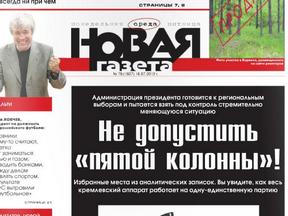
In this sense, the publication of a “new newspaper” of a number of analytical notes of some power experts about the political situation in the regions where the elections will be held in the fall, to understand the practices of the authorities (see also from the administration with love: “Active, loyal, to provide media support”). Who, outside the high offices and editions of the media, may be seriously interested in the fact that the Governor of the Bryansk region Denin Rating is equal to anti -rating, and 40 percent of the inhabitants believe that the region needs a new governor? Or the fact that the Novgorod governor, according to the author of the analysis of the situation in the region, “actually reached its electoral limit with an extremely high recognition and an active counter -cabin using protest moods can significantly reduce its rating” - this can be interesting?
Those who little Malski followed the situation in these and other regions mentioned in the documents and so should know this or at least guess. The regional elites and governors themselves, and even residents of the corresponding area, understand this. But from Moscow, where they are striving to create at least the visibility of control over the electoral process, there are requests for the party and administrative line (often this is the same thing) - "to understand, evaluate, report." As a result, reports are sent to the capital, often of dubious quality, from cities and weights, here they are sewn in one document and put on the table to the authorities. Or they are not placed - "from sin."
The usual bureaucratic story and value in the tradition of this kind of information of publicity, if there is, is for a separate small number of political gourmets. However, this is a well -known fact, almost any bureaucratic machine works. Our bureaucracy always works so that in the elimination of accidents, that with the north of the grain, in the election.
It would be more interesting to see the regional election strategies of United Russia and candidates for governors. At least there would have been something about the counterparty, all kinds of “black PR” and generally a lot of unpleasant details for the authorities and the details interesting for society that reveal the mechanism for organizing elections and how exactly citizens try to inflate this time. And here is just an analysis of the political situation, which in most Russian regions can be learned from local newspapers or rumors. However, there is a publication and causes well -known nervousness in the offices and interest among the public.
Any administration of domestic policy in the presidential administration turns into the minds of politicized citizens into a certain demonic structure, and the consciousness of officials in the likeness of the Masonic lodge is terribly mysterious and influential. Therefore, any information about its activities, devoted to public, is extremely undesirable, even if this information can be available to anyone if desired.
When the authorities are denied confidence, Krymsk turns out with its hundreds and thousands of volunteers and rumors that it was the authorities who ordered the “open gateways on the dam” (see volunteers without borders ). When the leitmotif becomes “the authorities hide again” all secrecy ceases to work to create a magical appearance of mysterious power.
No, of course, it is clear: it is unpleasant for representatives of the authorities when on the eve of the elections, journalists publish the data of closed surveys, and citizens begin to massively catch power on elected manipulations, and then they also go to many thousands of rallies. But such publications, it seems, will still appear.
Of course, the informational closeness of the authorities, even with the mature Putin, could not be absolute. And due to the existence of some but independent of the media, and due to the numerous conflicts of interests within the federal elite (what can we say about the regional elite), and the power of the cumbersome and incompatibility of the power vertical. The vertical seems to have to work according to the army principle, but it doesn’t work out.
Firstly, the authorities can become more open. Not in the sense of broadcasting online meetings of the Federation Council or even meetings in AP, but in the sense of a more clear and transparent motivation for their own decisions and presenting this motivation to citizens. True, citizens aware of the motives of the authorities can become more demanding on her.
Secondly, an inertial scenario can be implemented: "And so everything works." Its problem is that at some point the authorities mismatch by the request of citizens to openness of information and understandable motivation for decision-making can take extremely unpleasant for the authorities. That Krymsk with his “lowered locks” or rallies for honest elections will seem innocent regular events.
The third basic option may be tightening the information policy of the authorities. The administration has already created a commission "to comply with the requirements for the official behavior of the administration employees." And the law returning to the Criminal Code for slander the senators adopted at the last meeting of the spring session, not paying attention to the protests of the media, bloggers and adviser to President Mikhail Fedotov. The law, which, according to many, is aimed precisely at restricting the freedom of statements in the media and blogs.
This option is also fraught with risks for the authorities. Today, the same media still work with an understanding of the interests of new-mikers (no one has canceled the media law for the media), and bloggers, as a rule, are not particularly acute about the authorities. Due to the radicalization of the policy of power and some twisting of nuts in the modern world of information technology, “information anarchists”, “revolutionaries” and other radicals will come to the place of critics. In this case, instead of generally critical, but balanced statements, it is worth waiting for “Russian Wikileaks”. Is it necessary for the authorities - a big question.