
Translated material
Grigory Gritsenko: New Politics of the Central Bank

Grigory Gritsenko 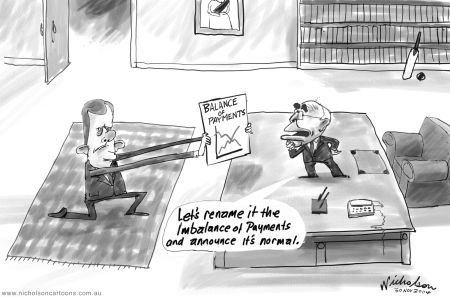 Balance of payments. Caricature: http://nicholsoncartoons.com.au
 Balance of payments. Caricature: http://nicholsoncartoons.com.au
The main feature of the payment balance of Russia for the 3rd square. 2012 is a sharp fall in the account of current operations. If in I sq. It amounted to $ 40 billion, then in III square. It fell to $ 13 billion. True, so far, in general, for 3 quarters of 2012, the remainder on the current account is quite decent - $ 75 billion, and it is highly likely that by the end of the year it will reach $ 100 billion and will repeat the success of the last year when the active balance was $ 99.
Nevertheless, a three -fold fall in the account of current operations cannot but be alarmed. Of course, on the one hand, this can be a seasonal hesitation, but on the other, the beginning of a new trend. Or the slow -off reaction of Russian consumers to changing foreign trade conditions: export has already begun to fall, and the import of inertia still continues to grow.
For the fact that the fall of the balance of the current account is seasonal, says the fact that a decrease in the cost of export occurred due to the drop in the revenue from gas export. If the revenue from oil exports decreased by $ 2.5 billion, oil products - by $ 1.5 billion, then the revenue from gas export fell by $ 5.5 billion. As the data is shown in the last few years, the cost of exported gas is always reduced in the 3rd square meter, but in IV square meters. grows up again. Therefore, while the fall can be attributed to the seasonal decrease in consumption, although it must be borne in mind that Gazprom gave so many discounts to foreign customers (and they continue to break out new ones), that soon the temporary seasonal drop in export will turn into permanent and year -round.
However, despite the unfavorable background, expenditure articles of the payment balance are growing. The cost of imported goods increased from I sq. in III sq. for $ 14 billion, and the costs of foreign trips are doubled, from $ 6.5 to $ 13.5 billion.
Actually, when the cost of export is dropped, in theory, in theory, it should also decline. But this has not yet been happening, although the ruble rate relative to the dollar fell during May from 30 rubles/$ to 34 rubles./$, And after which the ruble began to slowly re -revalize to 31/$ rubles. By October.
The weak reaction of consumers to the fall of the ruble exchange rate can be apparently explained by the fact that the nominal income of a significant part of the population has already reached such a size that even a simultaneous (well, that is, in a month) the fall of the national currency by 13% does not have a strong influence on their demand. They continue to buy imported goods and services, and in constantly growing volumes, stimulating the release, alas, in foreign economies.
The reduction in the active balance of the current account, according to all the rules, should lead not only to the fall of imports, but also to a reduction in external assets of Russian residents. As we have repeatedly had to write, precisely thanks to the high (or ultra -high) balance of the current account, Russian residents (represented by the state, as well as in the person of companies and private individuals) could increase foreign exchange assets.
Here it is necessary to make a methodological digression, and say that the growth of external assets is often interpreted as an outflow of capital, although it would be best to use the expression “non -return of part of the currency revenue” or “accumulation of part of the currency revenue”. The use of these expressions will make a more understandable picture of the events: it is not about the fact that foreign capital left Russia once and for all, but that the Russian residents have not fully decided on what they would spend currency on. And until they decided, these funds are kept on deposits in foreign banks and securities of foreign states, which, formally, gives the right to characterize them as a “outflow of capital”.
Until now, the active balance of the current account has been quite enough to purchase external assets. But if the drop in foreign exchange earnings from exports will continue, then the residents will more and more often have to resort to external debt to increase in order to make the necessary acquisitions at its expense. In any case, despite some deterioration in the currency and financial situation, this extension this year goes on a fairly high pace: Russian residents borrowed from non-residents in the 1st square meter. $ 10 billion, in II square. - $ 18 billion, and in III square. - $ 27 billion.
The reduction in active balance of payment balance has led to another surprise. Everyone has long been accustomed to the fact that at high prices for energy carriers and, accordingly, large currency revenues, currency assets are growing not only among citizens and companies, but also from the Central Bank. However, now there is no need to talk about the growth of foreign exchange reserves - for 9 months the Central Bank was able to buy currencies for $ 21 billion, including for the 3rd square. - Only $ 1.5 billion. It is clear that, with strong fluctuations in prices and foreign exchange rates, the Central Bank tries to refrain from mass procurement of currency in the market so as not to violate the fragile balance of demand and supply. However, in our case, the passive foreign exchange policy of the Central Bank of the Russian Federation has several more motives.
Firstly, the Central Bank of Russia recently began to adhere to the policy of inflation targeting. As a result, ruble money supply over eight months of this year increased by only 0.4%, despite the fact that the growth of both GDP and industrial production was in the region of 3%-3.5%. This policy is fundamentally different from the policy pursued to the crisis, when the main task of the Central Bank of the Russian Federation was to increase foreign exchange reserves, and the fact that at the same time the ruble money supply grew 30% -40% per year, provoking severe inflation, it did not particularly bother. Now the paradigm has changed. Our money is released (if you do not take into account anti -crisis measures) only when buying a currency in the reserve of the Central Bank, so the size of foreign exchange reserves will be very stable, and inflation will be low.
Another motive that we also had to write about is that the IMF and the ICBR have long been offered to the Russian monetary authorities to abandon the further accumulation of foreign exchange reserves. The calculation of these international financial organizations is well understandable - if Russia (as well as other countries with the largest currency reserves) will cease to buy currency in reserves, then it will be released to increase import and import payments, respectively, will increase. And this, of course, will lead to an increase in production in countries with which Russia has significant foreign economic relations.
Naturally, for these countries (mainly European), similar proposals of the IMF and ICBR on the hand. Moreover, it can be assumed that they themselves formulated these proposals and invested in the mouth of the IMF officials and the ICBR, who only voiced them. But be that as it may, these proposals are not very suitable for Russian enterprises, since due to tightening monetary policy (and the termination of the increase in foreign exchange reserves leads to a slowdown in the growth of the money supply, as we wrote above) the Russian banking system loses the additional influx of liquidity and cannot expand the lending of clientele in the previous amounts. And the additional receipt of imported goods to the Russian market will lead to toughening competition, for which our companies are far from always ready.
At the same time, representatives of these two respected organizations argue their position in a completely different way. They say, referring to the data of Russian statistics, that economic growth in Russia has already reached the limit, and further extension of demand by expanding the money supply will only lead to inflation, and the Russian economy will not receive any positive effect. Therefore, the Russian economic authorities should stop stimulating economic growth and, which is implied, but never said aloud, begin to stimulate the economic growth of foreign economies.
Of course, we cannot say with all certainty that the Central Bank of Russia during its monetary policy follows the recommendations of the IMF and the ICBR. But the combination of two facts reflected in our payment balance - a relatively small increase in foreign exchange reserves with the continuing increase in the import of goods and services - suggests that this policy, consciously or not, is already being implemented.